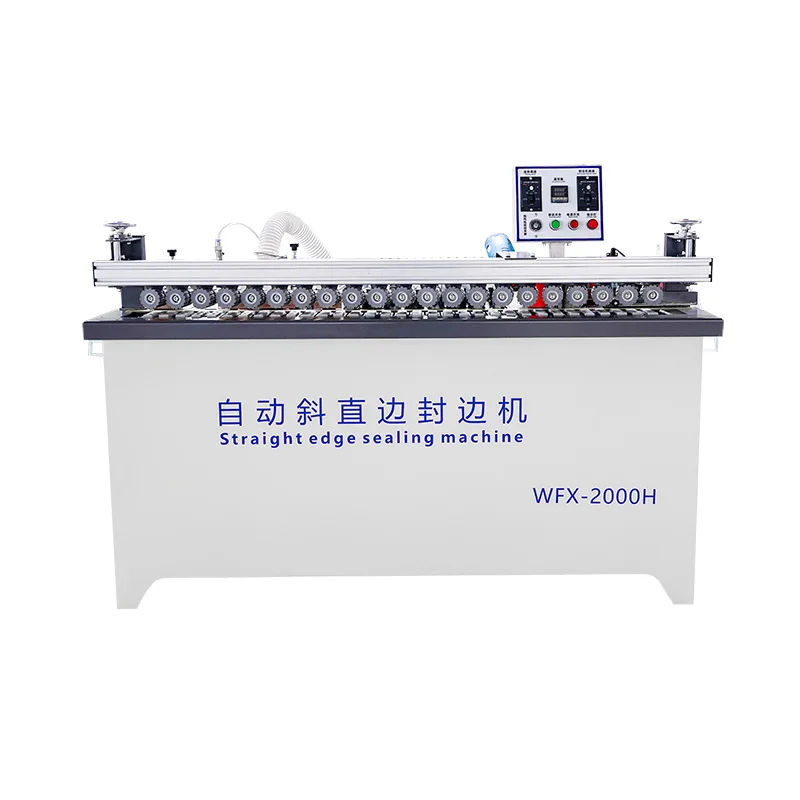
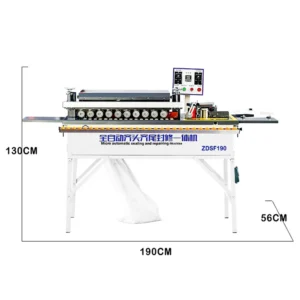
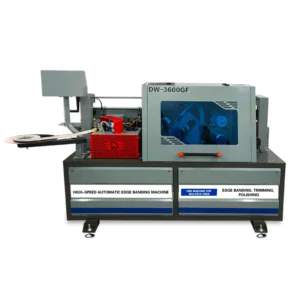
Compact footprint, full function — The ZDSF-2000H packs gluing, pressing, trimming and dust extraction into a 2.1-meter frame so your workshop can start edging panels without buying auxiliary systems first.
Technical Specifications
| Parameter |
Value |
| Model |
ZDSF-2000H (Oblique Straight Shape Automatic Edge Banding Machine) |
| Product Type |
Oblique Straight Shape Automatic Edge Banding Machine |
| Overall Dimensions (L×W×H) |
2100×600×1100 mm |
| Net Weight |
149 kg |
| Plate Thickness Range |
18–25 mm |
| Strip Thickness |
1.2 mm |
| Rated Voltage |
220V |
| Rated Power |
6.17 kW |
| Rated Air Pressure |
0.4–0.6 MPa |
| Plate Feeding Speed |
0–14 m/min |
| Gluing Device |
Hot air heating |
| Pressing Rollers |
8 pressing rollers |
| Trimming Stations |
Elastic profiling trimming |
| Vacuum Device |
Self-contained vacuum device included |
| Control System |
Standard control panel (basis to be confirmed for PLC/MCC availability) |
| Working Area or Capacity Range |
(basis not stated in source) |
| Output Capacity |
(basis not stated in source) |
| Warranty |
1 year |
Application Suitability
| Application |
Material or Output |
| Custom cabinet door edge banding |
MDF panels 18–25 mm with PVC edge strip |
| Straight and bevel edge finishing |
Particleboard shelving and carcass components |
| Small-batch furniture production |
Plywood panels with melamine or veneer edging |
| Joinery workshop automation |
Mixed substrate batches on a single machine setup |
Why Voltage Compatibility Matters Before You Sign the Order
Confirming your workshop's voltage and frequency first prevents a machine that arrives but never runs.
I have seen small workshops take delivery of an edge bander only to discover their single-phase supply cannot handle the rated load. The ZDSF-2000H runs on 220V, which aligns with many single-phase systems, but frequency mismatches and breaker sizing still cause commissioning delays. A 6.17 kW draw requires a dedicated circuit with adequate headroom for the hot air heating element and vacuum motor simultaneously [NEED_CITE: voltage and frequency standards by export market]. Sorting this out before production starts avoids weeks of idle floor space.

A Footprint That Fits Where You Already Work
Most small joinery shops do not have the floor space for a six-meter edge banding line plus a separate dust collector. This automatic edge banding machine for small workshop environments measures just 2100×600 mm and includes a self-contained vacuum device, so you are not routing ductwork or allocating room for external extraction. The compact frame leaves clearance for panel staging on either side.
Single-Machine Setup, No Auxiliary Equipment Required
When you are moving from manual edge banding to an automated process, the last thing you need is a second purchase just to make the first one work. The eight pressing rollers, elastic profiling trimming, and integrated hot air gluing system are all housed in one unit. You unbox, assemble, and begin processing panels without sourcing a separate compressor beyond your existing shop air supply.
What the Spec Sheet Numbers Mean for Your Panels
The 18–25 mm plate thickness range covers the standard board stock most cabinet and furniture workshops handle daily, from MDF carcass sides to particleboard shelving. Feeding speed adjusts from 0 to 14 m/min, which lets you slow down for delicate veneer strips or speed up when running batches of PVC on standard panels. Elastic profiling trimming follows the panel contour rather than scraping a fixed blade across the surface, reducing the risk of scoring softer substrates [NEED_CITE: edge banding trimming methods and surface protection]. The 0.4–0.6 MPa air pressure requirement is within reach of most small workshop compressors, meaning you likely will not need to upgrade your air supply to run this machine.
The Real Cost of Skipping Material Verification
Ordering an edge bander without confirming your actual strip material leads to adhesion failures that show up only after the first week of production. PVC and wood veneer demand different glue temperatures and feed speeds, and a machine set for one will produce lifting edges on the other. When operators spend days chasing trim quality instead of adjusting the process, the backlog grows and rework costs accumulate [NEED_CITE: common edge banding adhesion failures by substrate]. Verifying material compatibility during the inquiry stage prevents this entirely.
Why Procurement Through This Channel Works for Small Shops
Engineer-led configuration means someone reviews your panel sizes and strip materials before recommending the ZDSF-2000H, so you are not guessing whether a 25 mm board will feed cleanly. Voltage confirmation happens before production, not after the crate arrives. The four-stage quality check covers incoming components through pre-shipment testing, catching tolerance drift before the machine leaves the factory. Factory test records on your specific panel thickness range are available, giving you documented evidence rather than a promise.
Documentation & Verification
- Machine specification sheet confirming 220V rating and 6.17 kW total load
- Electrical schematic with wiring diagram for the hot air heating circuit
- Factory test record on 18–25 mm panels before dispatch
- Operation manual in the agreed language covering elastic trimming adjustment
- Spare parts list with pressing roller and trimming blade part numbers
- Packing photographs showing assembly state and crate condition
Installation, Commissioning & Support
- Requires a 220V dedicated circuit rated above 6.17 kW with proper breaker sizing
- Allow clearance around the 2100×600 mm footprint for panel infeed and outfeed
- Main unit arrives partially assembled; expect on-site assembly of feed and trim sections
- First-run parameter setting for glue temperature and feed speed based on your strip material
- Elastic profiling trimming adjustment training included during commissioning guidance
Before You Request a Quote
Tell us the panel materials you run most often and the edge strip types — PVC, melamine, or veneer — so the configuration matches your actual workload. Confirm your workshop voltage and whether your compressor meets the 0.4–0.6 MPa requirement. If you have upstream saws or downstream boring machines, share their feed heights so we verify throughput compatibility.
Frequently Asked Questions
Q: What panel width and length can this machine handle beyond the 18–25 mm thickness?
A: The ZDSF-2000H specification sheet lists plate thickness range but does not state maximum panel width or length limits in the source data. We confirm these dimensions during the inquiry stage based on your typical board sizes and adjust the pressure beam and guide fence accordingly before finalizing the order.
Q: Does the 220V rating work with my workshop electrical system?
A: The machine is rated for 220V single-phase supply. You need to confirm your local voltage and frequency match this rating, and ensure your breaker panel can handle the 6.17 kW draw on a dedicated circuit. We verify electrical compatibility during the specification confirmation step before production begins.
Q: How much floor space do I need around the machine?
A: The machine itself measures 2100×600×1100 mm. You should plan for additional clearance on the infeed and outfeed sides to handle full-length panels comfortably. We can advise on minimum working space once you share your typical panel dimensions and workshop layout.
Q: What assembly is required after delivery?
A: The ZDSF-2000H ships with the main unit partially assembled and some components in KD packing for transport protection. Expect to complete assembly of the feed table, guide fence, and trim stations on site. Installation guidance is provided to walk your team through the process.
Q: Can this machine handle both PVC and wood veneer edge banding?
A: The machine processes strip materials up to 1.2 mm thickness with hot air gluing. PVC and wood veneer require different glue temperatures and feed speed settings. We configure the parameters based on your actual materials during the inquiry stage and verify results in a factory test before shipment.