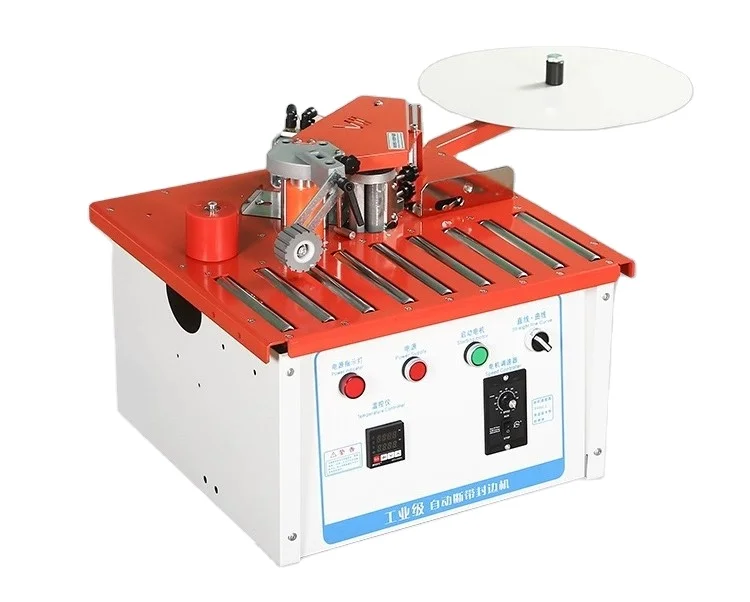
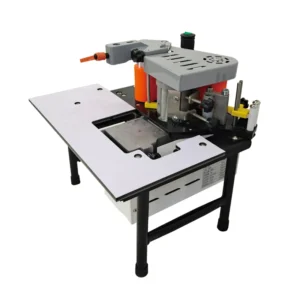
Stocked for Fast Dispatch — this ZDSF50+ portable edge bander leaves our warehouse with confirmed 220V configuration and a language-matched operation manual, cutting the wait between order and first production run.
Technical Specifications
| Parameter |
Value |
| Model |
ZDSF50+ Mini Edge Banding Machine |
| Product Type |
Mini Edge Banding Machine |
| Rated Power |
1.2 kW |
| Voltage & Frequency |
220V (frequency to be confirmed by buyer) |
| Control System |
Manual/Pneumatic with foot switch and travel switch |
| Overall Dimensions (L×W×H) |
54 × 54 × 56 cm |
| Net Weight |
28 kg |
| Strip Thickness Range |
0.5–1.5 mm |
| Sheet/Panel Thickness Range |
10–60 mm |
| Glue Pot Capacity |
1000 ml |
| Heating Time |
5–10 min |
| Feed Speed |
0–6 m/min |
| Rated Air Pressure |
0.4–0.6 MPa |
| Edge Banding Function |
Curve and straight line, double-sided gluing, automatic tape breaking |
| Assembly State |
Portable, benchtop |
| Tape Breaking Control |
Pneumatic automatic via travel switch (straight), foot switch (curve) |
| Pressure Rollers |
Adjustable, rubber material |
| Edge Strip Transport |
Adjustable bayonet by strip height |
| Glue Application |
Double-sided via glue-coated rollers |
| Heating Elements |
4 heating tubes |
Application Suitability
| Application |
Material or Output |
| Small joinery workshop edge finishing |
MDF, particleboard, plywood panels 10–60 mm thick |
| Custom cabinet curved-edge banding |
PVC and veneer strips 0.5–1.5 mm |
| On-site furniture installation trimming |
Prefabricated panels requiring field edge sealing |
| Prototype and low-volume production runs |
Mixed panel substrates in startup environments |
| Supplementary banding alongside a full-size line |
Irregular or curved pieces bypassing automatic machinery |
Why the Voltage Question Should Come Before the Price
Confirm local supply compatibility in writing before any payment is made.
I remember a customer in Southeast Asia who received a portable bander wired for 50 Hz while his grid runs at 60 Hz — the heating tubes overheated within the first hour and the glue charred inside the pot. The machine itself was fine; the mismatch was the problem. When sourcing a Mini Edge Banding Machine in stock, the lead time advantage disappears the moment the unit arrives unusable [NEED_CITE: voltage and frequency standards by export market]. Always share your exact voltage and frequency before the crate is nailed shut.

Small Footprint, Immediate Availability
Workshops moving from hand-held edge banding need a machine that fits a standard workbench and plugs into an existing outlet. The ZDSF50+ occupies a 54 × 54 cm footprint and weighs 28 kg, meaning one operator can position it without lifting equipment. Because this Mini Edge Banding Machine in stock is held as a stocked configuration, dispatch does not depend on a production slot opening up — the unit is tested, crated, and ready to leave the warehouse once voltage and language are confirmed.
Straight and Curved Edges Without a Second Machine
Most entry-level banders handle only straight profiles, forcing a small shop to buy two machines or hand-finish curves. This unit uses a travel switch for automatic tape breaking on straight runs and a foot switch for curved work, covering both geometries on a single benchtop. The adjustable bayonet transport adapts to strip heights across the 0.5–1.5 mm range, so switching between PVC and veneer does not require a tool change [NEED_CITE: edge banding material behavior on curved profiles].
How Heating and Glue Flow Affect the Joint
The 1000 ml glue pot holds four heating tubes that bring adhesive to working temperature within five to ten minutes. Double-sided gluing through coated rollers applies adhesive to both the strip and the panel edge simultaneously, which matters when bonding veneer to porous particleboard — uneven glue coverage on low-density substrates is a frequent cause of edge lift in small-shop production. The 0.4–0.6 MPa pneumatic supply keeps the pressure rollers firm against the strip, and the adjustable roller gap accommodates panel thicknesses from 10 mm up to 60 mm without losing contact pressure.
What Happens When the Wrong Configuration Ships
A workshop that receives a bander without confirmed air-pressure requirements often discovers mid-installation that their compressor cannot sustain 0.4 MPa, leaving the tape-breaking cylinder sluggish and the strip end ragged. Similarly, an operation manual printed in a language the operator cannot read delays commissioning by days while the owner searches for translation [NEED_CITE: CE machinery directive requirements for operator documentation]. These are not defects — they are preventable configuration oversights that erase any delivery-time advantage the buyer thought they were getting.
Why Buyers Source This Unit Through Our Stock Channel
Stocked machines are tested against a pre-shipment checklist before crating, with sample edge banding photographs showing glue coverage and tape-breaking accuracy on the buyer's specified panel thickness. Voltage is confirmed in writing for each order, and the operation manual is produced in the agreed language before dispatch. The ZDSF50+ sits within a broader product family, so a workshop that later needs a full-function pre-milling line can transition to a larger model from the same manufacturing source without relearning controls or retraining operators. Our four-stage quality check covers incoming material, in-process assembly, finished-product testing, and final verification [NEED_CITE: ISO 9001 quality management requirements for machinery manufacturing].
Documentation & Verification
- Factory test record on your specified panel thickness and strip material before dispatch
- Electrical schematic confirming 220V wiring and heating-tube circuit for local electrician review
- Operation and maintenance manual produced in the language your operator reads
- Pre-shipment edge banding photograph showing glue adhesion on your chosen substrate
- CE declaration of conformity included with the shipping documentation package
- Spare parts list with part numbers for glue rollers, heating tubes, and pressure rollers
Installation, Commissioning & Support
- Benchtop placement requires a flat, stable surface supporting at least 40 kg including workpiece load
- Dedicated 220V circuit with appropriate breaker rating for the 1.2 kW draw to avoid shared-line voltage drops
- Pneumatic hose connection to a compressor sustaining 0.4–0.6 MPa continuous output at the machine inlet
- First-run glue temperature calibration on your actual strip and panel material within the 5–10 min heat-up window
- Operator walkthrough covering travel-switch and foot-switch tape-breaking techniques for straight and curve transitions
- Recommended spare parts kit including replacement glue-coated roller and two heating tubes ordered with the machine
What to Share When You Request a Quote
Send the exact panel substrate you run most often — MDF, particleboard, plywood, or solid wood — along with the typical thickness range. Tell us your local voltage and frequency so the wiring matches your grid before the unit ships. If curved edge work makes up a significant share of your output, mention the minimum curve radius so we can confirm the unit's suitability and include the right strip material in the pre-shipment test.
Frequently Asked Questions
Q: Is the 220V configuration compatible with my local voltage and frequency?
A: The standard configuration is 220V, but frequency must match your local grid to prevent heating-tube overheating or motor speed issues. Share your exact voltage and Hz rating before dispatch so we verify compatibility and adjust wiring if needed. We confirm the final electrical specification in writing before crating.
Q: What daily volume can this mini bander sustain before I need a larger machine?
A: The ZDSF50+ is designed for low-volume and prototype environments with a feed speed of 0–6 m/min. When your daily linear meters of edge banding consistently require continuous multi-shift operation, a full-size automatic machine with higher feed rates becomes the appropriate next step in the product family.
Q: Which edge banding materials work within the 0.5–1.5 mm strip range?
A: PVC, veneer, and melamine strips within 0.5–1.5 mm thickness are all compatible with the adjustable bayonet transport and double-sided glue application. ABS strips at the thicker end of the range may require slower feed speeds for full adhesion on curved profiles.
Q: How do I commission the machine when it arrives?
A: The operation manual is provided in your agreed language and covers glue-pot heating, pressure-roller adjustment, and both tape-breaking modes. Remote guidance is available during first startup so your operator can run test pieces on your actual panel material with real-time support.
Q: Which spare parts should I order together with the machine?
A: We recommend adding a replacement glue-coated roller and two heating tubes to your initial order, along with extra pressure-roller rubber sleeves. These are the most frequently replaced wear items and having them on hand prevents unplanned downtime during your first months of operation.