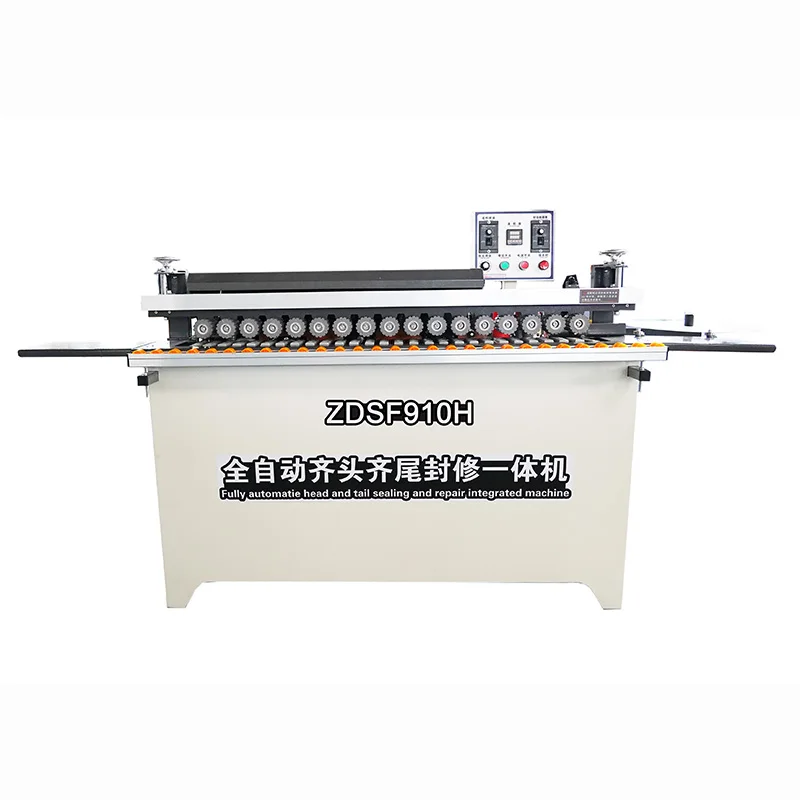
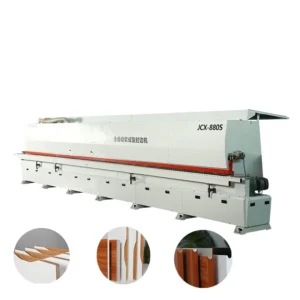
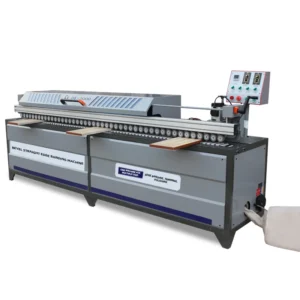
Compact Footprint, Workshop-Ready — the 910H miniature edge bander ships as a single-unit stock item with 220V plug-and-run configuration, eliminating the multi-week build cycle typical of entry-level machinery orders.
Technical Specifications
| Parameter |
Value |
| Model |
910H |
| Product Type |
Miniature Automatic Edge Banding Machine |
| Rated Power |
4 kW |
| Voltage & Frequency |
220V 50Hz |
| Control System |
Multi-function button operation panel |
| Overall Dimensions (L×W×H) |
1300×560×1090 mm |
| Net Weight |
140 kg |
| Edge Type |
Both curved and straight lines |
| Sheet Thickness Range |
10–50 mm |
| Strip Thickness Range |
0.5–2.5 mm |
| Minimum Board Width for Edge Sealing |
2.5 cm |
| Glue Capacity |
1000 ml |
| Air Supply Requirement |
0.4–0.6 MPa |
| Suction Power |
1200 W |
| Belt Power |
25 W |
| Transmission Power |
120 W |
| Heating Power |
800 W |
| Polishing Power |
180 W × 2 |
| Trimming Power |
800 W × 2 |
| Trimming Mechanism |
4-blade alloy arc knife, imported brand |
| Dust Collection |
Two large-diameter dust collectors |
| Transmission |
Crawler transmission with steel rod slide rails |
| Pressure Beam |
Aluminum alloy, adjustable |
| Feed Mechanism |
Double-row rubber pressure wheels, automatic plate feeding |
| Key Features |
Automatic plate feeding, double-sided gluing, upper and lower polishing, automatic head and tail trimming, curved and straight edge banding |
| Assembly State |
Partially assembled |
| Warranty |
1 year |
| Certification |
CE |
Application Suitability
| Application |
Material or Output |
| Small joinery workshop edge finishing |
MDF, particleboard, plywood panels 10–50 mm thick |
| Curved cabinet door production |
Shaped solid wood and composite panels with PVC or melamine edge banding |
| Low-volume custom furniture runs |
Limited-run cabinet components requiring consistent edge quality |
| Prototype and hobby-scale woodworking |
Small-format panels with 0.5–2.5 mm strip thickness |
| Startup workshop transitioning from manual banding |
Straight and curved panels above 2.5 cm minimum width |
Why the Voltage Question Must Come Before You Click Order
Confirming your local supply voltage against the machine's rated input is the single most important pre-order check for any small automatic edge banding machine in stock.
I have seen workshops receive equipment configured for 380V three-phase only to discover their facility runs on single-phase 220V. The machine sits uncrated for weeks while an electrician evaluates whether a phase converter is viable or the unit must be returned. This problem appears far more often than it should among buyers ordering from overseas stock [NEED_CITE: common electrical mismatch incidents in imported woodworking machinery]. The 910H ships configured at 220V 50Hz as standard, which matches single-phase supply in many regions, but frequency and plug type still vary across markets. Requesting the electrical schematic before dispatch costs nothing and prevents a costly stall at commissioning.

Single-Unit Dispatch Without the Production Run Wait
Most edge banding equipment is built to order, meaning a small workshop faces a multi-week lead time even for a single machine. The 910H is held in ready stock, so a joinery startup can place a single-unit order and have it dispatched on a standard freight timeline rather than waiting for a batch production window to open. This matters when your current manual banding process is bottlenecking output and every week of delay is lost revenue.
Dual-Mode Curved and Straight Operation in One Frame
Workshops with limited floor space cannot justify keeping two separate machines for curved and straight edge work. The 910H handles both profiles within its 1300×560 mm footprint by rotating the banding head through 180°, so a small furniture maker producing both flat cabinet sides and shaped door fronts works from one station. Switching between modes is a manual adjustment at the head rather than a full reconfiguration, keeping changeover time short between jobs [NEED_CITE: typical setup changeover practices for dual-mode edge banders].
Reading the Numbers That Actually Matter
The sheet thickness range of 10–50 mm and strip thickness range of 0.5–2.5 mm define what this machine can physically process. Running 3 mm PVC strip outside the rated range risks incomplete glue coverage and trimming chatter. The 800 W heating element brings the glue pot to working temperature for standard EVA adhesives, which suits most PVC and melamine banding materials in the workshop environment. Trimming power of 800 W per side through the 4-blade alloy arc knife provides clean end cuts on panels within the rated thickness, while the two 180 W polishing units smooth the trimmed edge for a finished appearance. The crawler transmission with steel rod slide rails maintains feed stability on panels up to the maximum 50 mm thickness without slippage.
What Happens When You Skip the Specification Check
Ordering an edge bander without verifying panel thickness compatibility against your actual production mix leads to two outcomes: the machine struggles on material beyond its range, producing ragged trims and visible glue lines, or it runs fine but you realize later you needed a wider strip capacity for a new product line. Either scenario means a second purchase within months. Buyers who skip confirming the air supply requirement of 0.4–0.6 MPa against their existing compressor often find the pneumatically controlled strip cutting device underperforms on day one [NEED_CITE: compressed air supply requirements for pneumatic edge banding tools]. These are avoidable problems that cost time and credibility with your own customers.
Stock Availability and Configuration Verification
The 910H is maintained in ready stock for single-unit orders, so dispatch follows a standard freight schedule rather than a production queue. Voltage and frequency are confirmed against your local supply before the crate is sealed, and the control panel language is set to your operator's requirement as part of pre-shipment preparation. Each unit carries a CE declaration of conformity and ships with a factory test record documenting edge trim quality on your specified panel material. The four-stage quality verification process covers incoming component inspection through to pre-shipment operational testing, so what arrives at your dock has been run under load before packing.
Documentation & Verification
- CE declaration of conformity covering the 910H miniature edge bander
- Electrical schematic confirming 220V 50Hz wiring and plug type for your market
- Factory test record showing trim quality on your panel thickness and strip material
- Operation and maintenance manual provided in your operator's working language
- Spare parts list with consumable recommendations for glue pot and trimming blades
Installation, Commissioning & Support
- Requires a dedicated 220V single-phase circuit rated for the 4 kW total draw
- Air line connection at 0.4–0.6 MPa from existing workshop compressor or dedicated unit
- Partially assembled on arrival with final setup per the included manual
- First-run calibration of pressure beam and feed wheels for your panel thickness
- Trimming knife and polishing wheel replacement intervals documented in spare parts list
What to Include With Your Inquiry
Send your typical panel material and thickness range, the edge banding strip type and thickness you run most often, and your workshop's confirmed voltage and frequency. If you produce both curved and straight components, note the approximate ratio so the configuration can be verified against your workflow. Mention whether you need the manual and control panel in a specific language.
Frequently Asked Questions
Q: What panel and edge band thickness does the 910H handle, and which materials work best?
A: The machine processes sheet thickness from 10 to 50 mm with strip thickness between 0.5 and 2.5 mm. It is suited to MDF, particleboard, plywood, and solid wood panels using PVC or melamine edge banding material within those thickness limits.
Q: Is the machine ready to run when it arrives, and what setup is needed?
A: The 910H ships partially assembled. You complete final assembly following the included manual, connect to your 220V supply and compressed air line at 0.4–0.6 MPa, then calibrate the pressure beam and feed wheels for your panel thickness before the first production run.
Q: Can I order a single unit, and how fast does it dispatch?
A: Single-unit orders are accepted from ready stock. Dispatch follows a standard freight timeline once voltage, plug type, and control panel language are confirmed against your requirements during the pre-order specification check.
Q: How do I switch between curved and straight edge banding modes?
A: The banding head rotates through 180° to switch between curved and straight operation. The adjustment is manual at the head assembly, and the changeover is documented in the operation manual with the recommended calibration steps for each mode.