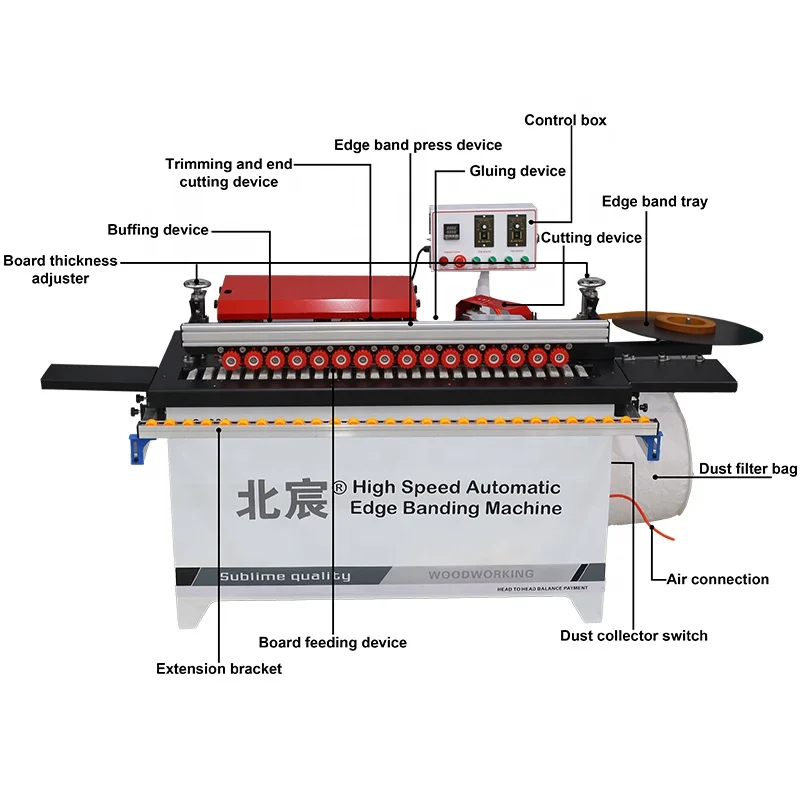
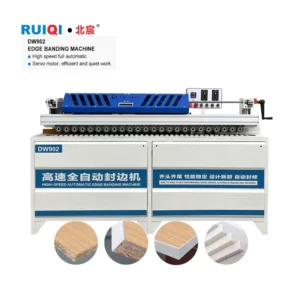
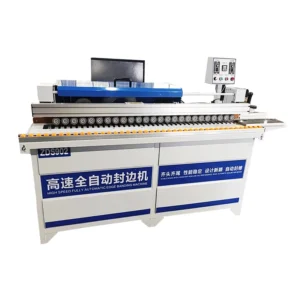
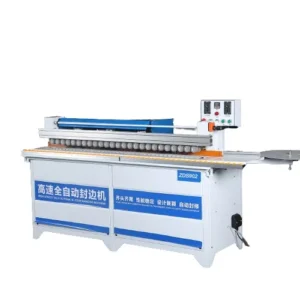
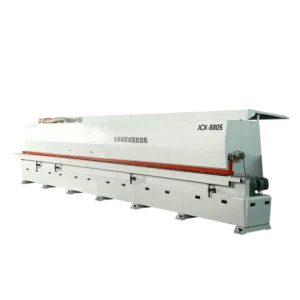
Compact Footprint Ready to Ship — stocked entry-level edge bander configured with 220V/380V options and multilingual controls for workshops scaling from manual to automated processing.
Technical Specifications
| Parameter |
Value |
| Model |
DW802 |
| Product Type |
Automatic Edge Banding Machine |
| Total Power |
4200W |
| Voltage & Frequency |
220V/380V/customization |
| Standard Features |
Edge banding, trimming, polishing, automatic head and tail, vacuum hold-down |
| Minimum Sheet Length |
25 cm |
| Minimum Sheet Width |
10 cm |
| Edge Banding Height |
0-50 mm |
| Edge Banding Thickness |
0.3-3 mm |
| Edge Power |
140W |
| Transmission Power |
140W |
| Trimming Power |
800W × 2 |
| Polishing Power |
180W × 2 |
| Air Source Pressure |
0.4-0.8 MPa |
| Glue Pot Capacity |
4000 ml |
| Vacuum Power |
1200W |
| Overall Dimensions (L×W×H) |
130 × 60 × 95 cm |
| Net Weight |
135 kg |
| Language Options |
Chinese, English (customizable to Spanish or other languages) |
| Control Panel |
Multilingual customization available |
| Certification |
CE |
Application Suitability
| Application |
Material or Output |
| Cabinet door and carcass edge sealing |
MDF and particleboard panels for custom furniture startups |
| Small-batch wardrobe panel processing |
Plywood and ecological board with PVC or melamine edge banding |
| Home decoration component finishing |
Solid wood board panels for interior joinery and trim |
| Workshop transitioning from manual banding |
Straight-edge automated sealing on standard panel substrates |
Why the Voltage Question Must Come Before the Order
A machine that cannot match your workshop's electrical supply will sit idle until the wiring is rebuilt.
I spent years on the assembly floor before moving into order fulfillment, and one mistake I saw repeatedly was a small custom cabinet shop receiving a 380V three-phase edge bander when their facility only had 220V single-phase power. The unit arrived, the operator plugged it in, nothing happened, and the shop waited three weeks for an electrical contractor to install a transformer and rewire the panel. That downtime cost them more than the machine itself. Every DW802 order now starts with a voltage confirmation sheet before production is released, because an automatic edge banding machine in stock is only useful if it actually runs when it arrives. Electrical incompatibility is one of the most common preventable failures in small workshop equipment procurement [NEED_CITE: voltage and frequency standards by export market].

Dispatch Timing Without the Waiting Game
Small workshops rarely have the luxury of planning equipment purchases months ahead. When a cabinet maker lands a new contract or a joinery shop decides to move past hand-held edge banding, the need is immediate. This DW802 automatic edge banding machine in stock is held in ready-to-ship configuration, meaning the unit is assembled, tested, and waiting for voltage confirmation rather than waiting to be built from scratch. The emphasis here is on reducing the gap between order decision and machine running on your shop floor.
A Configuration That Fits Before It Grows
The 130 × 60 × 95 cm footprint is deliberately sized for workshops where floor space is negotiated between machines. At 135 kg net weight, it can be positioned by two people with a pallet jack, without requiring a forklift or reinforced flooring. The 4000 ml glue pot means continuous panel runs through a typical small batch without stopping to refill, and the 0.3-3 mm edge thickness range covers the PVC and melamine bands that most MDF and particleboard cabinet work demands. As production volume grows, this unit serves as a reliable secondary machine or a dedicated line for shorter panel runs [NEED_CITE: CE machinery directive requirements for industrial equipment].
What the Spec Sheet Actually Means on the Shop Floor
The 800W × 2 trimming motors handle the excess banding material above and below the panel edge in a single pass, which matters when you are processing ecological board with thicker PVC banding that a weaker motor would chatter against. The 0.4-0.8 MPa air source pressure range aligns with standard workshop compressor output, so most small shops will not need to invest in a dedicated air supply. The integrated 1200W vacuum hold-down keeps panels flat against the feed bed without mechanical clamps that can mark softer substrates like plywood or melamine-faced MDF. The 25 cm minimum sheet length and 10 cm minimum width allow processing of narrow drawer sides and small shelf brackets that larger edge banders cannot grip, which is where many entry-level machines force operators back to hand-held tools.
The Real Cost of Skipping Configuration Checks
When a workshop buys a single machine without confirming feed height compatibility or local voltage, the problem does not appear in the quotation — it appears on delivery day. A control panel in a language the operator cannot read stalls commissioning while someone translates button labels. A glue pot sized for low volume forces mid-batch refills that create visible seam marks on panel edges. These are not defects in the machine; they are mismatches between the specification ordered and the reality of the shop floor [NEED_CITE: common causes of commissioning delays in imported woodworking machinery].
Why Source This Model Through This Channel
In-house manufacturing with verified tolerance means the DW802 is built and tested under the same four-stage QC process as the full-function production line models, not outsourced to a secondary assembler. Voltage and language customization are treated as standard order parameters, not special requests that add weeks to lead time. The full product family — from this entry-level unit through to pre-milling production machines — means a workshop can add capacity later without changing supplier or relearning a different control interface. Pre-shipment test records include actual edge banding samples run on your specified panel material and thickness, so the machine you receive has already processed your substrate. Single-unit orders are accepted without minimum quantity barriers, which matters when a small shop is making its first automated equipment purchase.
Documentation & Verification
- CE declaration of conformity covering the DW802 automatic edge banding machine
- Voltage confirmation sheet matching your workshop supply before dispatch
- Factory test record with edge banding samples on your specified panel material
- Operation and maintenance manual in your agreed operator language
- Electrical schematic with confirmed wiring configuration for your site
- Spare parts list with wear component identification for first-year planning
Installation, Commissioning & Support
- 220V/380V configuration confirmed pre-shipment to match your workshop circuit breaker panel
- 130 × 60 × 95 cm footprint requires level concrete floor with standard workshop clearance on all sides
- 0.4-0.8 MPa air supply connects to existing compressor via standard pneumatic fitting
- 4000 ml glue pot pre-heated and tested with your edge banding material before crating
- Multilingual control panel set to operator language before dispatch to eliminate commissioning delays
- Vacuum hold-down calibrated for panel thickness range from 0.3 mm to 50 mm banding height
What We Need to Confirm Your Configuration
Before releasing a unit from stock, we need your local voltage and frequency, the panel materials and edge banding thickness you will process most often, and the language your operators require on the control panel. If you have existing upstream saws or downstream boring machines, sharing their feed height and throughput helps us confirm this DW802 fits into your current workflow without creating a bottleneck.
Frequently Asked Questions
Q: What voltage options are available and how is the correct one confirmed before shipping?
A: The DW802 is available in 220V single-phase, 380V three-phase, or custom voltage configurations. Before any unit leaves the factory, a voltage confirmation sheet is completed with your workshop's actual supply specifications. This prevents the situation where a machine arrives and cannot be powered on due to electrical incompatibility.
Q: Can the control panel be customized to my operator's language?
A: Yes. The standard configuration includes Chinese and English, but the control panel can be customized to Spanish or other languages upon request. This is confirmed during the order process so the machine arrives with an interface your operator can read from day one.
Q: What is the dispatch lead time for a single unit from stock?
A: Units are held in ready-to-ship configuration and released once voltage confirmation and panel sample testing are complete. Single-unit orders are accepted without minimum quantity requirements, so a small workshop placing its first automated equipment order can proceed without delay.
Q: How do I know if this model suits my current panel volume and material?
A: The DW802 handles MDF, particleboard, plywood, ecological board, and solid wood panels with edge banding from 0.3 to 3 mm thick. It is designed for joinery workshops and small custom furniture startups transitioning from manual to automated edge sealing. Share your typical panel dimensions and daily volume for a configuration assessment.
Q: Is installation guidance included and what after-sales support is available?
A: Each unit ships with an operation and maintenance manual in your agreed language, an electrical schematic, and a spare parts list. Installation guidance covers power connection, air supply hookup, and initial parameter settings for your specific edge banding material and panel thickness range.