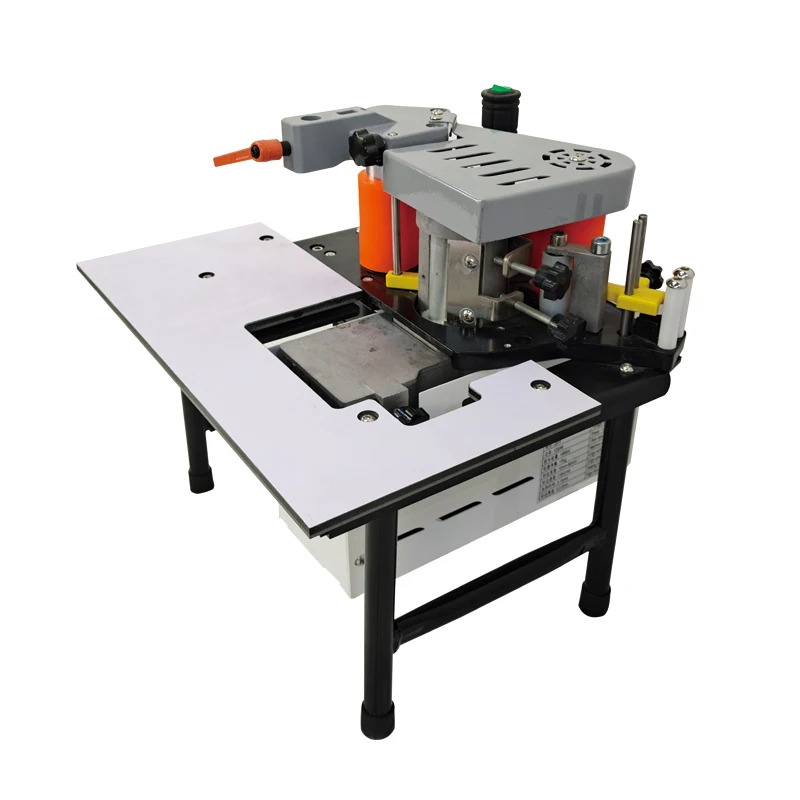
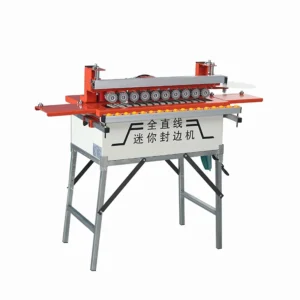
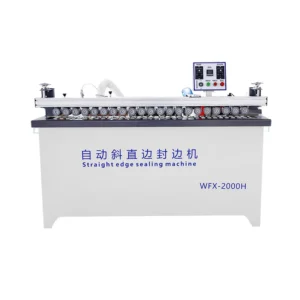
Compact Portable PVC Mini Edge Banding Machine for Woodwork – Entry Level ST-30
Benchtop-Ready Deployment — the ST-30 portable edge banding machine arrives with voltage and plug configuration confirmed for your workshop before dispatch, eliminating the commissioning delays that plague small-batch imports.
Technical Specifications
| Parameter |
Value |
| Product Type |
Portable Edge Banding Machine |
| Total Power |
1000W |
| Voltage & Frequency |
220V/380V/customization (frequency to be confirmed at order) |
| Control System |
Manual operation |
| Overall Dimensions (L×W×H) |
38×35×35 cm |
| Net Weight |
12 kg |
| Edge Banding Height Range |
0–50 mm |
| Edge Banding Thickness Range |
0.3–3 mm |
| Minimum Sheet Length |
25 cm |
| Minimum Sheet Width |
3 cm |
| Edge Trimming Power |
20W |
| Glue Pot Capacity |
1000 ml |
| Air Supply Requirement |
0.5–0.8 MPa |
| Edge Type |
Straight and curved edge |
| Compatible Banding Materials |
ABS, PVC, Melamine, Veneer |
| Language Options |
Chinese and English (custom language available on request) |
| Plug Options |
EU, USA, AU, UK |
| Standards |
CE |
Application Suitability
| Application |
Material or Output |
| Small workshop cabinet door production |
MDF and particleboard with PVC or ABS edge banding |
| On-site curved panel finishing for interior fit-outs |
Plywood and blockboard with veneer or melamine tape |
| Custom furniture one-off pieces |
Solid wood panels with veneer edge banding up to 3 mm |
| Joinery startup scaling from manual taping |
Mixed substrates including MDF, plywood, and particleboard |
Why the Voltage Question Must Come Before the Price
Confirming your workshop supply voltage and frequency before ordering prevents the machine from arriving unusable.
I have seen portable banders sit idle for weeks because the buyer assumed 220V/50Hz would work in a 110V/60Hz market. The motor overheats, the glue pot fails to reach temperature, and the trimming motor burns out within days. This portable edge banding machine in stock fast delivery listing is only useful if the unit matches your local electrical standard. A quick confirmation sheet exchanged before production avoids this entire failure mode [NEED_CITE: voltage and frequency standards by export market].

Single-Unit Ordering Without the Usual Import Friction
Most suppliers push container loads or require you to bundle ancillary equipment before they confirm a ship date. This portable edge banding machine in stock fast delivery is available as a standalone unit, dispatched once voltage, plug type, and language are verified. Small workshops testing their first mechanized edge finish do not need a full line commitment.
Straight and Curved Edges on One Benchtop Setup
Workshops handling custom cabinetry frequently encounter curved panel profiles that a stationary automatic bander cannot reach. The ST-30 handles both straight and curved edges without fixture changes. Operators move the machine along the workpiece, maintaining consistent glue application and pressure on profiles that would otherwise require hand-applied tape and a heat gun [NEED_CITE: edge banding adhesion standards for curved substrates].
Reading the Numbers That Matter for Small-Batch Output
The 0.3–3 mm banding thickness range covers PVC, ABS, melamine, and veneer — the four materials a small custom shop encounters daily. Switching between a 0.4 mm PVC tape for carcass panels and a 2 mm ABS edge for door fronts requires only a thickness adjustment, not a machine change. The 1000 ml glue pot sustains small-batch runs; for a shop processing twenty to thirty panels between refills, this capacity avoids constant interruption. The 0–50 mm height range accommodates standard 18 mm particleboard and thicker blockboard or solid wood panels used in worktops. Air supply at 0.5–0.8 MPa is within reach of a basic workshop compressor, though operators should verify their compressor can sustain this pressure continuously during banding operations.
The Hidden Cost of Skipping the Material Compatibility Check
I once configured an entry-level bander for a custom cabinet maker who tested successfully on MDF with PVC tape. When they switched to melamine paper edge banding on particleboard, the glue temperature was too low for proper wetting, and the bond failed across an entire batch of wardrobe doors. The loss was not the tape — it was the machined panels, the hardware already drilled, and the delivery deadline. Always specify your exact substrate and banding material combination when requesting a quotation [NEED_CITE: hot melt adhesive compatibility with melamine and PVC substrates].
What Manufacturing Depth Means for Your Spare Parts
The factory producing this unit maintains in-house machining of critical components and holds proprietary cutting mechanism patents. For a portable bander, this means replacement trimming blades, glue pot heating elements, and pressure rollers are sourced from the same production line rather than a third-party catalog. Four-stage quality control — incoming material, in-process, finished product, and pre-shipment verification — is applied to every unit regardless of order size. Voltage confirmation and plug adaptation are handled as standard configuration steps, not afterthoughts.
Documentation & Verification
- CE declaration of conformity specific to the ST-30 portable bander
- Electrical schematic matching your confirmed voltage and plug configuration
- Factory test record on your specified banding material and substrate
- Operation manual in agreed language with illustrated setup sequences
- Spare parts list with part numbers for trimming blades and glue pot elements
Installation, Commissioning & Support
- Benchtop placement on any stable surface; 38×35×35 cm footprint requires no floor anchoring
- Dedicated 220V or 380V circuit matching confirmed voltage, with appropriate breaker rating for 1000W total draw
- Machine ships fully assembled; connect air supply at 0.5–0.8 MPa and power on
- First-run parameter setting includes glue temperature adjustment for your specific banding material
- Replacement trimming blades and glue pot seals available as consumable spare parts
Before You Request a Quote
Provide the substrate types you process most frequently, the banding materials you intend to use, and your workshop voltage and frequency. If you handle curved panels, note the minimum radius. This information allows the engineering team to confirm whether the ST-30 matches your volume or if a step up to a semi-automatic unit is more appropriate.
Frequently Asked Questions
Q: How do I confirm the correct voltage and plug type for my country before ordering?
A: Share your country and workshop electrical standard during inquiry. The engineering team provides a voltage confirmation sheet matching your 110V–440V supply before production begins. Plug options include EU, USA, AU, and UK types, with other configurations available on request.
Q: Can the control panel and manual be supplied in English or another language?
A: English is standard. Chinese is also available, and custom language options can be arranged for the operation manual and any labeled controls. Specify your preferred language during the quotation stage so documentation is prepared before dispatch.
Q: What is the dispatch lead time for a single-unit order?
A: Single-unit orders of stocked configurations are dispatched once voltage, plug, and language are confirmed. Units requiring custom voltage adaptation or non-standard language documentation follow a production schedule confirmed at quotation.
Q: Is this machine suitable for my production volume, or should I step up?
A: The ST-30 suits workshops processing small batches or handling on-site curved edges. If your daily volume consistently exceeds what manual feeding can sustain, a semi-automatic or full automatic edge bander with continuous feed is more appropriate. Share your daily panel count for a configuration recommendation.
Q: What spare parts and consumables ship with the machine?
A: Each unit ships with a spare parts list detailing available consumables. Trimming blades, glue pot seals, and heating elements are the primary wear items. Confirm which consumables you want included in the initial shipment during the order stage.