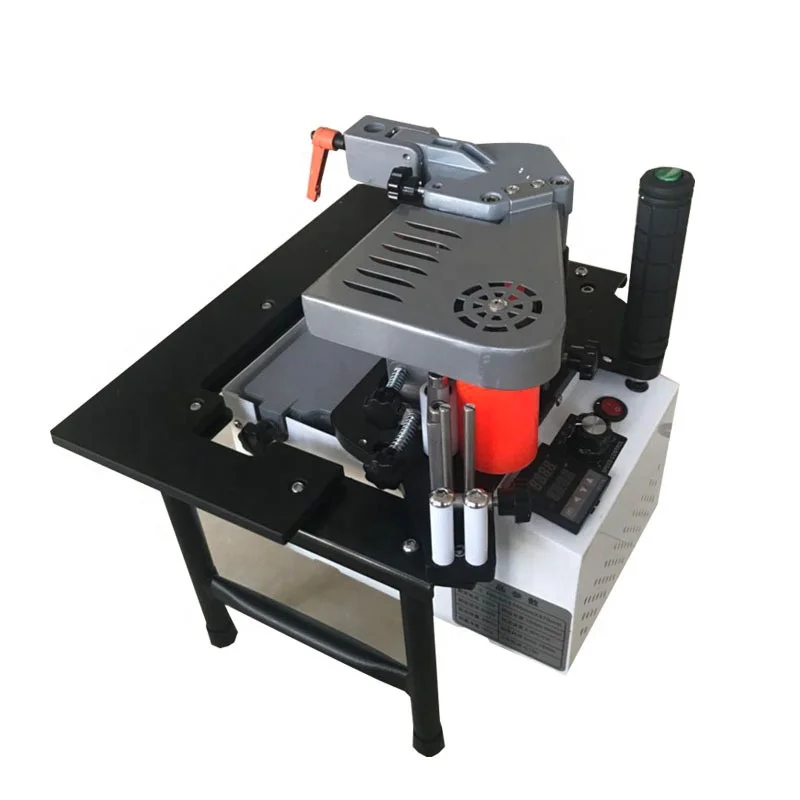
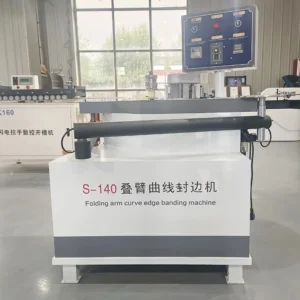
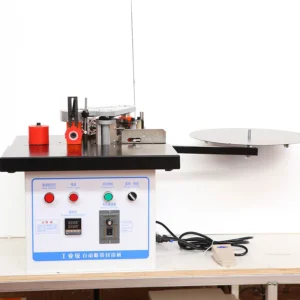
Compact Footprint — ready stock dispatch with region-specific plug configurations so a 14 kg benchtop unit arrives plug-and-play in any small workshop.
Technical Specifications
| Parameter |
Value |
| Product Type |
Portable Edge Banding Machine |
| Shape of Edge-banding Plates |
Curved, straight and special-shaped sheet |
| Edge Thickness Range |
0.3–3 mm |
| Edge Sealing Speed |
0–6 m/min |
| Edge Sealing Height |
7–60 mm |
| Gluing Method |
Double-sided gluing |
| Glue Pot Volume |
1000 ml |
| Machine Weight |
14 kg |
| Assembly State |
Portable / Handheld |
| Plug Options |
EU / AU / UK / USA / CN |
| Customization |
Logo customization available |
Application Suitability
| Application |
Material or Output |
| Joinery startup replacing hand-applied banding |
MDF, plywood and particleboard with PVC or veneer edge strips |
| Small custom furniture shop secondary edge bander |
Solid wood panels with curved or special-shaped profile edges |
| On-site cabinet installer portable banding |
Pre-cut boards requiring edge finishing at the installation location |
| Prototype and sample run edge finishing |
Mixed substrate offcuts used for client approval samples |
Why Voltage Confirmation Matters More Than the Sticker Price
A Portable Edge Banding Machine in stock fast delivery only helps if it actually powers on when you plug it in. I have watched small workshops receive compact edge banders that sat idle for weeks because the motor was wound for 220V 50Hz while the shop ran on a 110V 60Hz supply. The unit arrived, the operator pressed start, the thermal overload tripped instantly, and the return shipping conversation began. Asking one question about your local voltage and frequency before the order ships avoids that entire cycle. A Portable Edge Banding Machine in stock fast delivery is only fast if it runs on day one [NEED_CITE: voltage and frequency standards by export market].

Stock Availability and Dispatch Lead Time
This Portable Edge Banding Machine in stock fast delivery is packed and ready for dispatch rather than built against a confirmed order. That distinction matters when a workshop has a backlog of cabinet carcasses waiting on edge finishing and cannot absorb a multi-week production lead. Stocked units carry confirmed plug configurations, meaning the correct cable and plug type ship inside the crate rather than arriving as a separate adapter parcel.
Matching the Machine to Your Workshop Volume
Benchtop edge banders at this weight class serve workshops processing dozens of panels per day rather than hundreds. The 0–6 m/min feed speed suits careful, operator-guided passes along curved and shaped edges where an automatic through-feed machine would require complex fixturing. Shops running repetitive straight-panel work at higher volumes should evaluate full-size automatic models instead.
Reading the Spec Sheet Against Your Actual Panels
The 7–60 mm sealing height covers the standard 16 mm, 18 mm and 25 mm panel thicknesses common in cabinet and shelving production. If your shop regularly processes 40 mm solid bench tops or panels exceeding 60 mm, this unit will not clear the workpiece. The 0.3–3 mm edge thickness range accommodates standard PVC and thin veneer strips but excludes heavy solid-wood lipping above 3 mm. The 1000 ml glue pot volume supports a continuous run before refill is needed, and double-sided gluing applies adhesive to both the strip and the panel edge for consistent bond coverage across porous substrates like particleboard [NEED_CITE: adhesive bond requirements for particleboard edge banding].
The Cost of Skipping the Compatibility Check
Workshops that order a single portable bander without verifying panel thickness limits often discover the gap only after delivery. A 65 mm door panel will not pass under a 60 mm maximum sealing height, and no adjustment compensates for that physical constraint. Similarly, shops working exclusively with 4 mm solid timber lipping will find the 3 mm upper edge thickness limit restrictive, leading to partial adhesion and visible glue starvation on the strip face. These mismatches are not quality defects in the machine — they are specification mismatches that a two-minute measurement check before ordering would have prevented [NEED_CITE: common edge banding specification mismatches in small workshops].
What Arrives With the Machine
Each unit ships with confirmed regional plug type, eliminating the adapter guessing game at commissioning. Logo customization is available for workshops branding their equipment fleet or distributors private-labling the unit. The 14 kg weight means one operator can move the machine between a benchtop and a job-site worktable without mechanical aids. Multi-region plug options (EU, AU, UK, USA, CN) are selected at order stage, not improvised on arrival.
Documentation & Verification
- Operation manual in the operator's agreed language shipped inside the crate
- Electrical schematic confirming voltage, frequency and plug type for your region
- Factory test record on your specified edge thickness and panel height before dispatch
- Packing photographs showing machine condition and accessory count prior to crate sealing
- Spare parts list identifying glue pot, guide rollers and consumable items for reorder
Installation, Commissioning & Support
- Benchtop placement requires a stable flat surface supporting the 14 kg unit without vibration
- Dedicated electrical circuit matching confirmed voltage and frequency prevents thermal overload trips
- Glue pot filled and heated to operating temperature before first panel pass ensures adhesive flow
- Edge guide roller tension adjusted to your specific strip thickness during initial setup
- Spare glue pot ordered alongside the machine eliminates downtime during future maintenance cycles
Before You Submit an Enquiry
Tell us the edge banding material you run most often (PVC, veneer, or melamine strip) and the thickness range you need to cover. Confirm your workshop supply voltage and frequency so the correct plug and motor winding ship with the unit. If you process curved or special-shaped panels, note the tightest radius so we can confirm the guide roller clearance.
Frequently Asked Questions
Q: What plug and voltage options are available, and how do I confirm the right one for my country?
A: The machine ships with EU, AU, UK, USA or CN plug types. Before dispatch we confirm your local supply voltage and frequency so the motor winding and cable match your workshop circuit. This step is completed at order stage to avoid receiving a unit that cannot power on without a transformer.
Q: Can this portable machine handle the same edge materials as a full-size automatic edge bander?
A: It processes PVC and veneer strips within the 0.3–3 mm thickness range, which covers most standard cabinet edge banding. However, solid wood lipping above 3 mm and high-pressure laminate strips fall outside the specification. Full-size automatic machines typically accommodate thicker solid lipping with additional trimming stations.
Q: What is the realistic daily output for a small workshop using this machine?
A: Output depends on panel size, edge profile complexity and operator pace. At the 0–6 m/min speed range, an experienced operator can edge-band a batch of cabinet components through a typical working shift. This unit suits workshops finishing dozens of panels daily rather than high-volume continuous production environments.
Q: How do I upgrade to a larger automatic edge bander as my production volume grows?
A: The portable unit handles startup volume and shaped edges while a full-size through-feed machine takes over straight-panel runs as throughput increases. We recommend keeping the portable machine as a secondary unit for curved work and on-site jobs once the larger machine is installed.
Q: What spare parts and consumables should I order together with the machine?
A: A spare glue pot, replacement guide rollers and a supply of adhesive granules matched to your edge material are the most common first-order consumables. We include a spare parts list with the shipment identifying each replaceable component and its part reference for future reorders.