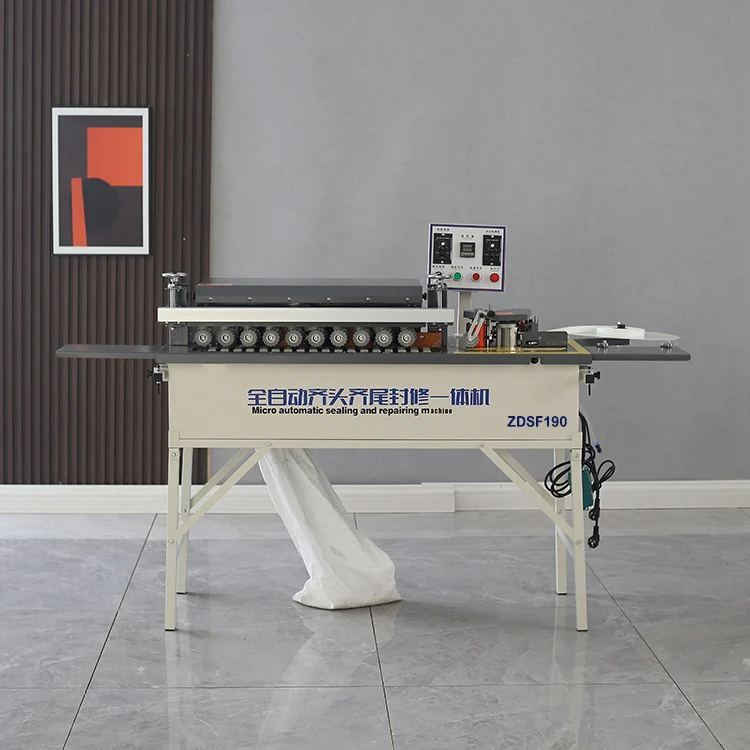
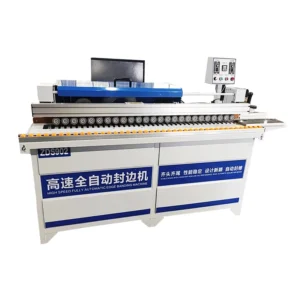
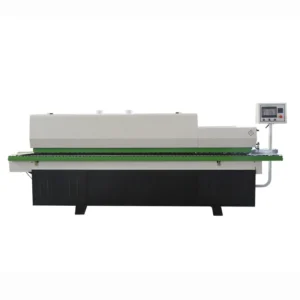
Fast Dispatch from Stock — ZDSF190 units are built, tested, and ready to ship rather than waiting through a production queue, letting small workshops move from manual trimming to automated curved and straight edge banding without delay.
Technical Specifications
| Parameter |
Value |
| Model |
ZDSF190 |
| Product Type |
Curved and Straight Edge Banding Machine |
| Function |
Automatic plate feeding, belt breaking, double-sided gluing, upper and lower trimming, polishing, curved and straight edge banding |
| Edge Type |
Both curved and straight lines (180° rotation) |
| Voltage & Frequency |
220V 50Hz |
| Rated Power |
4 kW |
| Heating Power |
800 W |
| Trimming Power |
800 W × 2 |
| Polishing Power |
180 W × 2 |
| Suction Power |
1200 W |
| Transmission Power |
120 W |
| Belt Power |
25 W |
| Rated Air Pressure |
0.4–0.6 MPa |
| Feed Speed |
0–14 m/min |
| Panel Thickness Range |
10–50 mm |
| Strip Thickness Range |
0.5–2.5 mm |
| Glue Pot Capacity |
1000 ml |
| Transmission |
Crawler transmission with steel rod slide rails |
| Trimming Mechanism |
Square slide rail profiling, 4-blade alloy arc knife |
| Pressure Beam |
Aluminum alloy, adjustable |
| Feed Plate |
Extended design |
| Edge Strip Cutting |
Pneumatically controlled |
| Overall Dimensions (L×W×H) |
1900 × 560 × 1300 mm |
| Net Weight |
120 kg |
Application Suitability
| Application |
Material or Output |
| Small-batch cabinet production |
MDF and particleboard with PVC or ABS edge banding |
| Custom curved furniture components |
Plywood and shaped solid wood panels with veneer strip |
| Joinery workshop edge finishing |
Melamine-faced board with 0.5–2.5 mm straight and curved strips |
| Prototype and sample runs |
Mixed substrates requiring quick changeover between edge profiles |
| Shelving and retail fixture edges |
MDF with PVC banding on both radius corners and straight runs |
Why Voltage Confirmation Matters Before You Order an Edge Banding Machine in Stock
Matching your workshop's electrical supply to the machine's rated input is the single step that prevents a delivered unit from sitting idle.
I spent years running quality control before moving into equipment sales, and the pattern is consistent: a joinery shop orders a compact edge bander, it arrives, and the local supply is 110V 60Hz or 440V three-phase while the machine was built for 220V 50Hz. The motor hums, the heater never reaches glue activation temperature, and the trimming motors stall under load. By the time an electrician rewires the panel, the delivery deadline has already passed. The ZDSF190 ships configured at 220V 50Hz, and if your site runs differently, that conversation needs to happen before the crate leaves the factory — not after it clears customs [NEED_CITE: voltage and frequency standards by export market].

Single-Unit Ordering Without the Production-Line Commitment
Many small workshops hesitate to invest because a full edge banding line demands space, power, and capital they have not yet justified. The ZDSF190 sits at the opposite end of that spectrum: a 1900 mm footprint that fits against a wall, a 4 kW total draw that runs on a standard workshop circuit, and a self-contained workflow from gluing through polishing. You order one edge banding machine in stock, place it next to your panel saw, and start producing finished edged panels the same week it arrives.
Ready Stock Means Real Lead Times, Not Estimates
When a supplier lists fast delivery, the question is whether the machine physically exists in a warehouse or is still a bill of materials waiting for a production slot. The ruiqishop.com model is built around stocked units with dispatch lead times and shipping options quoted upfront. You see what is available, you confirm the voltage and language on the control panel, and the unit ships — no multi-week build queue attached.
What the Spec Sheet Actually Means on the Shop Floor
The 10–50 mm panel thickness range covers everything from thin shelving stock to thick workbench tops, and the adjustable aluminum pressure beam keeps the board flat against the crawler belt regardless of where in that range you are working. The 4-blade alloy arc knife on a square slide rail is what produces a clean radius on curved edges; cheaper trimming heads leave witness marks that show through thin veneer. Double-sided gluing from the 1000 ml pot ensures adhesive reaches both the board edge and the strip back, which matters when you are running porous MDF that absorbs glue faster than plywood [NEED_CITE: adhesive penetration differences across wood-based panel substrates]. The 0–14 m/min variable feed speed lets you slow down for tight curves and open up for long straight runs without swapping tooling.
The Cost of Skipping the Material Conversation
A custom furniture shop I worked with in Dubai ran PVC banding all year without issue, then took an order requiring thin wood veneer on curved cabinet fronts. They kept the same glue temperature and pressure wheel settings, and the veneer cracked at every radius while the glue line starved on the straights. Output dropped to a fraction of normal, and the delivery window collapsed. Before you order, confirm the strip materials and thicknesses you will actually run — the ZDSF190 handles 0.5–2.5 mm strips across PVC, ABS, melamine, and veneer, but each one demands different heat and pressure settings that your operator needs documented before day one.
What Buying Through This Channel Actually Provides
Stock availability is confirmed at the point of inquiry, so you are not quoting against a hypothetical build slot. Voltage customization from 110V to 440V and multilingual control panels are configured before dispatch, not retrofitted on arrival. The four-stage QC process — incoming material, in-process, finished product, and pre-shipment verification — applies to every stocked unit before it is released for shipping [NEED_CITE: ISO 9001 quality management requirements for machinery manufacturers]. An engineer reviews your panel material, edge profile, and production volume to confirm the ZDSF190 is the right fit rather than simply processing an order. If your volume grows, the same product family scales to higher-throughput models without switching suppliers.
Documentation & Verification
- CE declaration of conformity covering the ZDSF190 electrical and mechanical safety requirements
- Machine specification sheet with confirmed voltage and frequency for your destination market
- Electrical schematic showing circuit layout, breaker ratings, and wiring terminal assignments
- Factory test record using your specified panel thickness and edge strip material
- Operation and maintenance manual written in the language your operators read
Installation, Commissioning & Support
- Requires a level floor with 1900 × 560 mm clear footprint and overhead clearance above 1300 mm
- Dedicated 220V 50Hz circuit rated for the 4 kW total draw with appropriate breaker protection
- Arrives fully assembled; connect power, compressed air at 0.4–0.6 MPa, and dust extraction to begin setup
- First-run calibration of glue temperature, feed speed, and trimming depth for your chosen strip material
- Pneumatic edge strip cutter and adjustable pressure beam walkthrough included in commissioning guidance
- Spare parts list with wear items identified: trimming blades, polishing wheels, and crawler belt segments
Before You Request a Quote
Send the panel substrates you cut most often — MDF, plywood, particleboard, or solid wood — along with the edge strip materials and thicknesses you plan to run. Confirm your workshop voltage and frequency so the unit is configured correctly before it ships. If you are replacing a manual process, note your current daily output so the engineer can confirm the 0–14 m/min feed speed covers your volume without bottlenecking upstream cutting.
Frequently Asked Questions
Q: Is this edge banding machine in stock and how fast can it ship?
A: Units are held in ready stock with dispatch lead times and shipping options quoted at the point of order. Once you confirm voltage, control panel language, and strip material requirements, the machine is prepared for shipment. Transit time then depends on your destination port and chosen freight method.
Q: My workshop runs on a different voltage — can it be reconfigured before dispatch?
A: Yes. The ZDSF190 supports voltage customization from 110V to 440V. Specify your local supply voltage and frequency during the inquiry stage so the motor windings, heater element, and control transformer are matched before the machine leaves the factory, avoiding on-site rewiring.
Q: Can I start with this one machine and add more stations later?
A: The ZDSF190 covers gluing, trimming, and polishing in a single footprint, so it functions as a complete edge banding station on its own. As your volume grows, you can add upstream panel saws or downstream boring machines from the same product family without compatibility conflicts in feed height or throughput.
Q: What edge banding materials does it handle within the 0.5–2.5 mm range?
A: The machine processes PVC, ABS, melamine, and veneer strips across the full 0.5–2.5 mm thickness range. Each material requires specific glue pot temperature and pressure beam adjustments, which are documented in the operation manual and confirmed during commissioning guidance.
Q: How does single-unit ordering and shipping work?
A: You place an order for one unit with your specifications confirmed. Shipping options and costs are quoted upfront based on your destination. The machine ships with the operation manual, spare parts list, electrical schematic, and factory test record included in the crate.