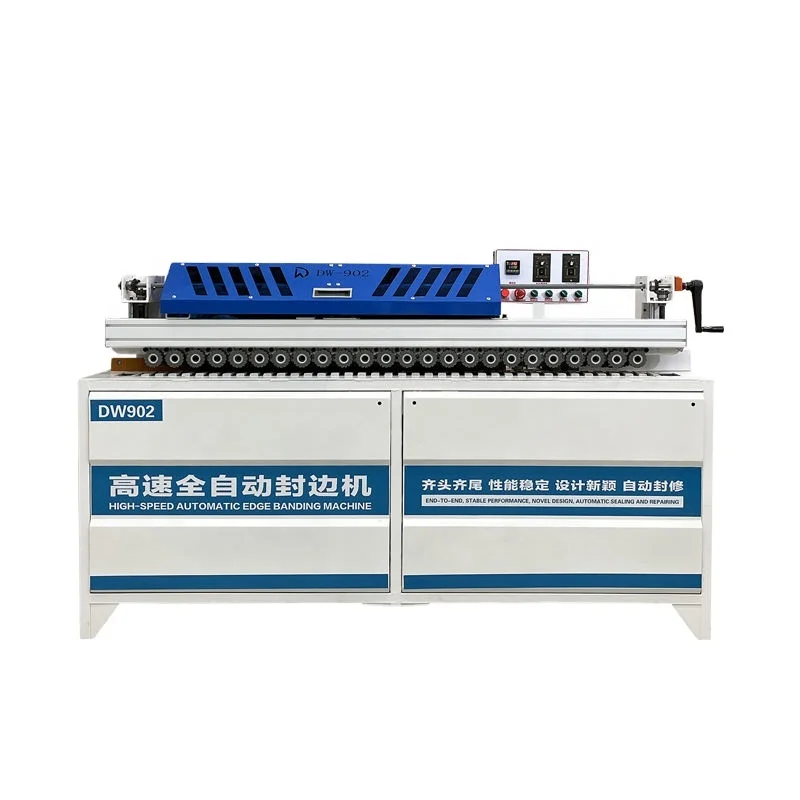
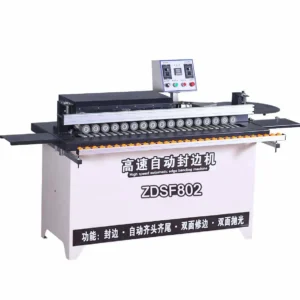
Compact Footprint, Full Automation — the DW902 brings five edge-processing stations into a 175 cm frame, letting small workshops replace manual banding without reconfiguring the floor.
Technical Specifications
| Parameter |
Value |
| Model |
DW902 |
| Product Type |
High-speed Fully Automatic Edge Banding Machine |
| Function Stations |
Gluing, Trimming, End Cutting, Scraping, Polishing |
| Voltage |
220V (50Hz/60Hz to be confirmed before dispatch) |
| Total Power |
3300W |
| Board Thickness Range |
0–50 mm |
| Strip Thickness Range |
0.5–3 mm |
| Glue Pot Capacity |
4000 ml |
| Pressure Beam |
Integrated, double-row pressure wheels |
| Conveyor Belt |
Silicone material |
| Edge Strip Cutting |
Pneumatically controlled |
| Trimming Configuration |
Double high-speed motors (up and down) |
| Polishing Configuration |
Dual up/down motors |
| Dimension |
175 × 60 × 112 cm |
| Weight |
240 kg |
| Feed Speed |
(basis to be confirmed) |
| Tolerance |
(basis to be confirmed) |
| Control System |
(basis to be confirmed) |
Application Suitability
| Application |
Material or Output |
| Small cabinet workshop production |
MDF and particleboard panels with PVC edge banding |
| Custom furniture joinery |
Plywood panels with veneer or melamine paper edge strips |
| Startup panel processing cell |
Board thicknesses from thin stock up to 50 mm |
| Moderate-volume edge finishing |
PVC, veneer, and melamine strip from 0.5 to 3 mm |
Why the Voltage Question Comes Before Everything Else
Buying a compact automatic edge banding machine without confirming your local frequency is the fastest route to a silent workshop. A 220V motor rated for 50Hz running on a 60Hz supply will spin faster, draw more current, and burn out its windings within weeks.
I once watched a Middle East cabinet shop unbox a brand-new bander, wire it in, and hear the contactor chatter without the feed belt moving. The supplier had shipped a 50Hz unit to a 60Hz region. The glue pot element survived, but the conveyor motor did not. That shop lost three production days while waiting for a replacement stator. Voltage alone is never enough — frequency, phase configuration, and plug type all have to match before the crate leaves the factory. [NEED_CITE: voltage and frequency standards by export market]

What "Ready Stock" Actually Means for Your Timeline
Dispatch speed matters most when a single machine is the bottleneck. The DW902 ships as a fully assembled unit — no on-site mechanical assembly beyond leveling the frame and connecting power. For a joinery workshop replacing a handheld bander, that difference means panels can be running through the stations the same day the unit is positioned. Stocked configurations leave the factory on a compressed schedule compared to built-to-order lines.
Matching the Machine to Your Daily Panel Count
A small cabinet maker running fifty to eighty panels a day sits comfortably inside what this class of automatic edge banding machine is designed for. Push the volume to several hundred panels per shift and the glue pot refill intervals, trimming head duty cycle, and conveyor belt wear all start to exceed what a compact station was engineered to handle. Planning the upgrade path before the first order avoids the trap of buying a machine twice. [NEED_CITE: typical duty cycle expectations for entry-level edge banders]
How the Specifications Translate on the Shop Floor
The 4000 ml glue pot holds enough adhesive to run a short production batch without pausing for a refill — a detail that matters when melamine paper strips demand a steady thermal reserve. The double-row pressure wheels on the integrated beam distribute feed force across the panel face, reducing the chance of slippage on glossy or pre-finished MDF surfaces. Pneumatic strip cutting keeps the end cut square without relying on the operator's hand pressure, and the dual up/down polishing motors remove the scraping marks that would otherwise require a separate buffing pass. Board thickness capacity reaching 50 mm means the same machine can handle standard 18 mm cabinet stock and thicker shelving without a tooling change.
The Cost of Skipping Configuration Checks
Ordering a single machine on dimensions and power alone leaves too many variables for the factory to guess. If the control panel language does not match the operator, commissioning stalls until a translated manual arrives. If the edge strip material is melamine paper but the glue temperature was set for PVC, the bond fails on the first humidity swing and an entire batch of panels comes back for re-banding. These are not defects — they are configuration mismatches that surface only after production starts. [NEED_CITE: CE machinery directive requirements for industrial equipment]
Why Procurement Runs Smoother Here
In-house manufacturing means the patented cutting mechanism and precision-ground components are built under one roof, not sourced from three unnamed subcontractors. The four-stage QC sequence — incoming material, in-process, finished product, and pre-shipment verification — applies to every unit regardless of order size. Voltage and frequency customization is treated as a standard configuration step, not an afterthought. Engineer-led proposals arrive within 24 hours and specify the exact glue pot temperature range and feed speed suited to your strip material. Factory visits are welcomed before you commit.
Documentation & Verification
- CE declaration of conformity covering the DW902 safety and EMC scope
- Electrical schematic confirming 220V wiring, frequency, and plug type
- Factory test record on your panel thickness and strip material before dispatch
- Operation manual provided in the operator's agreed language
- Spare parts list with consumable part numbers for glue pot and trimming heads
- Packing photographs for damage comparison on arrival
Installation, Commissioning & Support
- Level the 175 × 60 cm frame on a flat concrete floor with anti-vibration pads
- Connect a dedicated 220V circuit rated above 3300W with appropriate breaker protection
- Verify pneumatic supply pressure for the strip cutting cylinder before first run
- Set glue pot temperature to match your specific PVC or melamine strip material
- Calibrate double-row pressure wheel tension for the thinnest board in your range
- Schedule a remote video call for first-day parameter tuning and operator questions
What to Include in Your Inquiry
Send the exact edge strip materials you run — PVC, veneer, or melamine paper — along with their thickness and width. Confirm your local voltage, frequency, and plug type so the unit is wired correctly before it ships. Specify the maximum panel thickness and daily panel count so the engineer can confirm the DW902 fits your volume or recommend the next step in the range.
Frequently Asked Questions
Q: What panel sizes and edge banding materials is the DW902 designed for?
A: The machine handles board thicknesses from 0 to 50 mm and strip thicknesses from 0.5 to 3 mm. It is designed for PVC, veneer, and melamine paper edge banding on MDF, particleboard, and plywood. Confirm your specific strip material and width during inquiry so glue pot temperature and feed settings are matched before shipment.
Q: Is the 220V configuration ready for my local power supply?
A: The unit is built for 220V, but frequency must be confirmed as 50Hz or 60Hz depending on your region. A mismatch between motor rating and local frequency causes overheating or slow feed. State your country and local electrical standard in the inquiry so the correct motor and transformer configuration is fitted before dispatch.
Q: What is the dispatch lead time for a single-unit order?
A: Stocked configurations are prepared for dispatch on a compressed schedule. Single-unit orders ship with full documentation, packing photographs, and a pre-shipment test record. Exact timing depends on current stock availability and destination port. Shipping options and estimated transit are quoted at the quotation stage.
Q: Does the machine arrive fully assembled?
A: Yes. The DW902 ships as an assembled unit requiring only floor leveling, power connection, and pneumatic line hookup. An operation and maintenance manual in the agreed language is included. Remote installation guidance is available for first-day setup and parameter calibration.
Q: When should I plan an upgrade to a higher-throughput model?
A: If daily volume grows beyond moderate batch sizes, or if you add pre-milling and multi-strip requirements, a higher-tier model in the Ruiqi range will offer faster feed speed and additional stations. Discuss your projected volume growth during inquiry so the upgrade path is mapped from the start.