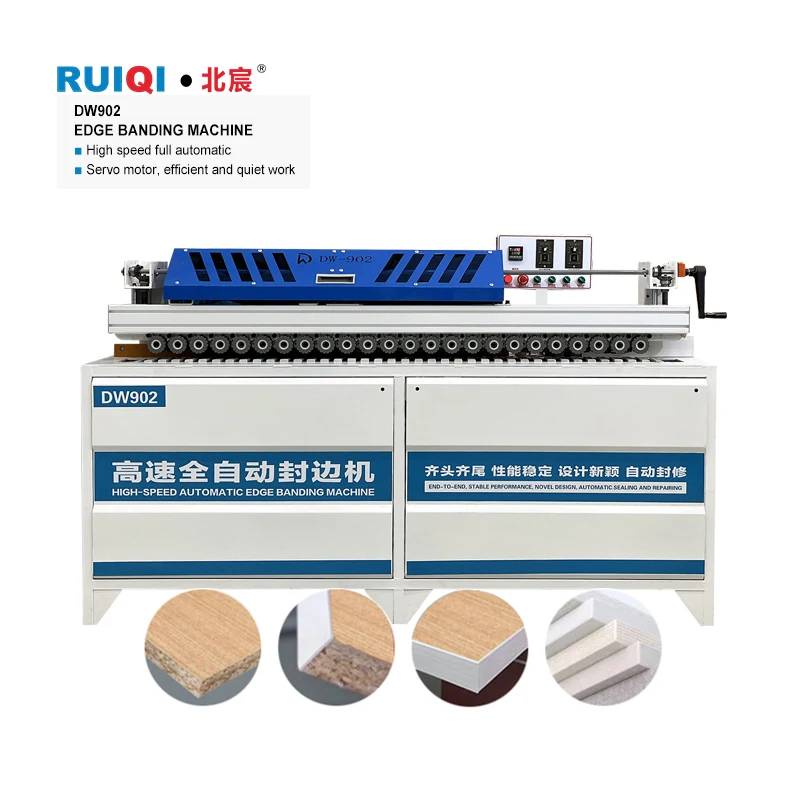
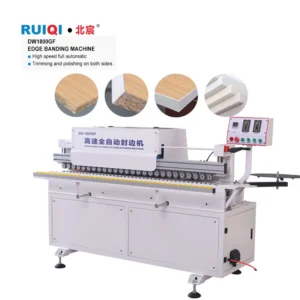
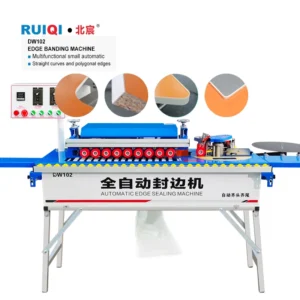
Voltage-matched dispatch — every DW902 ships only after the buyer's electrical panel photo and local frequency are confirmed, preventing three-week site delays.
Technical Specifications
| Parameter |
Value |
| Model |
DW902 |
| Product Type |
Automatic Edge Banding Machine |
| Rated Power |
4 kW |
| Voltage & Frequency |
220V / 380V / customization (50 Hz or 60 Hz — confirm before order) |
| Control System |
Operation panel available in Chinese / English; customizable to Spanish or other languages |
| Overall Dimensions (L × W × H) |
175 × 87 × 112 cm |
| Net Weight |
240 kg |
| Feed Speed |
140 W transmission motor (feed rate in m/min — basis to be confirmed) |
| Edge Banding Thickness |
0.3 – 3 mm |
| Minimum Panel Width |
10 cm |
| Minimum Sheet Length |
25 cm |
| Edge Banding Height |
5 cm |
| Trimming Stations |
Trimming (800 W × 2, 24 000 r/min), Polishing (380 W × 2), Automatic trimming, Scraping |
| Glue Pot Capacity |
4 000 ml |
| Air Supply Requirement |
0.5 – 0.8 MPa |
| Dust Extraction |
550 W vacuum with integrated extraction |
| Key Features |
Oblique and straight dual-purpose edge banding, double hot air design, feeding auxiliary slide plate, 4 groups of oblique pressure wheels, double row pressing wheels, chamfering |
Application Suitability
| Application |
Material or Output |
| Custom cabinet door edge finishing |
MDF and particleboard, 0.3 – 3 mm PVC or veneer banding |
| Home-decoration built-in wardrobe panels |
Plywood and ecological board, 90-degree straight edges |
| Small-batch furniture production runs |
Solid wood panels up to 5 cm banding height |
| Joinery workshop panel preparation |
MDF and particleboard with minimum 10 cm width |
Why the Voltage Question Must Precede the Purchase Order
A compact automatic edge banding machine in stock is only ready if its voltage matches the workshop's actual supply.
I once sent a 380 V unit to a Southeast Asian furniture factory whose site ran on single-phase 220 V. The machine sat idle for three weeks while transformers were sourced locally, and the owner called nearly every day asking when production could start. That delay was entirely avoidable. Most small workshops outside heavy-industry zones do not have three-phase supply, and assuming otherwise wastes time and money once the crate is opened [NEED_CITE: voltage and frequency standards by export market].

Sizing the Machine to the Workshop, Not the Brochure
Entry-level machines are often sold into production volumes they were never designed to handle, leading to premature wear on feed motors and trimming heads. The DW902 is specified honestly for home-decoration output and small-batch cabinet work, where daily panel counts stay within a comfortable range. Buying an automatic edge banding machine in stock at this tier means accepting a deliberate trade-off: a smaller footprint and lower power draw in exchange for throughput matched to a growing, not yet industrial, operation.
Footprint and Utility Requirements on a Workshop Floor
At 175 × 87 × 112 cm and 240 kg, this unit fits against a wall in a joinery shop that is still sharing floor space with a sliding table saw and a manual drill press. The 4 kW total rated power draws within a standard workshop circuit, and the 550 W vacuum port ties into existing dust collection rather than demanding a separate extraction room. Confirming floor load capacity and compressor line pressure (0.5 – 0.8 MPa) before delivery avoids the common problem of uncrating a machine that cannot run on day one [NEED_CITE: CE machinery directive requirements for industrial equipment].
Reading the Spec Sheet Against Real Production Needs
The trimming section runs two 800 W heads at 24 000 r/min, which is the speed band needed for clean PVC and veneer removal on MDF without chipping the substrate edge. Below this speed, the trimming cutters tear rather than shear, leaving visible lines that force operators into hand-scraping — exactly the step automation is supposed to eliminate. The double hot air design keeps adhesive at working temperature across the full 4 000 ml glue pot, so glue viscosity stays consistent from the first panel of the morning to the last. Panel width starts at 10 cm and minimum sheet length at 25 cm, which covers most cabinet door stiles and drawer fronts but rules out very narrow trim pieces that require a dedicated small-part bander.
The Hidden Cost of Skipping Configuration Checks
When an edge bander arrives with a control panel in a language the operator cannot read, commissioning stalls until a translator or replacement HMI is arranged. When voltage is wrong, the motor simply will not start — there is no workaround on site. These are not manufacturing defects; they are order-process failures that fall on the supplier who shipped without verifying [NEED_CITE: electrical compliance documentation for exported machinery]. The frustration compounds when the machine was bought as a single unit without checking feed height compatibility against existing upstream saws.
Reasons to Source This Model Through This Channel
In-house manufacturing with patented cutting mechanisms means tolerance claims are traceable to the actual grinding process, not a catalog promise. The product family spans entry-level to full-function models, so a workshop that outgrows the DW902 can move to a higher-tier machine without changing supplier or re-learning a new control ecosystem. Voltage, language, and mechanical specification customization are handled as standard line items, not special requests. A four-stage QC process with pre-shipment verification ensures each unit is tested before crating. Engineer-led configuration recommendation is delivered with a formal quotation within 24 hours of receiving panel samples and site details.
Documentation & Verification
- CE declaration of conformity covering the DW902 edge banding and trimming assembly
- Factory test record run on your specified panel thickness and banding material before dispatch
- Electrical schematic with confirmed voltage and frequency for your local supply
- Operation and maintenance manual in the agreed language, matched to the installed control panel
- Spare parts list identifying trimming cutters, polishing wheels, and glue pot seals by part number
Installation, Commissioning & Support
- Requires a level concrete floor supporting 240 kg static load across the 175 × 87 cm base footprint
- Dedicated circuit matching confirmed voltage (220 V or 380 V) with appropriate breaker rating for 4 kW draw
- Arrives fully assembled; connect air line at 0.5 – 0.8 MPa and dust extraction hose to the 550 W vacuum port
- First-run parameter setting covers glue temperature, feed motor speed, and trimming head alignment at 24 000 r/min
- Operator training addresses the multilingual control panel, glue pot refill procedure, and banding thickness changeover
- Scheduled maintenance intervals for trimming cutter replacement and polishing wheel inspection provided in manual
Before You Send an Inquiry
To configure the DW902 correctly, share the panel materials and thicknesses you process most often, the local voltage and frequency at your workshop panel, and the language your operators need on the control screen. If you already run a sliding table saw or panel saw upstream, note its feed height so throughput between stations stays compatible. Mention whether you need a sample edge-banding test on your own material before confirming the order.
Frequently Asked Questions
Q: Is the DW902 sized correctly for my current daily panel volume?
A: This model is intended for home-decoration workshops and small-batch cabinet makers moving from manual banding to automation. If your daily output already runs into several hundred panels per shift, a higher-tier machine in the same product family would be a better fit. Share your typical daily count and panel mix so an engineer can confirm whether this unit or the next tier suits your volume.
Q: What voltage and plug options can be configured before shipping?
A: The DW902 supports 220 V, 380 V, and custom configurations. Frequency (50 Hz or 60 Hz) must be confirmed against your local grid before production begins. We ask every buyer to photograph their workshop distribution board so the correct motor winding, plug type, and breaker specification are set at the factory rather than guessed.
Q: Can the control panel be set to English or another language before delivery?
A: Chinese and English are standard options on the operation panel. Spanish and other languages are available as customization. The agreed language is flashed to the HMI before the pre-shipment test, so the operator can begin commissioning on arrival without waiting for a software update or translator.
Q: What utility connections does my workshop need ready before the machine arrives?
A: You will need a dedicated electrical circuit at the confirmed voltage, a compressed air line delivering 0.5 – 0.8 MPa, and a dust extraction connection for the 550 W vacuum port. The machine footprint is 175 × 87 cm, so plan clearance for panel infeed and outfeed on both sides of the unit.