Engineer-led configuration — a formal quotation with voltage and language confirmation arrives within 24 hours, sized to your actual material list rather than a catalogue guess.
Technical Specifications
| Parameter |
Value |
| Model |
DW902 |
| Product Type |
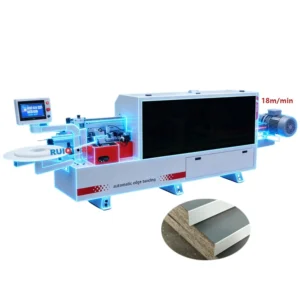
Automatic Edge Banding Machine |
| Total Power |
4000W |
| Voltage & Frequency |
220V / 380V / customization available |
| Edge Banding Height |
5 CM |
| Edge Banding Thickness |
0.3–3 MM |
| Minimum Sheet Length |
25 CM |
| Minimum Sheet Width |
10 CM |
| Edge Power |
140W |
| Transmission Power |
140W |
| Trimming Power / Speed |
800W × 2, 24000 r/min |
| Polishing Power |
380W × 2 |
| Vacuum Power |
550W |
| Glue Pot Capacity |
4000 ml |
| Air Source Pressure |
0.5–0.8 MPa |
| Product Size |
175 × 87 × 112 CM |
| Product Weight |
240 KG |
| Control Panel Language |
Chinese / English, customizable to Spanish or other languages |
| Plug Options |
EU / USA / AU / UK |
| Assembly State |
Fully assembled, wooden box packaging |
Application Suitability
| Application |
Material or Output |
| Custom cabinet startup production |
MDF and particleboard with PVC edge banding |
| Small joinery workshop mechanization |
Solid wood board and ecological board with veneer or PVC strips |
| Home decoration batch panel processing |
Plywood panels in batch sizes below full-line justification |
| Compact furniture workshop |
Boards as small as 25 CM × 10 CM, straight 90-degree edges |
Why the Voltage Question Must Come Before the Order
Confirming your workshop supply before dispatch avoids a machine that sits idle on arrival.
I once shipped an edge bander to a small cabinet shop where the owner confirmed the model and price over a phone call but never mentioned his workshop ran on a single-phase supply with a non-standard frequency. The machine arrived, the motor hummed but refused to start, and the first week became a costly exchange of emails instead of production. The DW902 is configurable from 220V to 380V and beyond, but that configuration only works when the buyer's actual supply is documented before the build [NEED_CITE: voltage and frequency standards by export market]. An edge banding machine in stock means little if the voltage is wrong — the DW902 ships ready to run only when the electrical match is confirmed upfront.

What This Machine Is Built to Handle
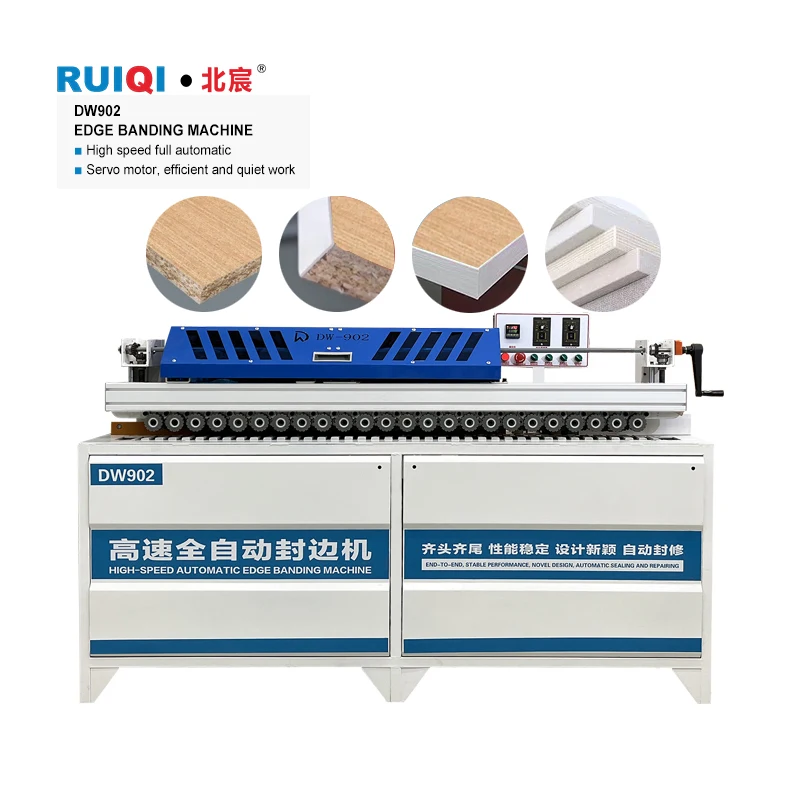
The DW902 occupies the narrow space between hand-held edge banding and a full production line. It is designed for workshops that have outgrown manual trimming and scraping but do not yet feed enough panels per day to justify a six-station automatic line. The 4000W total power draw keeps it within reach of standard workshop circuits, and the 240 KG weight means it can be positioned without a forklift.
Small joinery shops and custom cabinet startups represent the core buyer profile. The machine processes MDF, particleboard, plywood, and solid wood panels in a single pass — edge banding, trimming, polishing, and scraping — so a two-person team can move from raw cut panels to finished components without switching stations. The edge banding machine in stock designation means dispatch is measured in days, not months, which matters when a new contract demands mechanized output by next quarter.
Footprint and Placement in a Small Workshop
At 175 × 87 × 112 CM, the DW902 fits against a standard workshop wall with room for an operator on the feed side and an offload table on the exit. The compact footprint is deliberate: workshops moving from manual to machine production rarely have the floor space for a twelve-meter line [NEED_CITE: typical small workshop floor layouts for furniture production]. The auxiliary slide plate extends support for sheets as small as 25 CM × 10 CM, which covers the narrow drawer fronts and shelf brackets that larger machines simply cannot grip.
Air supply requirements stay modest at 0.5–0.8 MPa, compatible with the small reciprocating compressors most joinery shops already own. The 550W vacuum unit collects trim waste and dust at the source, reducing the need for a separate extraction system during the first year of operation.
Reading the Specs Against Your Actual Workload
The 0.3–3 MM edge banding thickness range covers standard PVC strips and thin veneer, which accounts for the majority of cabinet and shelving work in small shops. If your production involves thick ABS or acrylic edge banding above 3 MM, this machine is not the right configuration, and stating that clearly saves both sides a difficult conversation after delivery. The 4000 ml glue pot capacity supports extended runs without frequent refills — in practical terms, a full pot handles a typical day's batch of standard cabinet panels before needing a top-up.
The dual trimming motors at 800W each and 24000 r/min deliver clean cuts on PVC and melamine edges. The 5 CM maximum edge banding height covers standard 18 MM and 25 MM board thicknesses with margin, though panels thicker than 50 MM require a different class of machine. Trimming speed and polishing power together determine the visible quality of the finished edge, and these values position the DW902 for furniture-grade output on common panel materials.
The Cost of Skipping the Material Conversation
Buying an entry-level edge bander without confirming your actual edge banding material is one of the most common mistakes I see in small workshops. A customer once ordered a machine based on PVC samples, then switched to high-hardness acrylic strip for production without telling anyone. The glue temperature and feed speed settings were completely wrong for the new material, and the first week saw waste rates climb sharply before we identified the cause [NEED_CITE: edge banding adhesion failure causes on alternative materials]. The DW902 handles the materials listed in its specification, but every material has a different thermal and mechanical profile that affects setup.
Why Source This Model Through This Channel
The DW902 is manufactured in-house with a four-stage QC process covering incoming material inspection, in-process checks, finished product testing, and pre-shipment verification. Each unit ships with a factory test record and photographs taken on the production floor before crating.
Voltage and plug configuration are confirmed against the buyer's local supply before the build begins — 110V to 440V customization is standard, not an afterthought. The control panel language is set to the buyer's specification, whether English, Spanish, or another agreed language, so the operator can read the interface on day one. Engineer-led configuration means a formal proposal arrives within 24 hours of inquiry, addressing the buyer's actual panel sizes, edge materials, and daily volume rather than pushing a default package. The full product family — from this entry-level model to full-function pre-milling machines — allows a workshop to scale without changing suppliers when production volume grows.
Documentation & Verification
- CE declaration of conformity covering the DW902 automatic edge banding machine
- ISO 9001 certificate for the manufacturing facility producing this unit
- Electrical schematic and voltage confirmation sheet matched to your local supply
- Factory test record with photographs taken before wooden box crating
- Operation and maintenance manual printed in your agreed control panel language
- Spare parts list identifying consumable components and recommended replacement intervals
Installation, Commissioning & Support
- Requires a level concrete floor with the 175 × 87 CM footprint clear of obstructions
- Dedicated circuit matching the confirmed voltage, separate from welding or compressor loads
- Arrives fully assembled in wooden box — uncrate, position, connect power and air
- First-run parameter setup for your specific edge banding thickness and glue type
- Operator guidance covering the multilingual control panel and daily maintenance schedule
- Spare trimming blades and polishing wheels included for initial production runs
What to Share Before Ordering
Send your actual edge banding material type and thickness, the panel substrates you work with most often, and your local voltage and frequency. If you are replacing a manual process, a sample of your current finished edge helps the engineer confirm whether the DW902 trimming and polishing output matches your quality target. Mention your available air supply pressure and whether you need the control panel in a language beyond Chinese or English.
Frequently Asked Questions
Q: What production volume is the DW902 designed for, and when should I consider a larger model?
A: The DW902 suits small joinery workshops and cabinet startups running batch production on MDF, particleboard, and plywood. When your daily panel count consistently requires two shifts on this machine, or when you need pre-milling and multi-station processing for thicker edge materials, the next tier in the product family addresses higher throughput without changing suppliers.
Q: Can the voltage and plug be matched to my country's standard before shipping?
A: Yes. The DW902 supports voltage customization from 220V to 380V and beyond, with plug options including EU, USA, AU, and UK standards. Your local voltage and frequency must be confirmed before the build so the machine arrives ready to connect without additional transformers or adapters.
Q: How quickly can this edge banding machine in stock be dispatched?
A: Stocked DW902 units are available for fast dispatch once voltage, plug type, and control panel language are confirmed. The exact lead time depends on the customization scope — standard configurations ship sooner, while units requiring non-standard voltage or language settings follow a short build schedule.
Q: What is the smallest panel size this machine can edge-band reliably?
A: The DW902 handles sheets as small as 25 CM in length and 10 CM in width, thanks to the feeding auxiliary slide plate. This covers narrow drawer fronts, small shelf brackets, and offcut pieces that larger edge banders cannot grip, which matters for custom cabinet shops producing varied component sizes.
Q: Do you provide setup guidance and operator training for first-time buyers?
A: Each DW902 ships with an operation and maintenance manual in the agreed language, covering control panel navigation, glue temperature settings for different edge materials, and daily maintenance routines. Installation guidance is provided remotely, and the fully assembled delivery state means the machine is operational once power and air are connected.