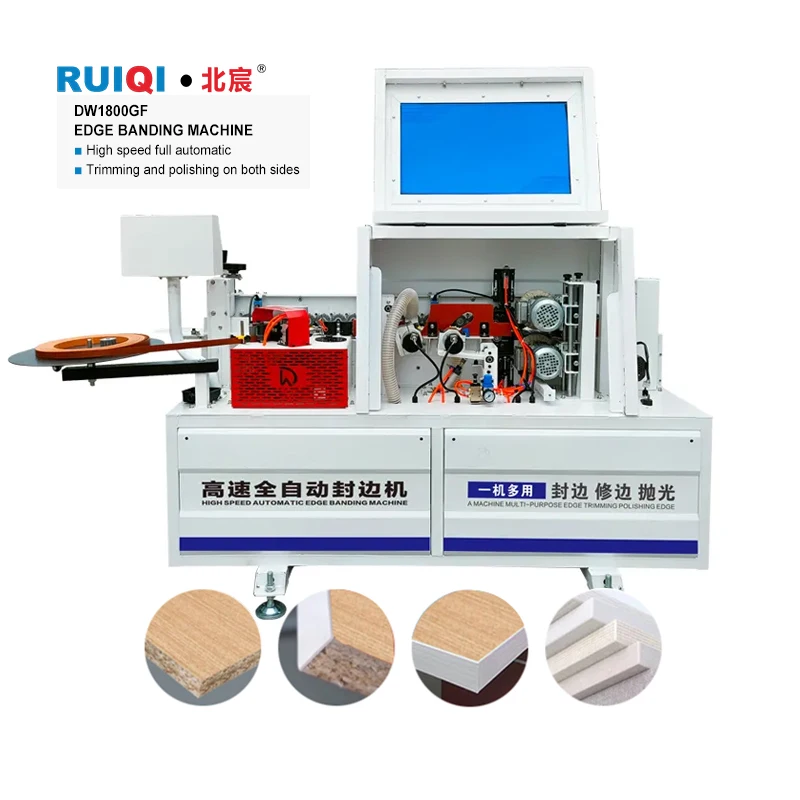
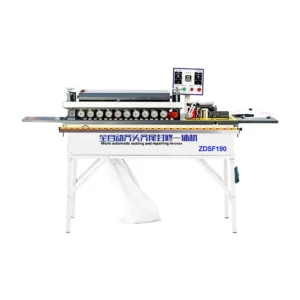
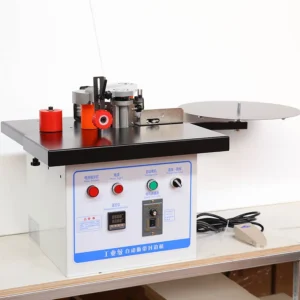
Compact Configuration, Full Capability — the DW1800 packs double-sided gluing, trimming, tracking, scraping, and polishing into a 220 cm footprint, arriving with voltage and control language confirmed for your workshop before dispatch.
Technical Specifications
| Parameter |
Value |
| Model |
DW1800 |
| Product Type |
Automatic Edge Banding Machine |
| Total Power |
4.9 kW |
| Voltage & Frequency |
380V / 220V / 415V |
| Control System |
Operation panel with Chinese and English; customizable to Spanish or other languages |
| Overall Dimensions (L×W×H) |
220 × 65 × 125 cm |
| Net Weight |
320 kg |
| Minimum Panel Length |
20 cm |
| Minimum Panel Width |
10 cm |
| Edge Banding Height |
0–50 mm |
| Edge Banding Thickness |
0.3–3 mm |
| Feed Speed |
0–14 m/min |
| Air Source Pressure |
0.4–0.6 MPa |
| Glue Pot Capacity |
4000 ml |
| Trimming Motor Power / Speed |
800 W × 2 / 24,000 r/min |
| Polishing Motor Power |
380 W × 2 |
| Vacuum Power |
550 W |
| Key Features |
Double-sided gluing, top/bottom trimming, front/rear alignment, profile tracking, flexible edge scraping, dust extraction |
| Guide Rail |
Roll-ball differential structure mobile table with oxidation-treated surface |
| Frame |
High-strength extruded aluminum alloy mobile workstations |
| Plug Options |
EU / USA / AU / UK |
| Assembly State |
Fully assembled |
Application Suitability
| Application |
Material or Output |
| Custom cabinet panel finishing |
MDF and particleboard with PVC edge banding |
| Small-batch furniture production |
Plywood panels with veneer or melamine banding |
| Joinery workshop edge processing |
Solid wood panels and ABB boards |
| Startup furniture operations scaling from manual edging |
PVC panels and organic glass plates |
Why the Language and Voltage Question Should Come Before the Quotation
An automatic edge banding machine for small workshop use that arrives with the wrong control language or incompatible voltage is dead weight on your floor until it is corrected — sometimes for weeks.
I once watched a Southeast Asian customer receive a fully automatic edge bander, only to find the entire control panel in Chinese. The operators could not read a single screen label, and commissioning stalled on day one. We had to push a multilingual firmware update overnight just to get the machine running. That kind of avoidable delay costs real money when you have orders waiting. Voltage mismatches are even worse — a machine wired for 380V/50Hz plugged into a 220V/60Hz supply will not simply underperform; it can damage motors and control boards before the first panel is edged [NEED_CITE: voltage and frequency standards by export market].

A Footprint That Fits Where You Actually Work
The DW1800 measures 220 × 65 × 125 cm and weighs 320 kg, meaning it sits on a standard workshop floor without requiring foundation work or a dedicated bay. For a joinery shop or startup furniture maker moving from hand-applied edging to an automatic edge banding machine for small workshop production, floor space is usually the first constraint. The extruded aluminum alloy frame keeps the unit stable during operation while staying light enough to reposition if your layout changes.
Full Function Set Without Switching Machines
This unit completes double-sided gluing, front and rear alignment, top and bottom trimming at 24,000 r/min, four-corner profile tracking, flexible edge scraping, and polishing — all in a single pass. Many compact edge banders on the market drop one or two of these stations to reduce cost, which forces the operator to finish edges by hand afterward. The DW1800 keeps the complete sequence intact, so a panel enters raw and exits ready for assembly or packing [NEED_CITE: CE machinery directive requirements for industrial equipment].
Reading the Numbers That Matter in Daily Production
The feed speed range of 0–14 m/min gives operators the flexibility to slow down for delicate veneer banding on plywood or speed up for standard PVC runs on particleboard. The 0.3–3 mm banding thickness range covers thin melamine strips through thicker PVC profiles used on cabinet carcasses. Glue pot capacity at 4000 ml means fewer refill interruptions during a batch run, which matters when you are edging forty or fifty panels in a single session. The trimming motors run at 24,000 r/min — fast enough to produce a clean cut on MDF without chipping the substrate edge, directly affecting how panels fit together during assembly.
The Hidden Cost of Choosing the Wrong Entry-Level Configuration
Buying a machine rated only for light duty and then feeding it production volumes it was never designed for leads to premature wear on guide rails, inconsistent trimming, and glue application failures. When tolerance drifts, panels stop fitting together cleanly in the assembly stage, and the rework cost compounds across every downstream operation. Equally common is the scenario where a workshop buys a single machine without checking feed height or throughput compatibility with existing saws and boring equipment, then discovers the bottleneck has simply moved rather than disappeared [NEED_CITE: common causes of edge banding machine downtime in small workshops].
Why Source This Unit Through This Channel
Voltage and plug configuration (EU, USA, AU, or UK) are confirmed with you before production begins, so the machine arrives ready to connect. The control panel language is set to match your operators — whether that is English, Spanish, or another agreed language — eliminating the commissioning stall I described earlier. A four-stage quality check covers incoming material, in-process assembly, finished product inspection, and pre-shipment verification with test records. Every unit ships with a formal specification sheet and electrical schematic so your local electrician can verify the circuit before the crate is opened. The product family includes larger models, so when your volume outgrows the DW1800, the transition stays within one supplier ecosystem.
Documentation & Verification
- CE declaration of conformity for the DW1800 edge banding unit
- Machine specification sheet with confirmed voltage and plug type
- Electrical schematic matching your workshop's supply configuration
- Factory test record on your specified panel material and banding thickness
- Operation and maintenance manual in your agreed operator language
- Spare parts list with recommended first-order consumables
Installation, Commissioning & Support
- Place the 220 × 65 cm unit on a level floor; no foundation bolts required at 320 kg
- Connect to confirmed 380V, 220V, or 415V supply on a dedicated 4.9 kW circuit
- Arrives fully assembled — position, level, and connect air source at 0.4–0.6 MPa
- First-run parameter setting for your panel thickness and banding material included
- Operator training covers the multilingual control panel and daily maintenance points
- Spare parts list provided with trimming cutters and polishing wheels identified
What We Need to Configure Your Machine
Send us your primary panel material (MDF, plywood, particleboard, or solid wood), the edge banding type and thickness you plan to run, and your workshop's local voltage and frequency. Let us know which plug standard applies and your preferred control panel language. If you have an existing production line upstream or downstream, share the feed height and throughput so we can confirm compatibility before the order is finalized.
Frequently Asked Questions
Q: How do I confirm the correct voltage and plug type for my workshop?
A: Before production starts, we provide an electrical schematic and voltage confirmation document for your local electrician to verify. The DW1800 supports 380V, 220V, or 415V configurations, and plug options include EU, USA, AU, and UK standards. Confirming this step early prevents the machine from arriving unusable on your floor.
Q: Can the control panel be set to my operator's language before delivery?
A: Yes. The standard panel ships in Chinese and English, and we configure it to Spanish or other agreed languages before the unit leaves the factory. This ensures your operators can read every screen label and parameter from the first day of production, avoiding the commissioning delays that come from language mismatches.
Q: What is the maximum panel thickness and edge banding thickness this machine handles?
A: The DW1800 processes edge banding from 0.3 mm to 3 mm thick, covering thin melamine strips through standard PVC profiles. The edge banding height range is 0–50 mm, suitable for most cabinet and furniture panel applications in MDF, plywood, and particleboard.
Q: How do I plan an upgrade path when my production volume outgrows this model?
A: The DW1800 sits within a product family that includes larger, higher-throughput models. When your batch sizes grow or you need additional processing stations, the transition stays within the same supplier and control system ecosystem, reducing the learning curve for your operators and simplifying spare parts inventory.
Q: What sample testing or factory visit options are available before I commit to an order?
A: You can send your own panel material and edge banding stock for a processing test, and we provide video or photographs of the results. Factory visits are also welcome, where you can observe the four-stage quality check process and see the DW1800 running under production conditions before placing your order.