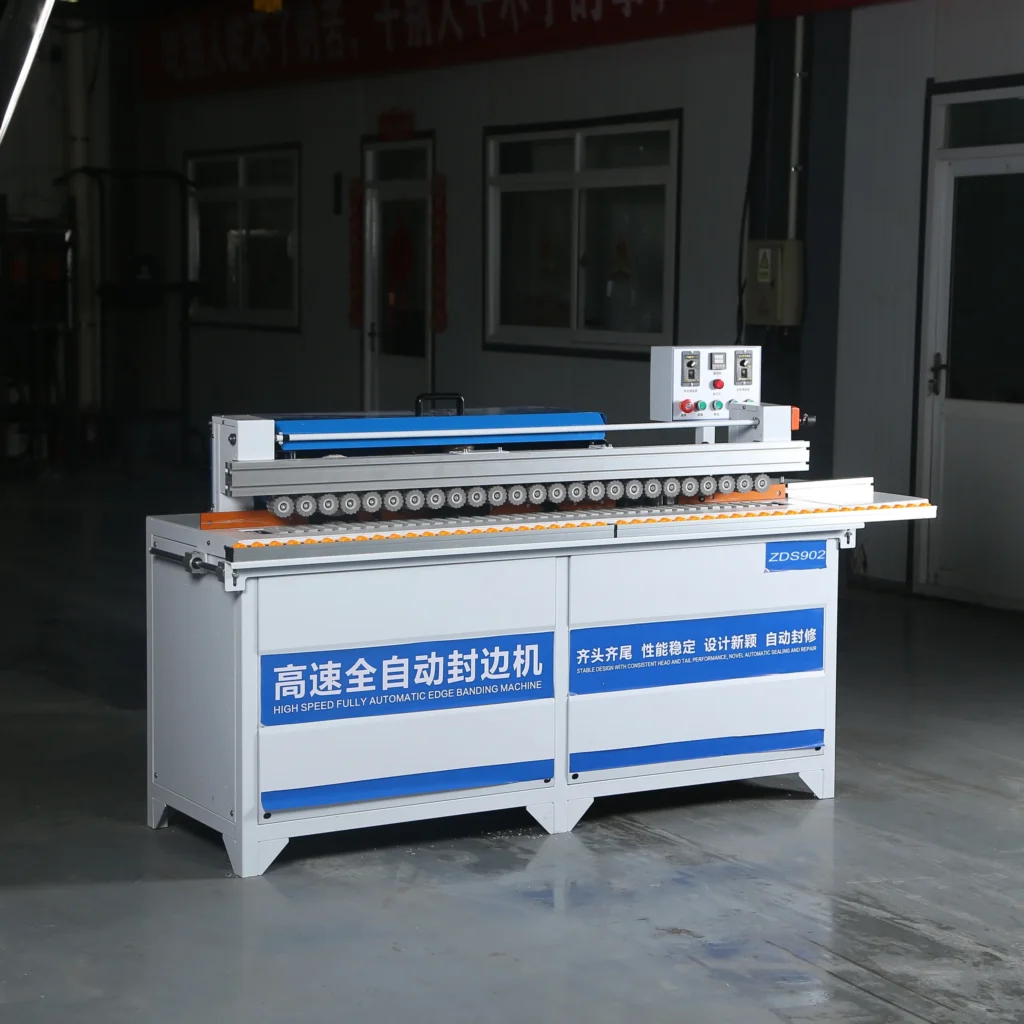
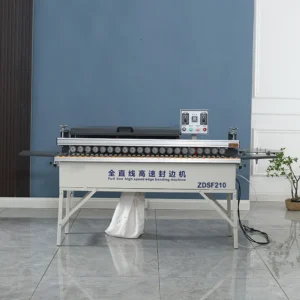
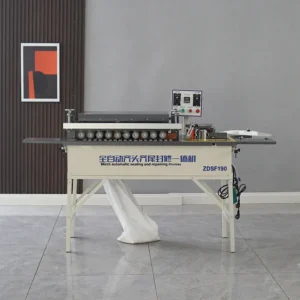
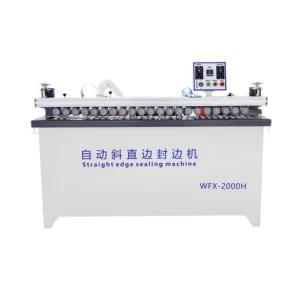
Compact readiness for small workshops — this entry-level edge bander is stocked and configured to ship quickly, avoiding the long wait times that stall workshop upgrades.
Technical Specifications
| Parameter |
Value |
| Product Type |
Automatic Edge Banding Machine |
| Voltage |
220V (basis not stated in source — confirm frequency and phase) |
| Equipment Size |
207 × 60 × 122 cm |
| Total Power |
4200W (rated or peak not specified in source) |
| Edge Banding Type |
Linear |
| Weight |
245 kg |
| Edge Band Height Range |
0–35 mm |
| Edge Band Thickness Range |
0.5–2.5 mm |
| Glue Pot Capacity |
4000 ml |
| Pressure Beam |
Integrated with double rows of pressure wheels, handle-adjustable |
| Conveyor Belt |
Silicone |
| Edge Strip Cutting |
Pneumatically controlled |
| Polishing |
Dual up-and-down polishing motors |
| Trimming |
Double high-speed trimming motors, up and down |
| Key Features |
Double-sided gluing, independent operating platform, intelligent temperature control, large capacity glue pot |
Application Suitability
| Application |
Material or Output |
| Custom cabinet door edge finishing |
MDF and particleboard with PVC edge banding |
| Small-batch wardrobe panel production |
Plywood and melamine-faced chipboard with veneer banding |
| Joinery workshop transition from manual trimming |
Solid wood panels up to 35 mm edge height |
| Startup furniture maker daily runs |
Low-to-medium volume board processing with 0.5–2.5 mm strip thickness |
Why Voltage Confirmation Must Come Before Dispatch
Specifying local voltage and frequency before the machine leaves the factory prevents costly commissioning dead-ends.
Single machines bought piecemeal often arrive to find the local grid does not match the motor winding. An Automatic Edge Banding Machine in stock may ship within days, but if the 220V configuration meets a 60 Hz supply when it was wound for 50 Hz, the feed motor runs at the wrong speed and the glue pot cannot maintain stable temperature. I have watched workshops sit on crated equipment for weeks while transformers were sourced locally [NEED_CITE: voltage and frequency standards by export market]. Confirming phase, frequency, and plug type during the order stage keeps the machine productive from day one.

Matching Footprint to Workshop Reality
Floor space in a startup joinery operation is always contested between saws, drills, and material racks. At 207 cm long and 60 cm wide, this Automatic Edge Banding Machine fits against a wall or between two workbenches without blocking the aisle a forklift needs. The 245 kg weight means two people and a pallet jack can position it — no overhead crane or reinforced slab required. Workshops that start with this compact footprint retain the option to add a second unit later or replace it with a higher-throughput model once daily panel counts justify the change.
The Upgrade Path Without Supplier Switching
Small workshops often buy an entry-level bander, outgrow it within two years, and then discover the next model up uses a different control interface, different spare parts, and a different glue system. Keeping the same product family means the operator already trained on this machine can step onto a full-function pre-milling model without relearning the HMI. The independent operating platform and intelligent temperature control on this unit mirror the logic flow used on higher-tier models, so the transition stays procedural rather than conceptual [NEED_CITE: woodworking machinery product family scaling].
How the Specifications Translate on the Shop Floor
The 0.5–2.5 mm edge band thickness range covers the two most common strip categories in custom furniture: thin PVC for carcass panels and thicker veneer for visible door faces. Switching between them requires adjusting the pressure beam via the handle — the double rows of pressure wheels distribute force evenly so thinner strips do not crush under roller marks. The 4000 ml glue pot holds enough adhesive for a sustained morning run without mid-batch refills that introduce temperature fluctuations. Pneumatically controlled edge strip cutting eliminates the manual guillotine step, keeping the operator's hands on the feed table and maintaining consistent panel spacing through the trimming zone.
When Entry-Level Becomes the Wrong Choice
A machine rated for low-to-medium daily volumes will show wear on its silicone conveyor belt and trimming motors well ahead of schedule if pushed into continuous two-shift production. The glue pot recovery time between panels lengthens as throughput exceeds its design envelope, leading to cold glue joints that fail during assembly. I have seen workshops blame the banding material when the real issue was feed speed exceeding what the pot could replenish. Matching the Automatic Edge Banding Machine to realistic daily panel counts avoids these hidden quality failures [NEED_CITE: edge banding machine duty cycle and component wear].
Why Procurement Through This Channel Works
Voltage customization from 110V to 440V is confirmed at the order stage, not discovered at the port of entry. Every unit ships with a factory test record run on the buyer's specified panel thickness and edge material. The operation and maintenance manual arrives in the agreed language so the operator can commission without waiting for a translator. Pre-shipment photographs document packing condition, and the engineer-led configuration recommendation ensures the machine matches the workshop's actual feed height and throughput rather than a theoretical maximum. Multilingual control panels are available so operators read instructions in their working language from the first day.
Documentation & Verification
- CE declaration of conformity covering machinery safety requirements
- Factory test record on buyer's specified panel thickness and edge material
- Electrical schematic confirming voltage, phase, and frequency at order
- Operation and maintenance manual in the agreed language
- Spare parts list with part numbers for consumables and wear items
Installation, Commissioning & Support
- Place on a level concrete floor; the 207 × 60 cm footprint requires only standard slab loading
- Connect to a dedicated 220V circuit matching confirmed phase and frequency
- Unit ships partially assembled; user manual and video guide cover final setup
- First run locks glue pot temperature and feed speed to buyer's edge material
- Silicone conveyor belt inspection and tension check included in weekly maintenance schedule
- Pneumatic cutting system requires standard workshop compressed air supply
What to Prepare Before Requesting a Quote
Send a sample of the panel material and edge banding strip you run most often so the machine can be tested against your actual substrate before dispatch. Specify your workshop voltage, phase, and frequency so the motor and heating elements are wound correctly at the factory. Confirming the languages your operators read ensures the control panel and manual match their working environment from the first shift.
Frequently Asked Questions
Q: What panel thickness range can this entry-level machine handle?
A: The machine accepts edge band heights from 0 to 35 mm and strip thicknesses from 0.5 to 2.5 mm, covering standard MDF, particleboard, and plywood panels used in custom cabinet and furniture production. The adjustable pressure beam adapts to different board thicknesses without tooling changes.
Q: How does feed speed match my current workshop output volume?
A: This Automatic Edge Banding Machine is configured for low-to-medium daily panel volumes typical of joinery workshops and startup furniture makers. Confirming your average daily panel count during the inquiry stage allows the engineer to verify that the feed speed and glue pot recovery cycle align with your production rhythm.
Q: What voltage options are available for my region?
A: Voltage is customizable from 110V to 440V, and phase and frequency are confirmed at the order stage. This ensures the motor winding, heating elements, and control system match your local grid without requiring external transformers on arrival.
Q: Can I move to a higher-capacity model later without changing supplier?
A: Yes. The control logic and operator interface on this entry-level unit share the same product family as full-function pre-milling models. Operators trained on this machine transition to higher-tier units with minimal retraining, and the supplier relationship and spare parts channel remain continuous.
Q: What assembly and installation support is included?
A: The machine ships partially assembled with a user manual and instructional video covering final setup. A factory test record verifies all functions before dispatch, and remote guidance is available during first-run commissioning to help lock in parameters for your specific edge material and panel stock.