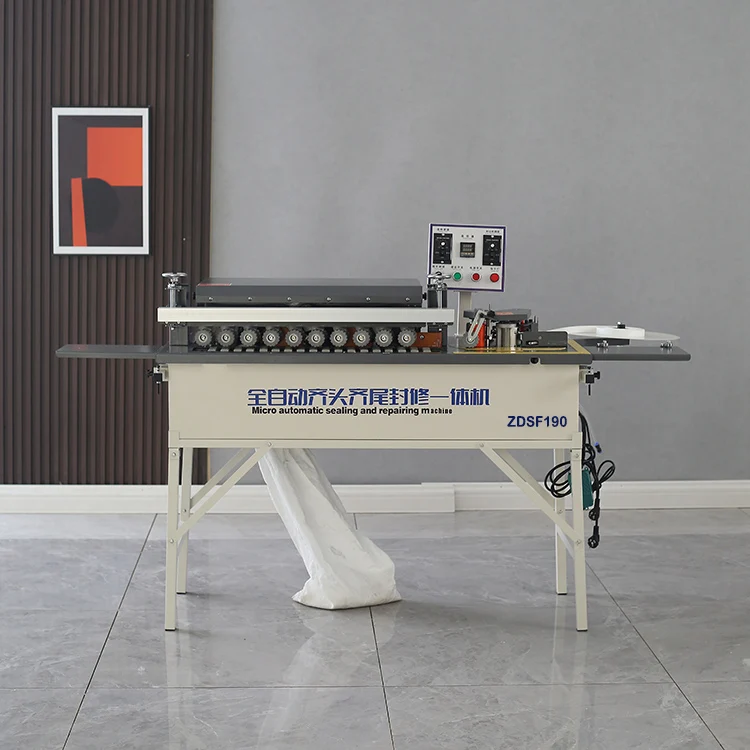
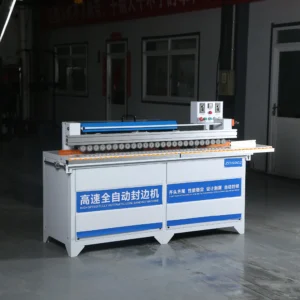
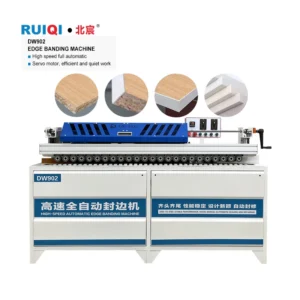
Fast Dispatch, Configured Right — Every ZDS 190 is voltage-verified before leaving our Shandong floor, so a 220V unit arrives ready to plug in, not waiting on a transformer.
Technical Specifications
| Parameter |
Value |
| Model |
ZDSF190 |
| Product Type |
Automatic Edge Banding Machine |
| Rated Voltage |
220V, 50Hz, Single-Phase |
| Total Rated Power |
4 kW |
| Feed Speed |
0–14 m/min |
| Sheet Thickness Range |
10–50 mm |
| Edge Strip Thickness |
0.5–2.5 mm |
| Glue Pot Capacity |
1000 ml |
| Overall Dimensions |
1900 × 560 × 1300 mm |
| Net Weight |
120 kg |
| Trimming Power |
800W × 2 |
| Polishing Power |
180W × 2 |
| Heating Power |
800W |
| Suction Power |
1200W |
| Control Interface |
Multi-function button operation panel |
| Pressure Beam |
Adjustable aluminum alloy |
| Trimming Cutter |
4-edge arc-shaped alloy cutter head |
| Feed Mechanism |
Double-row rubber pressure wheels, steel rod slide rails |
| Edge Type |
Curved and straight lines (switchable via 180° rotation) |
| Air Pressure Requirement |
0.4–0.6 MPa |
Application Suitability
| Application |
Material or Output |
| Custom cabinet door edge finishing |
MDF and plywood with PVC or veneer banding |
| Small-batch curved panel banding |
Particleboard and solid wood panels with curved profiles |
| Shelving and carcass panel sealing |
Straight-edge MDF and melamine-faced boards |
| Workshop transition from hand banding |
Mixed panel types at low to moderate daily volume |
Why the Voltage Question Must Come Before the Price
A machine that cannot plug into your shop's supply is not a bargain — it is a project.
I remember a ZDS 190-class unit shipped to a buyer who assumed 220V was standard everywhere in his region. His workshop ran on a different frequency, the heating element could not reach stable glue temperature, and the trimming motors tripped the breaker under load. The fix was not a simple swap; it required a custom transformer and three weeks of downtime while the shop floor sat idle [NEED_CITE: voltage and frequency standards by export market]. With an automatic edge banding machine in stock and ready to ship, the temptation is to click "order" before double-checking the electrical supply. That shortcut costs more than any price difference between suppliers. Confirming 220V 50Hz — or arranging a factory-side configuration change — is the single most important step before payment.

Single-Phase Power Opens the Door for Small Shops
Most entry-level workshops do not have three-phase industrial power installed. Running a 380V line demands permits, a new meter, and an electrician visit that can stretch into weeks. This automatic edge banding machine in stock is built for standard 220V single-phase supply at 50Hz, which means it plugs into the same outlet type as most of your existing equipment. The 4 kW total draw is manageable on a dedicated circuit without upgrading your entire panel.
Curved and Straight on One Frame
Shops with limited floor space often face a choice: buy a straight-line edge bander and outsource curved work, or buy both machines. The ZDS 190 solves this by allowing the operator to rotate the banding head 180° to switch between curved and straight modes [NEED_CITE: dual-purpose edge banding machine setup]. One machine handles arched cabinet doors and rectangular shelving panels in the same production run, which matters when you are quoting mixed jobs for custom furniture clients.
What the Specs Mean at the Workbench
The 10–50 mm sheet thickness range covers everything from thin MDF drawer sides to thick solid-wood tabletop panels, so you do not need to adjust or swap the feed system between common jobs. The 0–14 m/min variable feed speed lets operators slow down for tight curves and speed up on long straight runs. Dual 800W trimming motors paired with the 4-edge arc-shaped alloy cutter head produce a clean radius on curved edges — the kind of finish that avoids hand-sanding at the next station. Two 1200W vacuum devices capture the bulk of trimming debris before it settles on the glue pot or the freshly banded surface [NEED_CITE: dust extraction standards for woodworking machinery].
When the Wrong Configuration Ships to Your Floor
A compact 120 kg edge bander seems simple to install, but problems surface fast when assumptions go unchecked. If the air compressor in your shop cannot sustain 0.4 MPa at the machine's inlet, the pneumatic edge-strip cutter stalls mid-cycle and leaves ragged ends. If the operator panel is delivered in a language your crew cannot read, commissioning turns into guesswork, and the first batch of panels comes off with inconsistent glue lines and uneven trimming. These are not machine defects — they are configuration gaps that should have been caught before the crate left the factory.
Ordering with Your Shop in Mind
Every ZDS 190 we dispatch goes through a four-stage check that includes incoming material inspection, in-process assembly verification, a finished-product run on test panels, and a pre-shipment test documented with photos and a factory record. Voltage and frequency are confirmed against the buyer's written specification, not assumed from the destination country. The operation manual is prepared in the language you specify before production starts, and the packing photograph set shows your exact unit before the crate is sealed.
Documentation & Verification
- CE declaration matching the ZDSF190 configuration shipped
- Electrical schematic confirming 220V 50Hz wiring and breaker ratings
- Factory test record run on panels within your thickness range
- Operation manual translated into your specified language
- Spare parts list with reorder codes for trimmer cutters and pressure wheels
- Packing photographs of your serial-numbered unit before crating
Installation, Commissioning & Support
- Dedicated 220V circuit with adequate breaker capacity for the 4 kW total draw
- Compressed air line rated to sustain 0.4–0.6 MPa at the machine inlet
- Four leveling feet on the 1900 mm base to stabilize the 120 kg frame
- First-run parameter setting for glue temperature and feed speed on your material
- Trimming cutter alignment check on both curved and straight profiles before daily use
What to Tell Us Before You Order
To make sure the unit arriving at your dock matches your shop's reality, share your panel materials and typical thickness range, the voltage and frequency at your facility, and the language you need on the operation manual. If you already have a dust extraction system, let us know the port size so the 1200W vacuum connection integrates cleanly.
Frequently Asked Questions
Q: Can the ZDS 190 be configured for 110V or 60Hz markets?
A: Yes. Voltage and frequency are confirmed during the quotation stage. The factory can configure the heating element, motors, and control transformer to match 110V or 60Hz supplies. An electrical schematic reflecting your exact configuration is provided before shipment so your electrician can prepare the circuit.
Q: How do I switch between curved and straight edge banding mode?
A: The banding head rotates 180° on the machine frame to change modes. The adjustment is done by hand using the built-in positioning mechanism — no separate tools or disassembly required. The operator switches between curved cabinet doors and straight shelving panels within the same shift.
Q: What daily volume can this entry-level unit sustain?
A: The 0–14 m/min feed speed is suited to small-batch custom work and low-to-moderate daily runs. When your order volume grows to the point where operators are running the machine continuously for full shifts, that is the signal to discuss a higher-throughput model from the same product family.
Q: What spare parts ship with the machine?
A: Each unit includes a spare parts kit matched to the ZDSF190, covering high-wear items like pressure wheel surfaces and glue pot seals. The packing list details every included item. Consumables such as the 4-edge arc-shaped alloy trimming cutters are listed with reorder codes for future purchases.
Q: Is the control panel available in my local language?
A: The multi-function button operation panel label and the accompanying manual are prepared in your specified language before the machine ships. This is confirmed during the quotation and specification review stage, so there are no surprises when you uncrate the unit.