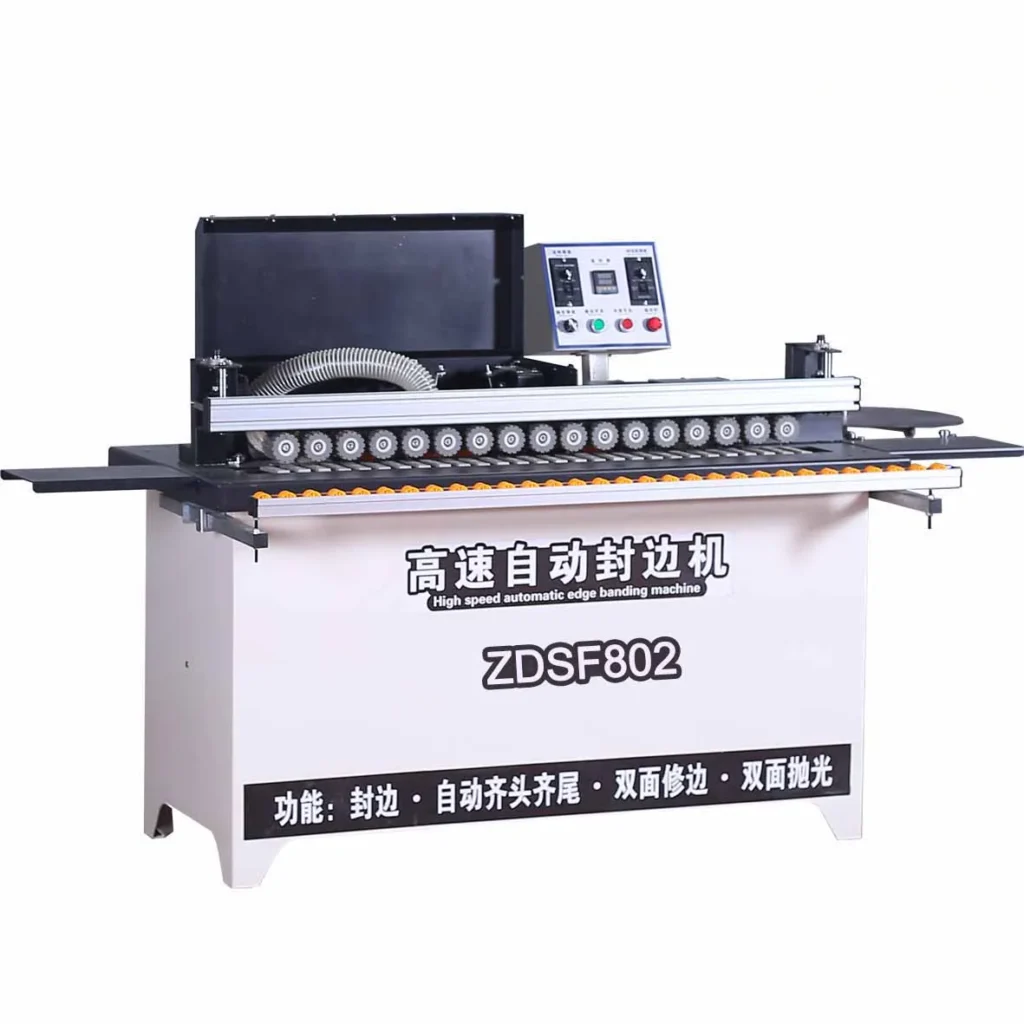
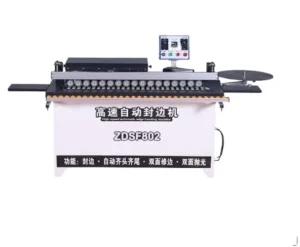
Ready stock dispatch — this compact 220V automatic edge banding machine ships with a pre-tested 4000ml glue pot and integrated dust extraction, so small workshops can commission it the day it arrives.
Technical Specifications
| Parameter |
Value |
| Model |
ZDSF802 |
| Product Type |
Automatic Edge Banding Machine |
| Edge Type |
Straight line |
| Rated Voltage |
220V |
| Rated Power |
4 kW |
| Trimming Power |
800 W × 2 |
| Polishing Power |
180 W × 2 |
| Heating Power |
1000 W (heat-up time 5–10 min) |
| Suction Power |
1200 W (built-in dust collector) |
| Feed Speed |
0–10 m/min |
| Conveyor Belt Speed |
0–10 m/min |
| Strip Thickness Range |
0.5–2.5 mm |
| Sheet Thickness Range |
10–50 mm |
| Glue Pot Capacity |
4000 ml |
| Rated Air Pressure |
0.4–0.6 MPa |
| Conveyor Belt Material |
Silicone |
| Pressure Beam |
Integrated, double-row pressure rollers |
| Edge Band Breaking Method |
Pneumatically controlled |
| Control System |
Digital display glue pot temperature, independent switch panel |
| Assembly State |
Partially assembled, extendable fluent strips for large plate support |
| Overall Dimensions (L×W×H) |
130 × 65 × 75 cm |
| Machine Weight |
150 kg |
| Certification |
CE |
Application Suitability
| Application |
Material or Output |
| Small cabinet workshop batch runs |
MDF and plywood panels with PVC edge banding |
| Joinery startup straight-line edging |
Particleboard and veneer strips 0.5–2.5 mm |
| Custom furniture prototyping |
Solid wood panels up to 50 mm thickness |
| Compact workshop daily production |
Mixed panel types in short to medium runs |
Why the Voltage Question Should Come Before Everything Else
A 220V machine that matches your supply is one that actually runs on day one — not one sitting in a crate while you source a transformer.
I have seen small workshop owners lose entire commissioning windows because the Automatic Edge Banding Machine in stock they ordered arrived configured for a voltage their facility does not carry. The frustration is not the machine itself — it is the silence between unboxing and first cut. For a joinery startup trying to fulfill its first real orders, that dead time costs more than the equipment. [NEED_CITE: voltage and frequency standards by export market]
This ZDSF802 ships at a fixed 220V single-phase rating. Before you place the order, confirm your workshop's outlet matches both the voltage and the frequency. It sounds basic, but skipping that check is the single most common reason entry-level machines sit idle after delivery.

What "Ready to Ship" Actually Means for a Small Workshop
When a small joinery business decides to move from hand-held edge banding to an automatic process, the gap between ordering and running production needs to be as short as possible. This Automatic Edge Banding Machine in stock configuration arrives partially assembled with extendable fluent strips already fitted, so you unfold the support rails, connect the air line, and begin test runs within hours rather than days.
The digital temperature display on the glue pot eliminates guesswork during first-time setup. You set the target, watch it climb, and start feeding panels once the reading stabilizes — no manual thermostat fiddling, no burnt glue from overshooting.
The Footprint Reality in a Tight Workshop
A 130 × 65 × 75 cm footprint with a 150 kg weight means this machine can be pushed into position by two people and does not require a reinforced floor or a forklift. For workshops operating in rented spaces or converted garages, that physical flexibility matters. The built-in 1200 W dust collector means you are not also finding room for a separate extraction unit or routing ductwork across the ceiling.
The silicone conveyor belt and double-row pressure rollers hold panels flat without scratching laminate or veneer surfaces — something operators using improvised manual setups learn the hard way when finished panels come back with feed marks. [NEED_CITE: CE machinery directive requirements for edge banding equipment]
Reading the Specs That Actually Affect Your Output
The 10–50 mm sheet thickness range covers most standard panel stock used in cabinet and furniture work, but it also reveals the machine's intended duty cycle. Panels at the thin end of that range (10–12 mm MDF) require steady conveyor grip and consistent pressure beam force to avoid chatter during trimming — the integrated double-row pressure rollers address this directly.
The 0–10 m/min variable feed speed lets operators slow down for thicker PVC strips that need more glue contact time, then speed up for thin veneer on standard 18 mm particleboard. Two 800 W trimming motors handle head and tail cuts in a single pass, while the 180 W × 2 polishing units clean up the edge profile. The 4000 ml glue pot capacity reduces refill interruptions during a batch run — a practical advantage over smaller pots that force operators to stop mid-job and wait for fresh glue to reach temperature.
What Happens When You Skip the Material Check
I once helped a startup cabinet maker who bought an entry-level edge bander without confirming their thinnest panel stock fell outside the machine's working range. The thin MDF sheets vibrated against the pressure beam during feeding, producing visible glue lines and uneven trimming on every piece. The machine was not defective — it was simply asked to do something it was not configured for. [NEED_CITE: edge banding quality tolerance on mixed panel thickness]
With the ZDSF802, confirming your actual sheet thickness range (10–50 mm) and strip material (PVC, veneer, 0.5–2.5 mm) before ordering avoids that mismatch entirely. This is the kind of detail that seems minor in a catalog but becomes the entire conversation once production starts.
Why Source This Model Through This Channel
The ZDSF802 ships from stocked inventory, so a single-unit order does not wait for a production slot to open up. Small workshops ordering their first Automatic Edge Banding Machine in stock benefit from this because their timeline is driven by customer orders, not factory schedules.
Voltage confirmation happens before dispatch — not after the machine arrives and fails to power on. A pre-shipment test record documents that the glue pot reaches temperature, the conveyor runs true, and the trimming motors cut clean.
Custom language options for the operation manual and control labels mean the operator reading the display speaks the language on it. Pneumatically controlled band breaking and extendable fluent strips are fitted as standard, not listed as optional extras that inflate the final configuration.
Documentation & Verification
- CE declaration of conformity matching this machine class
- Factory test record covering glue pot heat-up and trim quality on your panel thickness
- Electrical schematic with confirmed 220V wiring diagram
- Operation manual in the language your operator reads
- Spare parts list for trimming blades, polishing wheels, and belt components
Installation, Commissioning & Support
- Requires a dedicated 220V single-phase circuit rated for the 4 kW total load
- Pneumatic connection at 0.4–0.6 MPa with clean, dry compressed air supply
- Partially assembled state: extend fluent strips and connect air before first run
- Digital glue pot display allows temperature verification within the 5–10 minute heat-up window
- Silicone conveyor belt inspection and pressure roller alignment before initial panel feed
- Built-in 1200 W dust collector needs no external ducting — plug in and run
What We Need From You to Confirm the Right Fit
Tell us your primary panel material (MDF, plywood, particleboard, or solid wood), the sheet thickness range you run most often, and the edge banding strip type and thickness. Confirm your workshop's available voltage and frequency at the outlet where this machine will sit. If you are replacing an existing manual process, describe your current daily panel volume so we can verify this feed speed range matches your throughput expectation.
Frequently Asked Questions
Q: What voltage does this machine require and how do I confirm compatibility?
A: The ZDSF802 runs on 220V single-phase power at 4 kW total rated load. Before ordering, verify that your workshop outlet supplies 220V at the correct frequency. We confirm voltage compatibility during the quotation stage so the machine arrives ready to plug in without additional transformers or rewiring.
Q: How long can the 4000 ml glue pot run before needing a refill?
A: Capacity depends on strip width, panel feed rate, and glue application thickness. In typical small-workshop batch runs at moderate feed speed, the 4000 ml pot provides enough adhesive for continuous processing through a standard work session before topping up is needed. The digital temperature display maintains consistent glue viscosity throughout.
Q: What is the typical dispatch timeline for a single-unit order?
A: This model is held as Automatic Edge Banding Machine in stock inventory for fast dispatch. Single-unit orders are prepared, tested, and crated from existing stock rather than queued behind a production schedule. Exact shipping timelines depend on destination and freight method selected at order confirmation.
Q: Can the manual and control labels be provided in my operator's language?
A: Yes. The independent switch panel and operation manual can be configured in the language your workshop staff reads. This is confirmed during the ordering process so the machine arrives with documentation your operator can follow on day one without translation delays.
Q: Which panel materials and edge band types work with this machine?
A: The ZDSF802 handles MDF, plywood, particleboard, and solid wood panels from 10 to 50 mm thickness. Compatible edge banding includes PVC and veneer strips between 0.5 and 2.5 mm thick, applied in straight-line configuration with pneumatic band breaking for clean head and tail cuts.