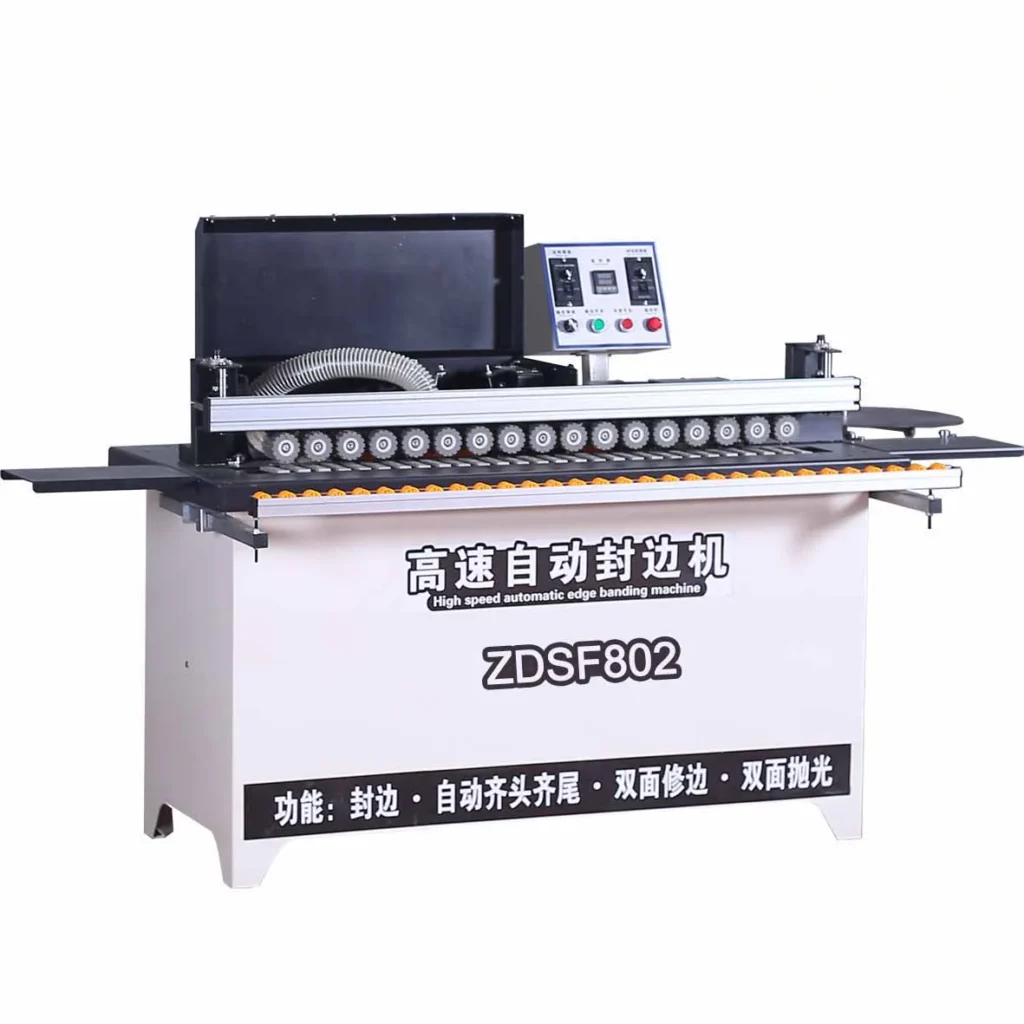
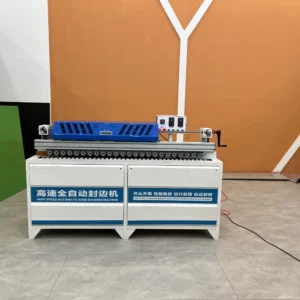
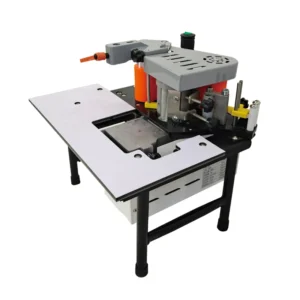
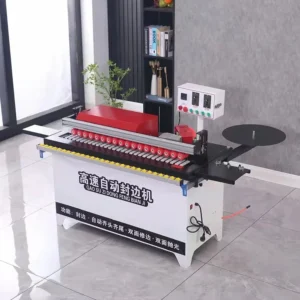
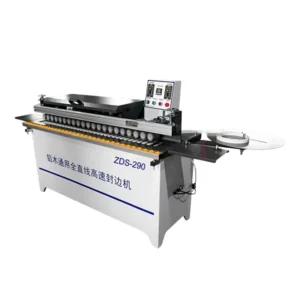
Fast Dispatch Configuration — stocked compact footprint and standard 220V setup ready for small workshops seeking an immediate automatic edge banding solution without waiting for custom builds.
Technical Specifications
| Parameter |
Value |
| Model |
ZDS802 |
| Product Type |
Automatic Edge Banding Machine |
| Edge Type |
Straight line |
| Rated Voltage |
220V (basis not stated in source — confirm frequency and phase) |
| Rated Power |
4 kW |
| Trimming Power |
800 W × 2 |
| Polishing Power |
180 W × 2 |
| Suction Power |
1200 W |
| Heating Power |
1000 W (5-10 min heat-up) |
| Feed Speed |
0-10 m/min |
| Strip Thickness |
0.5-2.5 mm |
| Sheet Thickness |
10-50 mm |
| Glue Pot Capacity |
4000 ml |
| Rated Air Pressure |
0.4-0.6 MPa |
| Overall Dimensions |
130 × 65 × 75 cm |
| Machine Weight |
150 kg |
| Key Features |
Digital temperature display, independent switches, integrated dust collector, extendable fluent strips, pneumatically controlled belt breaking |
Application Suitability
| Application |
Material or Output |
| Cabinet door and carcass panel edging |
MDF and particleboard with PVC edge banding |
| Custom furniture small-batch production |
Plywood panels with veneer or melamine strips |
| Joinery workshop first automation step |
Solid wood panels up to 50 mm thickness |
| Straight-line component finishing |
Boards requiring trim and polish in a single pass |
Why Workshop Door Width Matters More Than Feed Speed
A machine that cannot physically enter your shop floor is a machine that never runs.
I once helped a custom cabinet maker source an edge bander very similar to this ZDS802 class. We confirmed voltage, checked the panel thickness range, verified the glue pot capacity, and finalized everything on paper. Then the machine arrived at their workshop and the main door was ten centimeters too narrow for the forklift. They ended up removing the door frame entirely to get the unit inside. That single oversight cost them a full day of production and structural repair work. Before you evaluate feed speeds or polishing stations, measure every doorway, corridor turn, and elevator clearance on the delivery path. [NEED_CITE: industrial equipment delivery access requirements for small workshops]
An automatic edge banding machine in stock for fast delivery solves the waiting problem, but it only works if the physical dimensions match your space. At 130 × 65 × 75 cm and 150 kg, this unit is compact enough for most ground-floor joinery shops, but verifying the route from the truck to its final position prevents costly surprises on delivery day.

Smallest Viable Setup for First-Time Automation
Transitioning from manual edge banding to an automatic process does not require filling an entire production hall. The ZDS802 occupies roughly one square meter of floor space, making it practical for workshops where every meter counts. The extendable fluent strips support larger panels when needed yet fold away when space is tight, giving operators flexibility without demanding permanent conveyor runs.
For a joinery startup processing custom cabinet doors and shelving panels, this automatic edge banding machine in stock configuration covers the essential sequence: plate feeding, end cutting, trimming, and polishing in a single pass. The integrated dust collector means you do not need to route ductwork to a central extraction system before the first production run.
Reducing Operator Dependency Through Mechanical Stability
Small workshops often have one or two skilled operators who cannot afford to babysit every panel through the feed zone. The integrated pressure beam with double rows of pressure wheels holds boards flat against the silicone conveyor belt, minimizing the lateral drift that causes uneven edge adhesion. This mechanical stability matters most when processing thinner MDF sheets that tend to flex under manual guidance.
The pneumatically controlled belt breaking system stops the feed without requiring the operator to reach for an emergency lever mid-cycle. Combined with independent function switches on the digital control panel, a less experienced worker can manage the machine safely after basic training. [NEED_CITE: operator training requirements for entry-level woodworking machinery]
How the Numbers Translate on the Shop Floor
The 10-50 mm sheet thickness range covers the majority of panel stock used in cabinet and furniture production, from 10 mm MDF shelving to 50 mm solid wood worktops. Running boards outside this range risks poor adhesion at the thin end or conveyor stall at the thick end. The 0.5-2.5 mm strip thickness accommodates both thin PVC for visible surfaces and thicker veneer for premium finishes.
Feed speed at 0-10 m/min gives operators control over throughput based on glue open time. At the lower end of the speed range, the 1000 W heating element maintains stable glue temperature across the 4000 ml pot, which is important when processing short batches where the glue would otherwise cool between panels. The dual 800 W trimming motors handle both sides of the panel simultaneously, reducing the chance of asymmetric edge profiles that cause assembly fit issues downstream.
The 0.4-0.6 MPa air pressure requirement is standard for most workshop compressors, but confirming your compressor can sustain this range continuously — not just at peak — prevents pressure drops that cause incomplete trimming or belt slipping mid-panel.
What Happens When the Voltage Does Not Match
Ordering a 220V machine for a region running on different frequency or phase configuration is one of the most common procurement mistakes in small workshop equipment. The unit arrives, gets wired in, and either fails to start or runs with enough voltage instability to damage the heating element and trimming motors within the first week. The repair cost and downtime typically exceed whatever time savings the fast delivery offered in the first place.
Equally problematic is a control panel in a language the operator cannot read. A digital temperature display is only useful if the person setting the glue pot understands the units and alarm codes. These are not cosmetic preferences — they directly determine whether the machine produces acceptable edges or wastes material on its first day. [NEED_CITE: voltage and frequency standards by export market]
What This Configuration Delivers at Point of Order
The four-stage quality control process — incoming material, in-process, finished product, and pre-shipment verification — means the unit you receive has been tested before it leaves the factory floor, not just assembled and boxed.
Voltage customization from 110V to 440V and multilingual control panel options are available as standard configurations, so the machine arrives matched to your local electrical infrastructure and operator language from the first day.
The full product family ranges from this entry-level model to higher-throughput units, allowing your workshop to scale production volume without switching to a different supplier or learning a new control system.
Patented cutting mechanisms and precision-ground components maintain trim accuracy within the tolerance band, which matters when panels move directly from edge banding to assembly without intermediate rework.
An engineer reviews your workshop layout, panel specifications, and production targets before confirming the configuration, with a formal quotation provided within one working day.
Documentation & Verification
- Factory test record run on your specified panel thickness and edge strip material before dispatch
- CE declaration of conformity confirming machinery directive compliance for import clearance
- Electrical schematic with confirmed voltage and phase matching your local supply
- Operation and maintenance manual in your chosen language with illustrated adjustment procedures
- Spare parts list identifying wear items and recommended replacement intervals
- Pre-shipment packing photographs documenting machine condition before crating
Installation, Commissioning & Support
- Confirm floor-level placement with 130 × 65 × 75 cm clearance plus operator standing zones on both sides
- Provide a dedicated 4 kW circuit with correct voltage and frequency as confirmed on the electrical schematic
- Unit ships requiring assembly; user manual and video teaching materials guide the setup sequence
- First-run glue pot temperature calibration and feed speed adjustment supported by remote engineering guidance
- Pneumatic connections require a stable 0.4-0.6 MPa supply with inline filtration for cylinder longevity
- Silicone conveyor belt and pressure wheel inspection included in weekly maintenance routine
What to Prepare Before Requesting a Quotation
Send the specific panel materials you process most often — MDF, particleboard, plywood, or solid wood — along with typical sheet dimensions and the edge strip types you use. Confirm your workshop voltage, frequency, and phase so the electrical system is configured correctly before production. If your facility has restricted access for delivery, provide doorway widths and any overhead clearance limits so the logistics plan accounts for them upfront.
Frequently Asked Questions
Q: Can this machine run on a different voltage or frequency than 220V?
A: Yes, the manufacturer configures voltage from 110V to 440V based on your local supply. You must confirm the exact voltage, frequency in hertz, and single or three-phase requirement before the order is finalized. This ensures the heating element, motors, and control panel are all matched to your electrical infrastructure from day one.
Q: How do I know if the ZDS802 matches my daily production volume?
A: With a feed speed of 0-10 m/min and a sheet thickness range of 10-50 mm, this unit suits small-batch custom furniture and cabinet door production. Assess your average panel perimeter and available operating hours to determine realistic daily throughput. If your volume requires continuous high-speed operation, a higher-tier model in the same product family may be more appropriate.
Q: What are the physical access requirements for delivery and installation?
A: The machine measures 130 × 65 × 75 cm and weighs 150 kg. Measure every doorway, corridor, and gate on the path from the delivery truck to the final installation point. You also need a stable 0.4-0.6 MPa compressed air supply and a dedicated electrical circuit matching the confirmed voltage rating.
Q: Which edge strip materials work with this edge bander?
A: The ZDS802 handles PVC and veneer edge banding from 0.5 to 2.5 mm thickness on straight-line applications. Glue pot temperature settings vary depending on the strip material and backing type. Confirm your specific edge strip specifications so the correct glue type and temperature range are established before your first production run.
Q: How quickly can the machine be ordered and delivered?
A: Stocked configurations of this automatic edge banding machine are available for fast dispatch compared to fully custom-built units. Lead time depends on current inventory and your configuration requirements, including voltage and control panel language. Request a quotation with your specifications to receive a confirmed dispatch schedule.