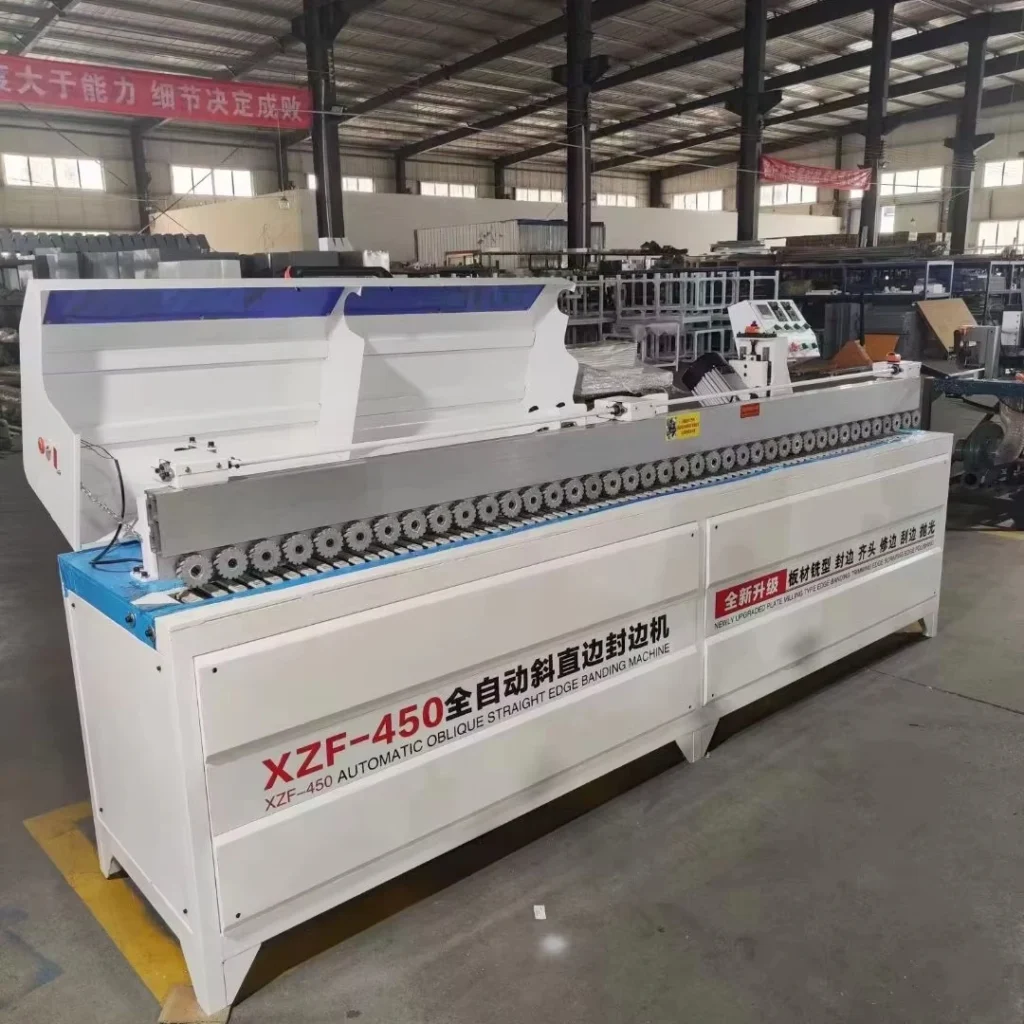
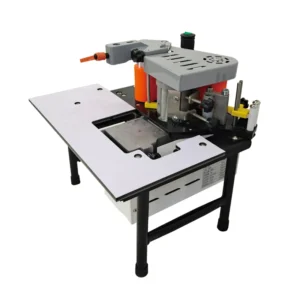
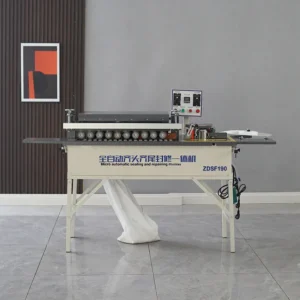
Ready-stock dispatch with verified voltage — This bevel and straight edge banding machine ships only after your local electrical supply is confirmed in writing, eliminating the arrive-and-find-it-unusable scenario that stalls small workshops.
Technical Specifications
| Parameter |
Value |
| Model |
XZF450 |
| Product Type |
Bevel and Straight Edge Banding Machine |
| Function Stations |
Gluing, End Cutting, Trimming, Scraping, Buffing |
| Edge Shape Capability |
30° / 45° / 60° bevel; 90° straight |
| Pre-milling |
Shape cutter included |
| Total Power |
9.5 kW |
| Voltage |
380V (220V available on customization) |
| Feed Speed |
0–12 m/min |
| Board Thickness Range |
0–50 mm |
| Strip Thickness Range |
0.5–3 mm |
| Glue Pot Capacity |
4000 ml |
| Overall Dimensions |
300 × 65 × 135 cm |
| Net Weight |
430 kg |
| Control Interface |
Control panel (type to be confirmed at order) |
Application Suitability
| Application |
Material or Output |
| Custom cabinet edge finishing |
MDF and particleboard with PVC or veneer banding |
| Bevel-edge modern furniture profiles |
Plywood panels at 30°/45°/60° angles |
| Small-batch joinery production |
Straight 90° edge on boards up to 50 mm thick |
| Workshop transition from manual edging |
Consistent glued, trimmed and buffed output |
Why the Voltage Question Should Come Before the Price on a Bevel and Straight Edge Bander
Confirming voltage and frequency in writing before shipment prevents the most common commissioning failure in cross-border machinery trade.
I spent years on service calls in Latin America where workshops had machines sitting idle for weeks because the quoted unit arrived wired for a supply that did not match the local grid. The bevel and straight edge banding machine in stock you see listed at a competitive price becomes an expensive floor anchor when the motor hums but will not turn under load. This XZF450 unit requires 380V three-phase as standard, and 220V configurations must be specified and built before dispatch — not reconfigured on-site by an electrician guessing at internal transformer taps [NEED_CITE: voltage and frequency standards by export market].

Compact Footprint, Full Station Coverage
A 300 cm machine length at 430 kg means this unit fits the floor space a small joinery shop can actually spare. The five function stations — gluing, end cutting, trimming, scraping and buffing — deliver a finished edge in a single pass, which matters when you are running cabinet sides in batches of twenty rather than two thousand.
Multi-Angle Bevel Without a Second Machine
Switching between 30°, 45° and 60° bevel profiles and a standard 90° straight edge happens on the same feed bed. For a workshop taking on custom furniture orders that mix modern angled profiles with conventional square edges, this eliminates the capital outlay and floor space of a dedicated bevel-only unit [NEED_CITE: bevel edge banding setup requirements for small workshops].
What the Spec Sheet Numbers Mean on the Shop Floor
The 0–50 mm board thickness range covers everything from 16 mm melamine-faced chipboard up to 50 mm solid-core doors, which is the practical span a custom cabinet shop encounters daily. Feed speed variable from 0 to 12 m/min lets the operator slow down for difficult substrates — melamine chips at high feed rates if the pre-milling cutter is not engaged correctly. The 4000 ml glue pot holds enough EVA adhesive for a full shift of intermittent runs without constant refills, and the included pre-milling shape cutter scores the panel edge before gluing to remove saw marks that would otherwise telegraph through thin PVC banding. Total power draw at 9.5 kW stays within the capacity of a small workshop's existing electrical supply without requiring a dedicated high-amperage circuit upgrade.
The Cost of Skipping Pre-Shipment Verification
Machines ordered without a factory test on the buyer's actual panel thickness and edge strip material arrive with settings calibrated for whatever the factory had on hand that morning. The operator then spends days chasing glue-line gaps and trimming chatter, blaming the machine when the issue is unverified configuration. For a small shop where this edge bander is the only one on the floor, downtime is not an inconvenience — it is a stopped production line [NEED_CITE: edge banding commissioning failures from unverified settings].
Why Source This Unit Here
- Voltage and frequency confirmed in writing before production begins, matching your local grid specification.
- Single-unit orders accepted with no minimum quantity, so a workshop adding its first edge bander is not forced into a container load.
- Pre-shipment test record included in the documentation pack, showing the machine ran on your specified board thickness and strip material.
- Operation and maintenance manual provided in the language your operator reads, not a generic English-only printout.
- Full product family available for future expansion — when volume grows, upstream panel saws and downstream boring machines integrate without changing supplier.
Documentation & Verification
- Factory test record on your specified panel thickness and edge strip before dispatch
- Electrical schematic confirming ordered voltage and frequency configuration
- Operation and maintenance manual in agreed operator language
- Spare parts list with part numbers for consumables and wear items
- Packing photographs taken before crate closure for freight claims
Installation, Commissioning & Support
- 300 × 65 cm footprint requires a level concrete floor with 135 cm overhead clearance for dust extraction hookup
- 9.5 kW total draw at 380V three-phase demands a dedicated circuit with correctly rated breaker before arrival
- Machine ships assembled; position, level the four feet, connect power and dust hose — no sub-assembly required
- First-run parameter setting covers glue temperature, feed speed and trimming depth for your specific board and strip combination
- Pre-milling cutter and trimming blades are the primary wear items; replacement schedule included in the manual
Before You Send an Inquiry
Provide your local voltage and frequency so the electrical configuration is locked before production starts. Include the panel materials you run most often — MDF, particleboard or plywood — along with typical board thickness and the edge strip material and width, so the pre-shipment test mirrors your actual workload. If you are adding this as a first machine in a growing line, mention your floor space and any upstream saws already on site so feed height compatibility is confirmed.
Frequently Asked Questions
Q: Can I order a single XZF450 unit, and what is the typical dispatch lead time from stock?
A: Single-unit orders are accepted without minimum quantity requirements. Stocked configurations dispatch quickly; custom voltage or language orders require a short production window. Confirm your specification early to lock your build slot.
Q: How do I confirm the correct voltage and frequency for my country before shipping?
A: State your local supply voltage, phase and frequency in your initial inquiry. The factory provides written confirmation of the electrical configuration before production, and the final schematic is included in your documentation pack.
Q: What panel materials and edge strip thicknesses does this machine handle day-to-day?
A: MDF, particleboard and plywood panels from 0 to 50 mm thick, with PVC or veneer edge strips from 0.5 to 3 mm. The pre-milling cutter prepares melamine and laminate faces for clean glue adhesion.
Q: How does the bevel angle changeover work on the XZF450?
A: Angle selection between 30°, 45°, 60° bevel and 90° straight is set at the edge shaping station. The exact adjustment method — manual fixture swap or dial-in — should be confirmed with the engineer during specification.
Q: What spare parts ship with the machine, and how are replacements ordered?
A: A spare parts list with part numbers for pre-milling cutters, trimming blades and scrapers is included. Replacements are ordered directly from the factory using those part numbers.