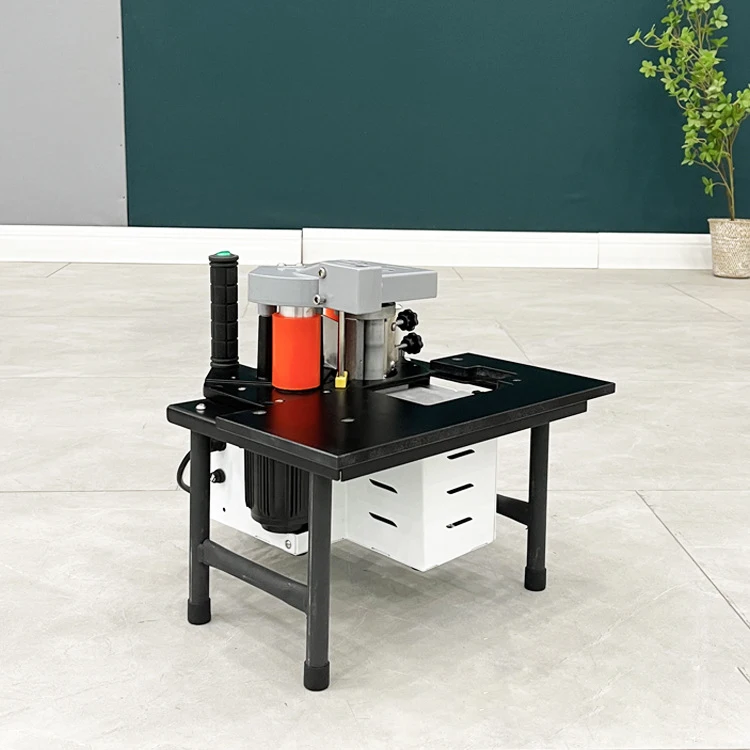
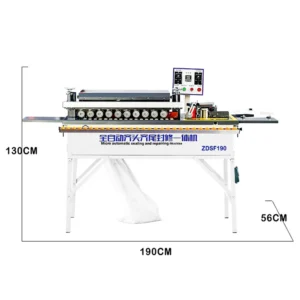
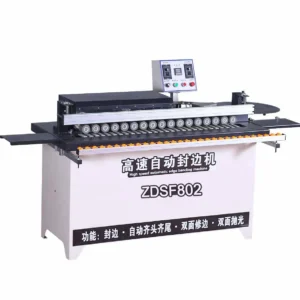
Compact Footprint, Immediate Dispatch — stocked portable edge bander units ship with matched plug configurations, reducing commissioning delays for small workshops ordering their first powered machine.
Technical Specifications
| Parameter |
Value |
| Product Type |
Portable Edge Bander |
| Edge Banding Shape Compatibility |
Curved, straight and special-shaped sheet |
| Edge Thickness Range |
0.3–3mm |
| Edge Sealing Speed |
0–6m/min |
| Edge Sealing Height |
7–60mm |
| Gluing Method |
Double-sided gluing |
| Glue Pot Volume |
1000ml |
| Net Weight |
14kg |
| Power Supply Options |
EU / AU / UK / USA / CN plug available (basis not stated in source — confirm voltage & frequency) |
| Control System |
Manual / portable operation (basis not stated in source — confirm control type) |
| Assembly State |
Ready to use (basis not stated in source — confirm out-of-box readiness) |
| Warranty |
One year |
Application Suitability
| Application |
Material or Output |
| Joinery workshop first-machine edge sealing |
MDF and plywood panels with PVC edge band |
| On-site curved profile banding |
Special-shaped cabinet doors and radius panels |
| Small-batch cabinet production |
Particleboard shelving with 0.3–3mm veneer or PVC |
| Field installation touch-up work |
Pre-cut boards requiring portable re-banding on site |
Why the Voltage Question Must Come Before the Plug Shape
A matching plug does not guarantee the motor will run at the correct speed or torque.
I have watched workshops receive portable edge banders with the right plug shape but wrong internal winding, only to find the glue pot never reaches bonding temperature and the feed motor stalls under load. The plug is just the physical interface; the voltage and frequency inside the machine determine whether the heating element and drive motor behave as designed. When a portable edge bander in stock ships without confirming your local supply, you risk a unit that powers on but cannot maintain consistent glue viscosity [NEED_CITE: voltage and frequency standards by export market]. Asking for a wiring schematic before dispatch avoids a machine that sits idle until a transformer arrives.

Stock Availability and Dispatch Timing
Workshops transitioning from hand-applied edge banding need a machine that arrives quickly and runs without a factory technician on site. This portable edge bander in stock is configured for light-duty, intermittent use where a full automatic line would consume floor space the shop does not have. The 14kg net weight keeps it manageable for one person to move between benches or load into a van for field work.
Matching the Machine to Your Daily Panel Volume
The 0–6m/min feed speed suits single-operator shops running a few dozen panels per session rather than continuous production shifts. Double-sided gluing applies adhesive to both the panel edge and the banding material, improving adhesion on porous substrates like particleboard where single-sided glue can starve the joint. If your output requirement exceeds what a hand-fed unit can sustain, an engineer-led configuration review will identify the next step up before you commit [NEED_CITE: edge banding throughput matching for small workshops].
How the Core Parameters Shape Your Edge Quality
The 7–60mm edge sealing height range covers standard 18mm particleboard, 25mm shelving stock, and thicker solid-wood panels used in furniture frames. Running material outside this window risks the band riding too high or too low on the edge, leaving an unprotected lip or an overhang that must be trimmed by hand. The 0.3–3mm edge thickness compatibility means you can switch between thin PVC foil for cabinet carcasses and thicker veneer strips for visible door edges without changing the feed mechanism. Glue pot volume of 1000ml provides enough adhesive for a sustained session, but operators running thick bands on long panels should monitor melt level to avoid a dry pot mid-run. Double-sided gluing is particularly relevant when working with MDF, where the substrate absorbs adhesive quickly and single-sided application often leaves a starved glue line.
The Hidden Cost of Skipping Specification Confirmation
Ordering a compact edge bander without verifying the edge thickness range against your actual banding stock leads to feed jams or poor wrap on curves. I have seen shops force 3mm PVC through a unit rated only to 2mm, cracking the band at every radius and scrapping an entire batch of curved door fronts. Likewise, assuming the machine handles your panel thickness without checking the 7–60mm sealing height can mean the pressure roller misses the band entirely on thin stock [NEED_CITE: edge banding adhesion failure from thickness mismatch]. These issues surface only after material is wasted and delivery deadlines slip.
Why Source This Portable Edge Bander Here
Engineers review your panel material, edge band specification, and local voltage before confirming the configuration, reducing the chance of a mismatch once the crate arrives. The four-stage quality check covers incoming components through to pre-shipment power-on testing, so the unit is verified under load before it leaves the factory. Custom plug and voltage options are confirmed at order stage rather than assumed from a dropdown menu. Operation and maintenance documentation is prepared in the language you specify, so your operator can follow set-up steps without guessing at translated labels. Factory test records on your actual panel thickness and edge band type are included with the shipment.
Documentation & Verification
- Machine specification sheet confirming your selected plug type and voltage
- Electrical schematic showing internal wiring matched to your frequency
- Factory test record on your specified edge band thickness and panel material
- Operation and maintenance manual in your requested language
- Spare parts list covering glue pot, feed rollers, and heating element
- Packing photographs taken before crate closure for condition reference
Installation, Commissioning & Support
- Confirm a dedicated circuit matching the unit's rated voltage and plug configuration before unboxing
- Verify glue pot reaches operating temperature with your chosen adhesive before running production panels
- Adjust feed roller pressure to match your edge band thickness within the 0.3–3mm range
- Review the manual section on glue pot cleaning to prevent cured adhesive blocking the nozzle
- Inspect spare feed rollers and heating elements included against the packing list on arrival
- Schedule a first-run test on scrap panels matching your production material before committing stock
What to Include with Your Inquiry
To configure the right unit, share the edge banding material you run most often, its thickness, and the panel substrates you cut. State your local voltage and frequency so the winding and heating element are matched before assembly. If you work with curved or special-shaped panels, describe the minimum radius so the feed path can be assessed.
Frequently Asked Questions
Q: Is this portable edge bander in stock and what is the typical dispatch lead time?
A: Stocked configurations are listed with available plug options and ship within a standard dispatch window. Units requiring voltage or language customization follow a short production cycle after specification confirmation. Confirming your requirements early avoids waiting for a configuration that is not currently on the shelf.
Q: Which voltage and plug option matches my country's power supply?
A: Plug options include EU, AU, UK, USA, and CN formats, but plug shape alone does not confirm internal voltage compatibility. Share your local supply voltage and frequency so the motor winding and glue pot element are matched. A wiring schematic is provided before shipment to verify the configuration.
Q: What panel materials and edge band types does this machine handle?
A: The unit seals edges on MDF, plywood, and particleboard using PVC or veneer banding from 0.3mm to 3mm thick. Double-sided gluing improves adhesion on porous substrates. Confirm your specific banding material and thickness so the feed path and glue temperature are validated before dispatch.
Q: What is the maximum feed speed and how does it affect glue line quality?
A: Feed speed ranges from 0 to 6m/min under manual control. Slower feed allows more glue transfer on porous materials like particleboard, while faster feed suits sealed surfaces. Running consistently at the upper limit on absorbent substrates may produce a thin glue line that weakens over time.
Q: What spare parts are included and how do I order replacements?
A: A spare parts list ships with the machine covering consumable items such as feed rollers and heating elements. Replacement parts can be ordered by referencing the list, and the one-year warranty covers manufacturing defects. Confirm your address and preferred shipping method when requesting a replenishment order.