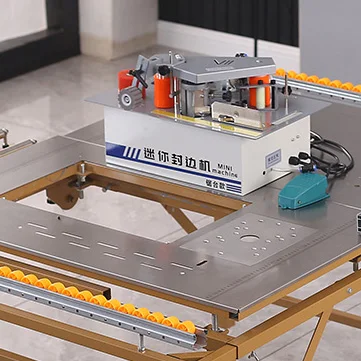
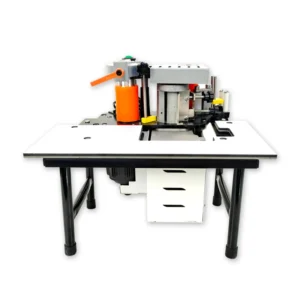
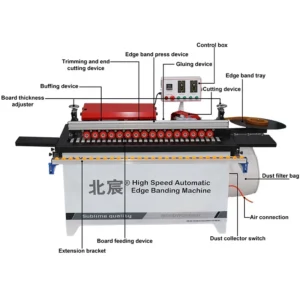
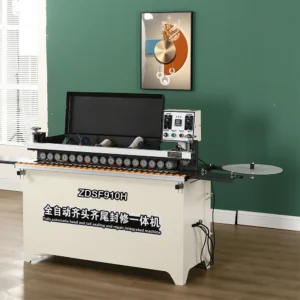
Compact footprint readiness — A 50×30×27 cm manual edge bander held in stock for immediate dispatch, positioned honestly for the small workshop scale it serves.
Technical Specifications
| Parameter |
Value |
| Product Type |
Portable Manual Edge Banding Machine |
| Voltage |
220V |
| Rated Power |
825W |
| Heating Time |
5-10 min |
| Glue Pot Capacity |
1000 ml |
| Edging Speed |
0-10 m/min (manual feed) |
| Edge Pattern |
Curves, straight lines, special shaped line |
| Overall Size |
50×30×27 cm |
| Control System |
Manual operation |
| Assembly State |
Partial assembly required |
| Warranty |
1 year |
Application Suitability
| Application |
Material or Output |
| Custom cabinet edge finishing in small joinery startups |
MDF and particleboard panels with PVC or melamine banding |
| On-site carpentry and portable workshop operations |
Plywood and solid wood panels requiring curved or shaped edges |
| Prototyping and short-run furniture production |
Small batch components where full automatic line setup is impractical |
| Complement to a single sliding table saw or panel saw |
Panel offcuts requiring immediate edge treatment before assembly |
Why the Voltage Question Must Come Before the Dispatch Date
A compact edge bander sitting in a warehouse is only useful if it matches your workshop's electrical supply the moment it arrives.
I once watched a small joinery shop in Colombia wait three weeks for an electrician to rewire a machine that shipped with the wrong voltage configuration. The portable edge banding machine in stock fast delivery promise means nothing when the control cabinet trips the breaker on first power-up. Many small workshops operate on single-phase 220V or 110V supplies, and assuming a standard industrial 380V three-phase connection will leave the unit idle until a costly conversion is arranged. Confirming frequency compatibility — 50Hz or 60Hz — is equally critical for the heating element and glue pot thermostat [NEED_CITE: voltage and frequency standards by export market].
Ready Stock Means Nothing Without the Right Electrical Configuration
A portable edge banding machine in stock fast delivery is only valuable when the voltage matches your site supply. This unit ships configured for 220V, but small workshops across different regions run on varying single-phase standards. Confirming the exact voltage and frequency before dispatch prevents the machine from sitting idle while a transformer or rewiring is sourced locally. The 825W rated power draws modest current, yet mismatched frequency will still affect the glue pot heating cycle and thermostat accuracy.
Dispatch Speed and the Single-Unit Order Reality
Small workshops and startup joinery operations rarely need container-load quantities. Ordering a single portable manual edge bander from ready stock keeps capital tied up in production rather than inventory. The compact overall size and partial assembly state mean the unit can ship via standard freight or express courier, arriving within days rather than the typical multi-week lead times associated with custom-built machinery [NEED_CITE: freight classification and dimensional weight for compact woodworking machinery].

What the 1000 ml Glue Pot and 5-10 Minute Heating Time Mean for Small Batches
A 1000 ml glue pot is sized for the short production runs and one-off panels that define a small custom workshop. The 5-10 minute heating time allows an operator to power on the unit, prepare the panel and banding material, and begin edge application without the prolonged idle wait that wastes adhesive in larger industrial pots. This thermal cycle suits PVC and melamine banding materials commonly used in cabinet and furniture components. Keeping the pot volume proportional to actual batch size reduces adhesive degradation from repeated reheating cycles.
Curve, Straight, and Special-Shaped Edging in One Portable Footprint
The ability to handle curves, straight lines, and special-shaped edges within a single 50×30×27 cm unit addresses the varied geometry found in custom furniture and architectural joinery. A workshop producing rounded shelf fronts, contoured cabinet doors, and straight carcass panels can process all profiles without switching machines. The 0-10 m/min manual feed speed gives the operator direct control over adhesive transfer and banding pressure on intricate shapes, where a powered feed might push too fast through tight radii [NEED_CITE: manual feed rate control for curved edge banding applications].
Interpreting Core Parameters for Workshop Integration
The 825W rated power is low enough for standard single-phase workshop circuits, avoiding the need for dedicated high-amperage breakers that larger automatic edge banders demand. The 0.4-0.6 MPa air pressure requirement means the unit needs a small compressor — typically a 2-3 HP reciprocating type already present in most woodworking shops running pneumatic nailers or clamps. Manual operation eliminates PLC complexity but places full responsibility on the operator for consistent feed speed and pressure. The partial assembly state requires bench mounting or a dedicated stand, so confirming workspace layout before arrival keeps commissioning straightforward.
The Hidden Cost of Buying Entry-Level for the Wrong Volume
An entry-level manual bander pushed beyond its realistic throughput will produce inconsistent glue lines and operator fatigue long before the machine itself fails mechanically. Workshops that grow from ten panels a day to fifty without reassessing equipment will see edge quality drift, and downstream assembly suffers when panels arrive at the drill station with visible gaps. The real cost is not the machine price but the rework hours spent stripping and reapplying banding on rejected components [NEED_CITE: edge banding failure modes in small-scale furniture production].
Why Sourcing From This Point of the Supply Chain Matters
Holding ready stock of compact manual edge banders eliminates the production wait that small workshops cannot absorb during peak custom order seasons. Single-unit ordering with upfront shipping options keeps purchasing decisions proportional to actual demand rather than speculative bulk commitments. Voltage and specification confirmation happens before the unit leaves the warehouse, not after it arrives and fails to power on. An operation manual provided in the agreed language ensures the operator can read heating time settings and safety instructions without guesswork. Factory pre-shipment testing on representative panel material verifies that the glue pot reaches temperature and the banding feeds smoothly before dispatch.
Documentation & Verification
- Operation and maintenance manual in the agreed language with glue pot temperature settings
- Electrical schematic confirming 220V wiring and 825W load for local electrician reference
- Factory test record on representative panel thickness before dispatch
- Packing photographs showing unit condition and partial assembly state at shipment
- Spare parts list covering glue pot heating element and feed rollers
Installation, Commissioning & Support
- Requires a stable workbench or dedicated stand to accommodate the 50×30×27 cm footprint securely
- 220V single-phase supply on a dedicated circuit rated for the 825W continuous load
- Partial assembly includes mounting the glue pot housing and connecting the 0.4-0.6 MPa air line
- First commissioning involves verifying glue pot heating cycle completes within 5-10 minutes
- Operator training covers manual feed speed control across curves and straight panel edges
- Spare heating elements and glue pot seals available for routine maintenance intervals
What We Need to Process Your Order Accurately
Confirm your workshop voltage and frequency so the unit ships configured for immediate connection on arrival. Specify the edge banding materials you run most often — PVC, ABS, or veneer — so we include the correct adhesive recommendation and temperature guidance. Let us know the panel thickness range you work with so the pre-shipment test uses representative stock and arrives ready for your first production run.
Frequently Asked Questions
Q: What production volume is this portable manual edge bander realistically designed for?
A: This unit suits small workshops processing short runs and one-off custom panels where a full automatic line would sit idle. It handles the transition from hand-applied banding to machine-assisted edge finishing for daily volumes that do not justify powered feed systems. When consistent daily output grows beyond what one operator can feed manually, stepping to an automatic edge bander becomes the logical next investment.
Q: Is 220V compatible with my workshop, and can other voltages be supplied?
A: The unit ships configured for 220V single-phase supply as standard. Workshops running on 110V or other regional standards should confirm their exact voltage and frequency before ordering so the electrical configuration matches on arrival. Mismatched voltage is the most common reason small machines sit unused after delivery.
Q: What edge banding materials can this machine handle?
A: The glue pot and manual feed system work with common PVC and melamine banding materials used in cabinet and furniture production. ABS and thin veneer strips are also processable, though adhesive type and pot temperature should be confirmed for each material family. Specifying your primary banding material at order stage ensures correct setup guidance.
Q: What is the dispatch lead time for a single-unit order from ready stock?
A: Single-unit orders from ready stock dispatch within days once voltage confirmation and documentation language are finalized. This contrasts with custom-configured automatic edge banders that require production scheduling. The compact packing size allows standard freight or express shipping depending on destination urgency.
Q: How do I know when to upgrade from this manual unit to a full automatic edge bander?
A: When daily panel volumes grow to the point where manual feed speed creates a bottleneck and edge quality consistency becomes difficult to maintain across multiple operators, an automatic machine with powered feed and trimming stations is the appropriate step. The manual unit remains useful for prototypes and short runs even after upgrading the main production line.