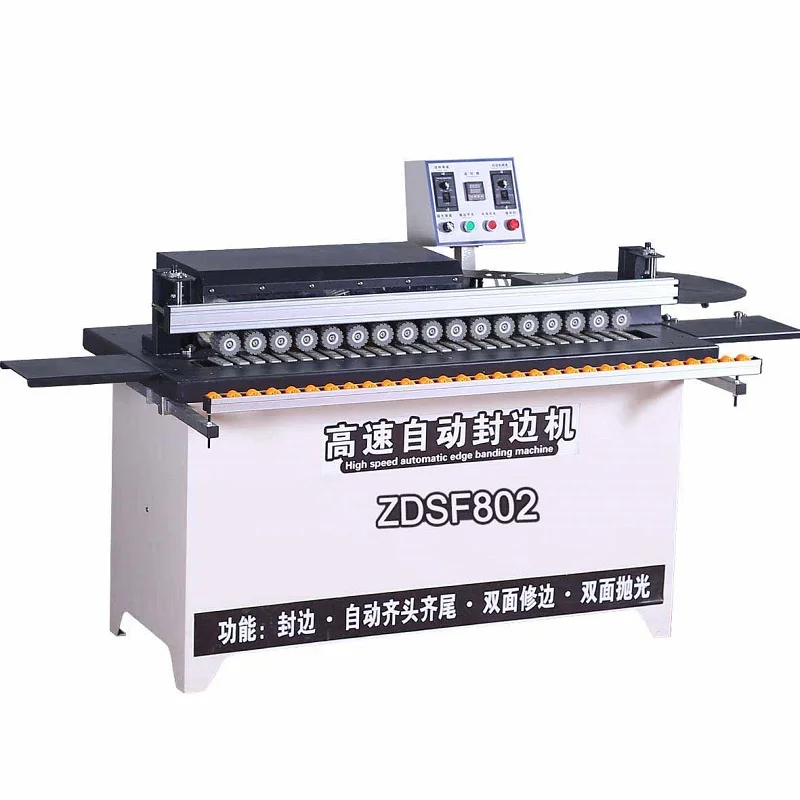
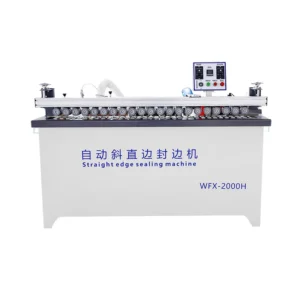
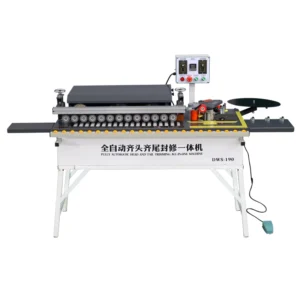
Voltage-Confirmed Dispatch — Every ZDSF802 unit ships only after your local grid parameters are verified at the factory, preventing the three-week transformer delay that stalls small workshop commissioning.
Technical Specifications
| Parameter |
Value |
| Model |
ZDSF802 |
| Product Type |
Automatic Edge Banding Machine |
| Function |
Automatic plate feeding, end cutting, upper and lower polishing, head and tail trimming, integrated dust collector |
| Edge Type |
Straight line |
| Rated Voltage |
220V (basis not stated in source — confirm frequency and phase before order) |
| Rated Power |
4 kW |
| Trimming Power |
800W × 2 |
| Polishing Power |
180W × 2 |
| Suction Power |
1200W |
| Heating Power |
1000W |
| Feed Speed |
0-10 m/min |
| Conveyor Belt Speed |
0-10 m/min |
| Strip Thickness Range |
0.5-2.5 mm |
| Sheet Thickness Range |
10-50 mm |
| Glue Pot Capacity |
4000 ml |
| Rated Air Pressure |
0.4-0.6 MPa |
| Overall Dimensions |
130 × 65 × 75 cm |
| Machine Weight |
150 kg |
| Control Panel |
Digital display for glue pot temperature, independent switches |
| Pressure System |
Integrated pressure beam, double rows of pressure wheels |
| Conveyor Belt Material |
Silicone |
| Belt Breaking Method |
Pneumatically controlled |
| Trimming Stations |
Double high-speed trimming motors (up and down) |
| Polishing Stations |
Up and down polishing motors |
| Dust Extraction |
Integrated vacuum cleaner |
| Key Features |
KD packing, single-operator design, compact footprint |
Application Suitability
| Application |
Material or Output |
| Custom cabinet door edging |
MDF and particleboard panels with PVC edge banding |
| Small-batch shelving production |
Plywood panels with veneer or melamine strips |
| Joinery workshop starter line |
Solid wood panels up to 50 mm thickness |
| On-site furniture fitting |
Straight-line edging on pre-cut boards in compact spaces |
Why the Voltage Question Must Come Before You Sign the PO
An automatic edge bander for small workshop use is useless if it cannot plug into your existing supply.
I have watched a joinery shop lose three weeks of production because the machine on their floor was wired for 380V/50Hz while the building only had 220V/60Hz. The transformer had to be special-ordered, and the crew stood around while the electrician rewired the panel. For a startup burning through its first contract, that delay is not an inconvenience — it is an existential problem. [NEED_CITE: voltage and frequency standards by export market]
When you order a compact edge banding unit from overseas, the default configuration is almost always the manufacturer's domestic grid standard. If your purchase order does not explicitly state the voltage, phase, and frequency you need, the factory has no reason to deviate from its baseline. The control panel language is another silent trap: operators facing an unfamiliar script will stall the commissioning process while they hunt for translations. These are not edge cases — they happen regularly when the configuration conversation gets skipped in the rush to ship.
Footprint and Power Draw Sized for a Garage-Scale Shop
The ZDSF802 sits on a 130 × 65 cm footprint, which means it can occupy a corner of a two-bay workshop without forcing a floor plan redesign. At 4 kW total rated power, it runs on a standard single-phase circuit in most markets, removing the need for a dedicated three-phase drop that a small shop rarely has. The 150 kg weight allows two people to reposition it if the layout needs to change during the first year of operation.
This automatic edge bander for small workshop environments is built for operators who are stepping up from hand-held manual trimmers and need a machine that does not require a facility upgrade to install. The integrated dust collector at 1200W suction power captures trimmings and polishing dust at the source, keeping a small room breathable without a separate cyclone system taking up additional floor space.
The 4-Liter Glue Pot and What It Actually Means for Your Day
A 4000 ml glue pot capacity lets a single operator run through a typical morning batch of cabinet sides and shelves without stopping to refill adhesive mid-run. Smaller pots on comparable machines force a pause every few boards, and each pause means the glue temperature drops, the next board gets an inconsistent bead, and the operator has to wait for reheating before continuing. [NEED_CITE: hot-melt adhesive open time and temperature stability in edge banding]
The digital temperature display on the control panel gives the operator a direct readout of glue pot conditions, so there is no guesswork about whether the adhesive has reached working temperature after a break. The 1000W heating element brings the pot to operating temperature within a five-to-ten-minute window at the start of each shift. For a shop processing small batches rather than continuous production runs, that quick heat-up means the machine is not idling through half the morning.
Reading the Numbers That Actually Matter
The 10-50 mm sheet thickness range covers everything from thin shelving stock to heavy workbench tops, so the same machine handles the full spread of panels a custom cabinet shop typically processes. Feed speed at 0-10 m/min is adjustable, letting the operator slow down for difficult veneer strips that need careful tracking and speed up for standard PVC edging on particleboard.
Double high-speed trimming motors handle the head and tail cuts, while the up-and-down polishing stations finish the edge in a single pass. The pneumatically controlled belt breaking mechanism provides clean end cuts without the operator needing to manually intervene with a hand tool. Silicone conveyor belt material prevents surface scratching on pre-finished panels, which matters when you are edging laminated cabinet doors that show every mark. [NEED_CITE: edge banding tolerance and downstream panel assembly fit]

The Hidden Cost of Skipping the Configuration Conversation
When a machine arrives with the wrong voltage configuration, the immediate cost is the transformer or rewiring work. The secondary cost is the three or four weeks of lost production while that work is arranged. For a small workshop that has committed to delivery dates on its first automated orders, that delay cascades into late penalties and damaged customer relationships.
Shops that buy on specification alone without confirming local electrical standards end up paying for the oversight twice — once for the corrective hardware and again for the contract penalties. The same applies to control panel language: if your operator cannot read the temperature display or fault codes, every minor alarm becomes a production stop while someone searches for a translation. [NEED_CITE: machinery directive requirements for operator interface language]
Why Procurement Through This Channel Works
Voltage and frequency are confirmed against your local grid standard before the unit enters production, so the machine that arrives on your floor plugs in and runs on day one. The four-stage quality check covers incoming materials, in-process assembly, finished product verification, and pre-shipment testing — you receive the test record with your documentation pack.
An engineer-led configuration review matches the machine to your actual panel range and daily volume rather than pushing you toward a higher-tier model you do not need. The formal quotation arrives within 24 hours of your inquiry, specifying every confirmed parameter so there are no surprises when the crate is opened. Operation and maintenance documentation is supplied in your agreed language, and the spare parts list is included so you can source consumables locally or order directly as needed.
Documentation & Verification
- Electrical schematic confirming your voltage, phase, and frequency configuration
- Factory test record on your specified panel thickness and edge strip material
- Operation and maintenance manual written in your operator's language
- Spare parts list with part numbers for local sourcing or direct reorder
- Pre-shipment packing photographs showing machine condition before crating
Installation, Commissioning & Support
- 4 kW draw requires a dedicated single-phase circuit at your confirmed voltage and frequency
- 130 × 65 cm footprint fits standard workshop floors without special foundation work
- KD packing means two-person assembly with included manual and video guidance
- Glue pot first heat-up cycle and temperature calibration completed before first production board
- Pneumatic belt breaking system requires connection to your existing 0.4-0.6 MPa air supply
- Integrated 1200W dust collector connects to a standard exhaust port or recirculates internally
Starting the Configuration Conversation
Send through your local voltage and frequency, the panel materials and thicknesses you process most often, and the edge strip types you plan to run. If you are replacing a manual process, let us know your current daily board count so the feed speed can be matched to your throughput target.
Frequently Asked Questions
Q: How do I confirm the correct voltage and frequency before ordering?
A: Provide your local grid specification — voltage, phase, and frequency — at the inquiry stage. The quotation will reflect the confirmed electrical configuration, and the pre-shipment test is conducted at that exact voltage to verify motor and heating element performance before the machine leaves the factory.
Q: Which edge banding materials and panel thicknesses does this model handle?
A: The ZDSF802 processes PVC and veneer edge strips from 0.5 to 2.5 mm thickness on panels ranging from 10 to 50 mm. This covers standard MDF, particleboard, plywood, and solid wood stock used in custom cabinet and small-batch furniture production.
Q: What does assembly involve when the machine arrives?
A: The unit ships in KD packing with an assembly manual and video instructions. Two people can complete the setup, connecting the pneumatic line to your existing air supply and plugging into your confirmed electrical circuit. The glue pot heat-up and initial calibration are completed before your first production board is edged.
Q: How do I source spare parts and consumables after delivery?
A: Every order includes a spare parts list with part numbers. Common consumables like trimming blades, polishing pads, and conveyor belt sections can be ordered directly or sourced locally using the specification sheet provided with your documentation pack.