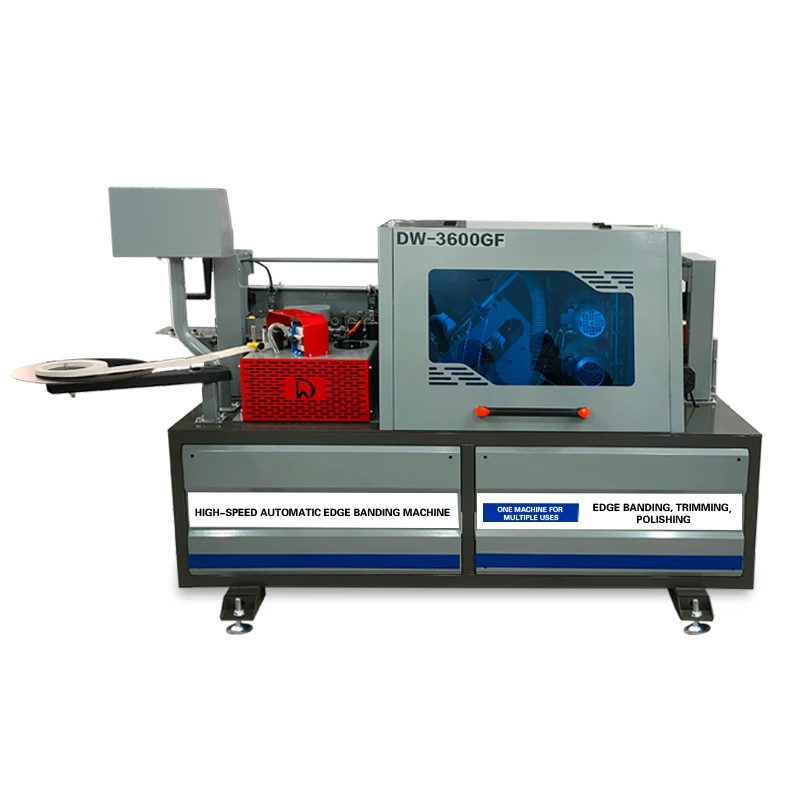
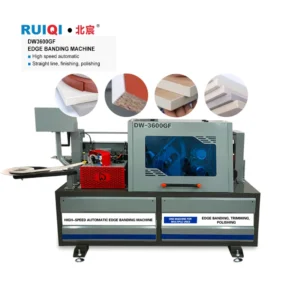
Voltage confirmation before production — 380V three-phase is standard on the DW-3600GF, but frequency and plug type are configured to match your local electrical standard before the machine leaves the factory.
Technical Specifications
| Parameter |
Value |
| Model |
DW-3600GF |
| Product Type |
Automatic Edge Banding Machine |
| Edge Banding Type |
Straight Edge Banding |
| Total Power |
4.9 kW |
| Voltage & Frequency |
380V Three-Phase Four-Wire (frequency to confirm at order) |
| Overall Dimensions (L×W×H) |
2200×650×1250 mm |
| Net Weight |
320 kg |
| Edge Band Height Range |
0–50 mm |
| Edge Band Thickness Range |
0.3–3 mm |
| Minimum Plate Length |
200 mm |
| Feed Speed |
0–14 m/min |
| Trimming Motor |
800W×2 at 24000 r/min |
| Polishing Motor |
400W×2 |
| Edge Banding Motor |
160W |
| Transmission Motor |
180W |
| Air Supply Requirement |
0.4–0.6 MPa |
| Standard Functions |
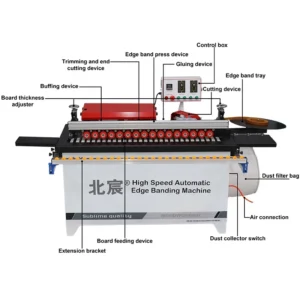
Gluing, Trimming, Front & Rear Trimming, Scraping, Polishing, Vacuuming |
| Control Panel Language |
Chinese and English standard; other languages configurable |
| Plug Options |
EU, USA, AU, UK |
Application Suitability
| Application |
Material or Output |
| Small-batch cabinet door production |
MDF and particleboard panels with PVC edge banding |
| Custom furniture panel finishing |
Plywood and MDF with 0.3–3 mm banding thickness |
| Joinery workshop transition from manual to machine |
Straight edge banding on standard panel substrates |
| Startup furniture shop limited-space installation |
Compact footprint panel processing at adjustable feed speeds |
Why the Voltage Question Should Come Before the Price
Ordering an automatic edge banding machine compact workshop buyers can actually plug in starts with confirming your local supply.
I have seen shops take delivery of a machine only to discover the frequency does not match their grid. The motor runs, but the feed speed drifts and the glue pot never reaches stable temperature. By the time an electrician rewires the panel, the commissioning window has closed and the operator has lost confidence in the equipment [NEED_CITE: voltage and frequency standards by export market]. The DW-3600GF ships with voltage and plug configuration locked in at the order stage, so the machine arrives ready for your specific electrical environment.

Fitting the First Machine Into a Small Workshop
A joinery shop moving from hand-applied banding to its first automatic edge banding machine compact workshop owners can rely on needs more than just a motor and a glue pot. The DW-3600GF packs gluing, trimming, front-and-rear trimming, scraping, polishing, and vacuuming into a single 2.2-meter frame. That means one operator handles the complete edge finishing sequence without moving the panel between stations. The 0–14 m/min adjustable feed speed lets you slow down for tricky grain directions or speed up once the operator builds rhythm with standard MDF cuts.
The Upgrade Path Without Changing Suppliers
Starting with this compact unit does not lock you into a dead end. The edge band thickness range of 0.3–3 mm covers the PVC banding most small furniture makers use daily, and the 50 mm band height capacity handles the majority of cabinet and shelving stock. When your volume grows and you need pre-milling or corner rounding, you move up within the same product family without retraining operators on a different control layout [NEED_CITE: edge banding machine configuration scaling for furniture workshops]. The control panel language is confirmed at order, so your operator reads instructions in a language they understand from day one.
Reading the Numbers That Actually Matter
The 24000 r/min trimming motors are the specification that separates a clean edge from a visible glue line. At that spindle speed, the trimming cutters shear the PVC banding cleanly rather than tearing it, which matters when you are running thin 0.3 mm material on particleboard. The 0.4–0.6 MPa air supply requirement falls within the output range of a standard workshop compressor, so you do not need to invest in a dedicated air system just to run the edge bander. Feed speed at 0–14 m/min gives the operator fine control during short runs where each panel might have a different profile.
What Happens When You Skip the Configuration Conversation
Shops that order an entry-level machine without confirming panel thickness range and feed height compatibility often discover the mismatch during the first production run. The panels jam at the infeed, the glue pot cannot maintain temperature on high-moisture particleboard, or the trimming station leaves a visible step on thicker banding [NEED_CITE: common edge banding defects from mismatched machine settings]. Reworking a batch of cabinet doors costs more in labor and material than the time it takes to verify specifications before the machine is built.
Why Source This Machine Through This Channel
In-house manufacturing with patented cutting mechanisms means the trimming accuracy is built into the machine, not adjusted after assembly. Four-stage quality control covering incoming material through pre-shipment verification catches tolerance issues before the crate is sealed. Voltage, language, and specification customization are handled as standard order options rather than special requests. An engineer-led configuration review matches the DW-3600GF to your actual panel stock and production volume before the quotation is finalized. Factory test records on your specific material are available before dispatch [NEED_CITE: pre-shipment inspection standards for woodworking machinery].
Documentation & Verification
- CE declaration of conformity covering the DW-3600GF edge banding machine
- Machine specification sheet with confirmed voltage and frequency for your market
- Electrical schematic matching the as-built control panel configuration
- Factory test record run on panel thickness within your specified range
- Operation and maintenance manual in the operator's confirmed language
- Spare parts list with trimming cutter and polishing wheel part numbers
Installation, Commissioning & Support
- 2200×650 mm footprint fits standard workshop bays; verify 1250 mm height clearance plus operator space
- 4.9 kW total load requires a dedicated 380V three-phase circuit with correct breaker rating
- Machine ships assembled; position on level floor and connect air supply at 0.4–0.6 MPa
- First run verifies all six functions — gluing, trimming, front-rear trimming, scraping, polishing, vacuuming
- Operator training covers feed speed adjustment and banding thickness changeover procedures
- Trimming cutters at 24000 r/min are the primary consumable; spare set included at shipment
Before You Request a Quotation
Tell us the panel materials you run most often — MDF, particleboard, or plywood — along with the banding thickness and type you source locally. Confirm your workshop voltage, frequency, and the plug standard your electrician expects. If you are replacing a manual process, share your current daily panel count so the engineer can confirm whether the 0–14 m/min feed speed aligns with your throughput target or whether a higher-capacity model suits your line better.
Frequently Asked Questions
Q: What is the smallest panel this edge bander can process?
A: The DW-3600GF handles a minimum plate length of 200 mm. If your typical workpieces are small drawer fronts or narrow shelf strips near that dimension, confirm the exact sizes so we can verify feed stability. Panels shorter than the minimum may not engage the conveyor properly, causing misalignment at the trimming station.
Q: Can I configure the voltage and plug for my country?
A: Yes. The standard configuration is 380V three-phase four-wire, but voltage is customizable and plug options include EU, USA, AU, and UK types. You must confirm your local voltage and frequency before production begins so the motor, transformer, and control components are matched to your grid supply.
Q: What language will the control panel display?
A: Chinese and English are standard. Other languages are configurable at the order stage. Confirming the operator's preferred language before production avoids commissioning delays where the operator cannot read error codes or parameter settings during the critical first week of operation.
Q: How do I plan for higher volume later?
A: The DW-3600GF covers straight edge banding with a complete function set for small-batch production. When your volume outgrows the 0–14 m/min feed speed, you can move to a higher-tier model within the same product family. The control logic and operator workflow remain consistent, reducing retraining time.
Q: What air compressor do I need for this machine?
A: The DW-3600GF requires 0.4–0.6 MPa air pressure, which most standard workshop piston or screw compressors can supply. Ensure your compressor has adequate tank capacity to maintain stable pressure during continuous trimming and scraping cycles, especially if other pneumatic tools share the same air line.