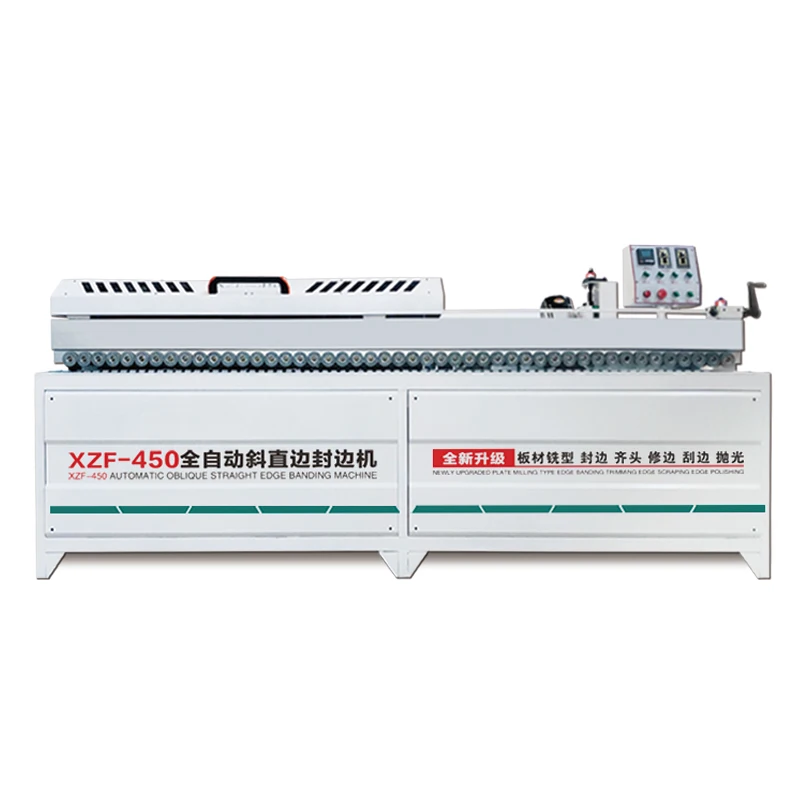
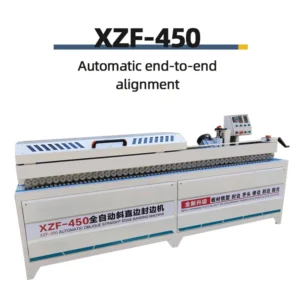
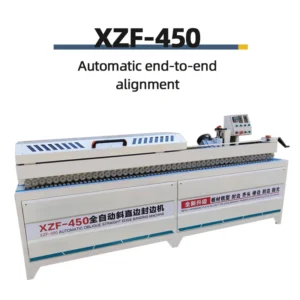
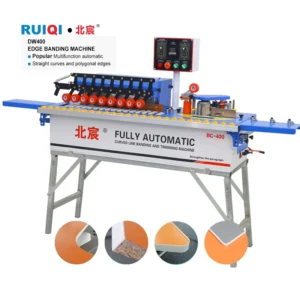
Compact Seven-Station Edge Bander — verified electrical schematics and factory test records accompany every XZF-450 before it leaves Shandong, ensuring the control panel speaks a language your operators actually read.
Technical Specifications
| Parameter |
Value |
| Model |
XZF-450 |
| Product Type |
Automatic Edge Banding Machine |
| Total Power |
9.5 kW |
| Voltage |
380V / 415V (configurable options available) |
| Pre-milling Motor |
4 kW |
| Edge Feed Power / Speed |
0.16 kW / 0–12 m/min |
| Transmission Power / Speed |
180 W / 0–12 m/min |
| Trimming Power |
2.2 kW × 2 |
| Polishing Power |
0.4 kW × 2 |
| Vacuum Power |
550 W |
| Edge Banding Height |
0–50 mm |
| Edge Banding Thickness |
0.3–3 mm |
| Minimum Panel Length |
30 cm |
| Minimum Panel Width |
15 cm |
| Glue Pot Capacity |
4000 ml |
| Air Source Pressure |
0.5–0.7 MPa |
| Standard Functions |
Pre-milling, 30°/45°/60° edge banding, trimming, scraping, polishing, high-power vacuuming |
| Product Dimensions |
300 × 65 × 135 cm |
| Product Weight |
430 kg |
| Language Options |
Chinese, English (customizable to Spanish or other languages) |
| Plug Options |
EU, USA, AU, UK |
Application Suitability
| Application |
Material or Output |
| Custom cabinet panel edging |
MDF, particleboard, plywood |
| Joinery workshop furniture production |
Melamine board, blockboard |
| Angled panel assemblies |
45° and 90° edges on polymer doors |
| Small-batch solid wood furniture |
Solid wood board, PVC and veneer edge banding |
Why the Voltage Question Should Come Before the Price on Your Next Automatic Edge Banding Machine for Small Workshop
Confirming local voltage and frequency before placing an order prevents a machine from sitting idle on your shop floor.
I once watched a workshop in Johor receive a brand-new edge bander only to discover the control panel was entirely in Chinese. The operator could not read a single button. The machine sat under a tarp for two weeks while the factory owner scrambled for a translator and an electrician to verify whether the incoming supply matched the motor windings. That unit had been ordered on price alone, with no pre-shipment language or electrical verification. When you evaluate an automatic edge banding machine for small workshop use, the first question should never be about cost — it should be about whether the voltage, frequency, and control language match your facility [NEED_CITE: voltage and frequency standards by export market].
Footprint and Power Draw for Joinery Startups
A small workshop rarely has the three-phase capacity or the floor space of a full production plant. The XZF-450 draws 9.5 kW total and fits within a 300 × 65 cm footprint, which means it can share a bay with a sliding table saw without blocking material flow. The automatic edge banding machine for small workshop environments needs to run on a standard 380V or 415V three-phase supply, and the plug options — EU, USA, AU, UK — are selected before shipment rather than adapted on arrival with aftermarket converters that void warranties.
Seven Integrated Functions Without an Industrial Footprint
Most entry-level edge banders offer gluing and trimming only, forcing the operator to scrape and polish by hand afterward. This unit carries a 4 kW pre-milling motor, end trimming, rough and fine trimming stations, a scraper, and dual polishing heads — all in one pass. That sequence is what separates a visible glue line from a finished edge ready for assembly. The automatic edge banding machine for small workshop adoption becomes viable precisely because seven stations compress into a single machine you do not outgrow when order volumes increase [NEED_CITE: typical edge quality requirements for cabinet assembly tolerances].

What the Spec Sheet Numbers Actually Mean on the Shop Floor
The 4 kW pre-milling motor is not just a power figure — it determines how cleanly the substrate edge is prepared before glue is applied. A weak pre-mill leaves tear-out on particleboard, and that tear-out telegraphs through the PVC or veneer strip as a visible ridge. With 0.3–3 mm edge banding thickness coverage, this machine handles thin melamine strips for cabinet carcasses as well as thicker solid wood lipping for tabletops. The variable feed speed up to 12 m/min lets an operator slow down for tricky curved-contour workpieces or run flat panel stock at higher throughput. Air consumption at 0.5–0.7 MPa is within the range of a standard workshop piston compressor, so no additional compressed-air investment is required to start running panels on day one.
The Hidden Cost of Skipping Pre-Shipment Verification
Buying a machine without a factory test on your actual panel material means the first real production run becomes your commissioning test. Glue temperature, feed pressure, and trimmer alignment all shift when the substrate changes from MDF to plywood. A unit tested only on standard chipboard may leave burn marks on melamine or fail to trim cleanly on 3 mm solid wood lipping. Small workshops rarely have a second machine to absorb overflow while the first one is being dialed in, so a bad first week can stall deliveries and erode customer confidence [NEED_CITE: common commissioning faults in edge banding equipment].
Why Procurement Through This Channel Works for Small Shops
Every XZF-450 ships with the control panel and operation manual in the language you specify — English, Spanish, or another agreed language — so your lead operator does not need to decode translated stickers. Voltage and plug type are confirmed during the quotation stage, not guessed at the packing stage. The four-stage quality control process covers incoming material, in-process assembly, finished product inspection, and pre-shipment verification with a test record on your specified panel thickness range. Single-unit orders are accepted, which means a joinery startup does not have to commit to a full production line before proving the machine on its own workpieces. Configuration recommendations come from engineers rather than catalog sales, reducing the chance of ordering a model that is either underpowered for your volume or oversized for your available three-phase capacity.
Documentation & Verification
- CE declaration of conformity specific to the XZF-450 automatic edge bander
- Factory test record on your panel thickness and edge banding material before dispatch
- Electrical schematic confirming 380V/415V wiring and plug type for your country
- Operation and maintenance manual in the agreed language with illustrated fault-finding section
- Spare parts list with part numbers matching the machines assembly drawings
- Packing photographs showing crate condition and accessory count before container loading
Installation, Commissioning & Support
- Dedicated 380V/415V three-phase circuit rated for the XZF-450s 9.5 kW total draw with appropriate breaker sizing
- Floor space of 300 × 65 cm plus operator clearance on the infeed and outfeed sides for panel handling
- Machine arrives fully assembled requiring only dust extraction hose connection to the 550 W vacuum port
- First-run parameter setting for glue pot temperature at 4000 ml capacity and feed speed calibration on your panel stock
- Trimmer and scraper adjustment guidance for 0.3 mm melamine through 3 mm solid wood edge banding
- Scheduled lubrication points and belt tension checks aligned with the 0–12 m/min variable transmission system
What We Need From You to Quote Accurately
To match the right configuration to your workshop, share the panel materials and thicknesses you process most often, the edge banding materials and widths you use, and your local voltage and frequency. Let us know your preferred control panel language and whether you need 45-degree angle banding capability for angled cabinet or door assemblies. If you have sample panels available, we can run a test and send you the finished edge quality record before you commit to an order.
Frequently Asked Questions
Q: What panel thickness and edge band thickness can the XZF-450 handle?
A: The machine accepts edge banding heights from 0 to 50 mm and edge banding thicknesses from 0.3 to 3 mm, covering PVC, veneer, and melamine strips. The 4 kW pre-milling motor prepares the substrate edge on MDF, particleboard, plywood, and solid wood board before glue application, and the dual 2.2 kW trimming motors handle the full thickness range in a single pass.
Q: Can the voltage and plug type be matched to my countrys electrical standard?
A: Yes. The XZF-450 is configurable for 380V or 415V three-phase supply, and plug options include EU, USA, AU, and UK types. Voltage and frequency are confirmed during the quotation stage so the motor windings and control electronics match your local grid before the machine leaves the factory, preventing idle time on arrival.
Q: What is the minimum panel size this machine can process?
A: The minimum panel length is 30 cm and the minimum panel width is 15 cm. This range accommodates small cabinet components such as drawer sides and shelf brackets. For smaller offcut pieces, a manual edge banding approach or a dedicated small-part edge bander may be more appropriate than running them through the automatic feed system.
Q: How does the 45-degree edge banding function work compared to standard 90-degree?
A: The XZF-450 supports 30-degree, 45-degree, and 60-degree angle edge banding alongside standard 90-degree straight edges. Angled banding is used for mitered cabinet assemblies and polymer door panels where the edge strip must follow a beveled substrate profile. The pre-milling and trimming stations adjust to the angle setting so the glue line and trim finish remain consistent across both straight and angled passes.
Q: What spare parts are included and how do I order replacements?
A: A spare parts list with part numbers is included in the documentation package, matching the machines assembly drawings. Critical wear items such as trimming blades, scraper inserts, and glue pot components are identified. Replacement parts can be ordered directly using the part numbers on the list, and packing photographs are provided before shipment to confirm accessory and spare part counts.