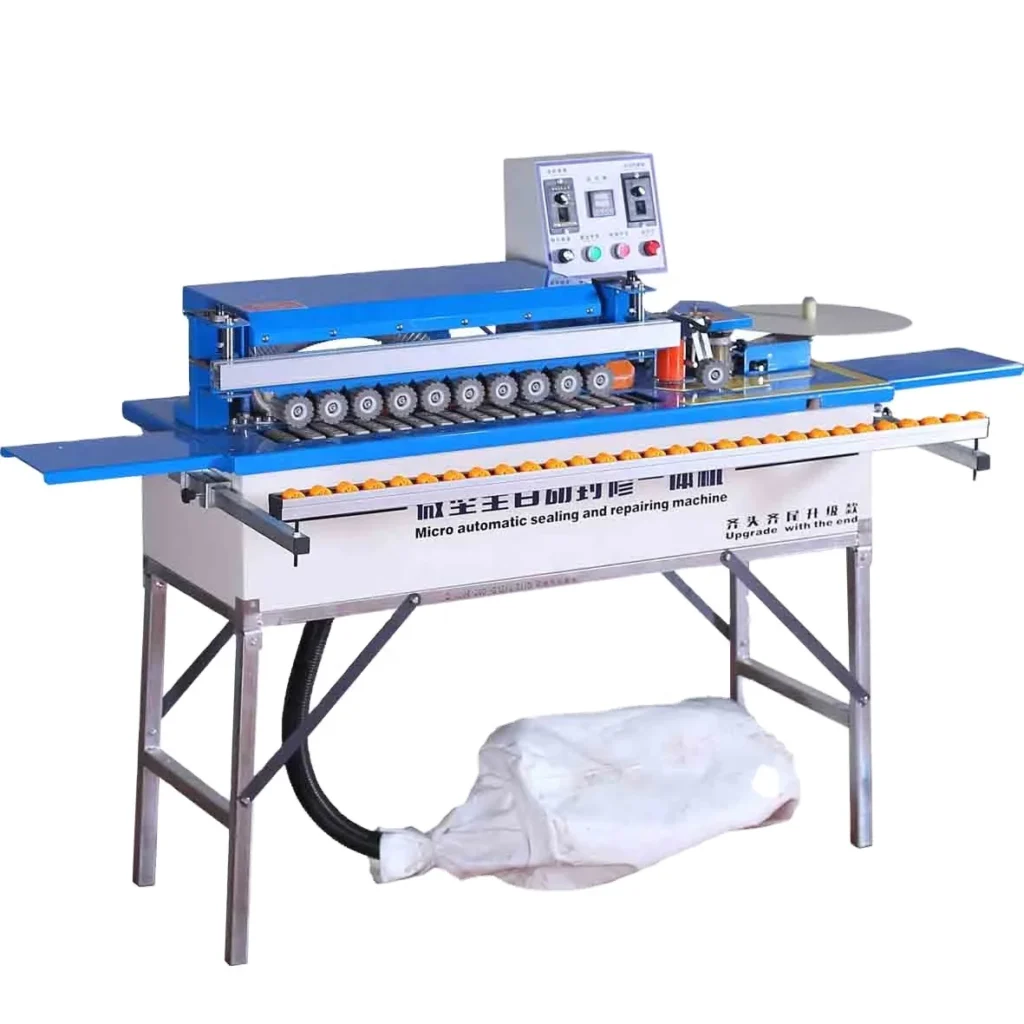
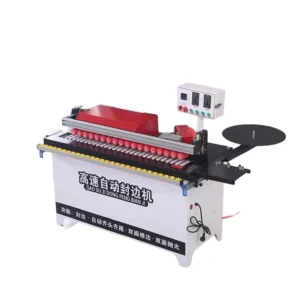
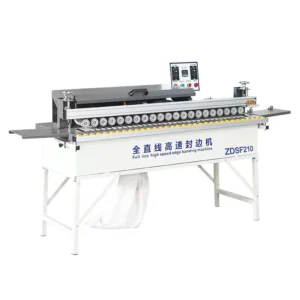
Stocked compact edge bander — 81 kg footprint ready to ship, configured for 220V single-operator joinery workflows.
Technical Specifications
| Parameter |
Value |
| Product Type |
Automatic Edge Banding Machine |
| Voltage |
220V |
| Suction Power |
1200W |
| Belt Power |
25W |
| Transmission Power |
60W |
| Polishing Power |
180W × 2 |
| Trimming Power |
800W × 2 |
| Conveying Speed |
0–15 m/min |
| Edging Speed |
0–6 m/min |
| Edge Height Range |
10–60 mm |
| Edge Thickness Range |
0.3–3 mm |
| Overall Dimensions |
120 × 54 × 72 cm |
| Net Weight |
81 kg |
| Control System |
Individual function control panel |
| Gluing Method |
Double-sided adhesive application |
| Gluing Device Rotation |
180° (for curved edge banding) |
| Feed Mechanism |
Double-row rubber pressure wheels |
| Key Features |
Integrated dust suction device, up/down trimming motors, cross polishing (2 motors), automatic head and tail cutting |
Application Suitability
| Application |
Material or Output |
| Custom cabinet door edging |
MDF and particleboard with PVC banding |
| Small-batch joinery production |
Plywood panels with veneer edge strips |
| Curved furniture component finishing |
Solid wood panels with 0.3–3 mm banding |
| Startup workshop transition from manual edging |
Mixed substrates in low-volume runs |
Why "Compact" Matters More Than Speed Ratings for a First Machine
A small workshop needs a machine that matches its actual daily panel count, not a brochure number from a production line it will never run.
I spent years on the assembly floor in Shandong, and the most common failure I diagnosed on site was not a broken motor — it was an entry-level edge bander pushed far past its intended duty cycle. A joinery shop would buy a machine rated for light work, then run it through three shifts of dense MDF, and wonder why the feed gears stripped within a season [NEED_CITE: typical gear wear patterns in overloaded entry-level edge banders]. This compact automatic edge banding machine in stock is built for the realistic pace of a small shop, where an operator feeds twenty to forty panels a day and needs every one of them clean off the outfeed side. The 0–6 m/min edging speed is not a limitation — it is the correct match for a single-operator workflow where alignment and glue spread matter more than throughput.

Straight and Curved Edging Without a Second Machine
Most small workshops that handle custom furniture encounter curved panels — shaped cabinet ends, rounded shelving, or contoured desk fronts. Buying a dedicated curved edge bander alongside a straight-line unit is not practical when floor space and budget are both tight. The 180° rotatable gluing device on this compact automatic edge banding machine in stock lets the operator switch between straight runs and curved profiles without changing machines or tooling. The double-sided adhesive application bonds to both the panel edge and the banding strip simultaneously, which is important when working with porous MDF where single-sided glue can starve the joint.
Footprint and Power Draw That Fit a Garage-Scale Shop
A full-size edge bander demands a dedicated three-phase supply, compressed air lines, and a floor area that dominates a small production room. This unit runs on 220V single-phase power and occupies roughly 120 × 54 cm of floor space. The total connected load across all stations — trimming, polishing, conveying, and dust suction — stays within the capacity of a standard workshop circuit. That means a startup joinery business can plug in and begin edging panels without first paying for an electrical panel upgrade [NEED_CITE: single-phase power availability in small industrial workshops].
Reading the Numbers That Actually Matter
The edge thickness range of 0.3–3 mm covers the two most common banding materials in custom furniture: thin PVC foil for flat-panel cabinet doors and thicker solid-wood or PVC strips for visible furniture edges. The 800W × 2 trimming motors handle the shear cut at both top and bottom of the banding in one pass, while the 180W × 2 cross-polishing motors smooth the trimmed edge to a finished surface. The double-row rubber pressure wheel feed mechanism keeps the panel stable against the fence through the trimming and polishing zones — a single row of wheels on lighter machines can let thin plywood drift, producing a visible step at the trim line. Conveying speed up to 15 m/min applies to the return belt and auxiliary feed; the working edging speed of 0–6 m/min is the figure to plan around when estimating daily output.
What Happens When the Machine Is Wrong for the Material
A compact edge bander is the right first purchase for a small shop — but only if the shop does not then feed it materials it was never designed to process. High-density MDF and thick laminate panels demand pre-milling stations and heavier feed mechanisms found on larger models. Running those substrates through an entry-level machine accelerates wear on the pressure wheels and trimming cutters, and the bond quality degrades before the operator notices [NEED_CITE: adhesive failure modes on high-density fiberboard with light-duty edge banders]. The honest conversation before purchase is about the actual panel types and daily volume, not the maximum speed printed on a nameplate.
What Stocked and Ready to Ship Actually Involves
Ordering an automatic edge banding machine in stock from this range means the unit has already passed incoming material inspection, in-process assembly checks, and a pre-shipment functional test. The voltage is confirmed at 220V before dispatch, and customization to other voltages from 110V to 440V is available if the destination workshop runs on a different supply standard. The operation and maintenance manual is supplied in the buyer's agreed language so the operator can read the startup sequence without waiting for a translation. Single-unit orders are accepted, which removes the minimum-order barrier that typically blocks a small shop from buying its first machine directly from the factory.
Documentation & Verification
- Factory test record run on buyer's specified panel thickness and edge material before dispatch
- Electrical schematic confirming 220V wiring and individual station circuit protection
- Operation manual in the operator's language covering glue temperature, feed speed, and trimming adjustment
- CE declaration of conformity for machinery entering regulated markets
- Packing photographs showing crate condition and machine securing before container loading
Installation, Commissioning & Support
- Requires a level floor area of approximately 120 × 54 cm with clearance on the infeed and outfeed sides for panel handling
- Connects to a dedicated 220V single-phase circuit rated for the combined load of all stations
- Arrives fully assembled; operator mounts the dust extraction hose and loads the adhesive supply on arrival
- First-run commissioning covers glue spread adjustment, trimming depth setting, and feed wheel pressure calibration
- Spare parts list identifies trimming cutters, polishing pads, and pressure wheel inserts as routine consumables
Before You Request a Quote
Send the specific panel substrates and edge banding materials the shop processes most often, along with the local voltage and frequency at the installation site. Note the available floor space and whether the control panel and manual need to be in a language other than English or Chinese. If the shop plans to scale production volume in the coming year, mention that so the configuration can account for the upgrade path.
Frequently Asked Questions
Q: What daily panel volume is this compact edge bander built to handle?
A: This unit is configured for a single-operator workshop producing custom cabinets or joinery in small batches, typically edging a few dozen panels per working day. It is not designed for continuous three-shift production runs. Shops expecting higher sustained volume should look at models with pre-milling stations and heavier feed mechanisms rated for continuous duty cycles.
Q: How do I confirm the voltage will match my workshop supply?
A: The stocked configuration is 220V single-phase. Before dispatch, the buyer provides the local voltage and frequency at the installation address, and the factory confirms compatibility or reconfigures the unit within the 110V–440V range. The electrical schematic supplied with the machine documents the final wiring and circuit protection settings.
Q: Can the control panel labels and operation manual be provided in my operator's language?
A: Yes. The individual function control panel and the accompanying operation and maintenance manual can be prepared in the agreed language before shipment. This prevents commissioning delays caused by an operator unable to read startup sequences, glue temperature settings, or safety warnings on the machine face.
Q: What is the dispatch lead time for stocked units and what shipping options exist?
A: Stocked units are prepared for dispatch after the pre-shipment test and packing verification are completed, which typically requires a short lead time rather than a full production cycle. Shipping options are quoted based on the destination port or address, and single-unit orders are accepted without a minimum quantity requirement.
Q: What is the upgrade path when the shop outgrows this entry-level machine?
A: The manufacturer produces a full product family from entry-level to full-function pre-milling edge banders within one platform. When production volume or substrate range exceeds the capacity of this compact unit, the shop can move to a higher-tier model from the same supplier, maintaining familiarity with the control logic and spare parts ecosystem while gaining heavier feed mechanisms and additional processing stations.