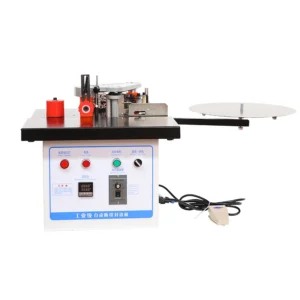
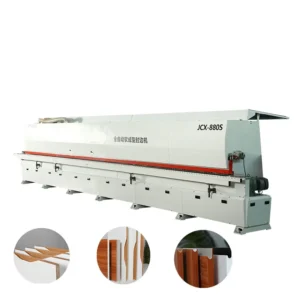
Voltage Verified Before Dispatch — each unit is tested at the rated 220V configuration and confirmed against your local power supply before it leaves the factory.
Technical Specifications
| Parameter |
Value |
| Product Type |
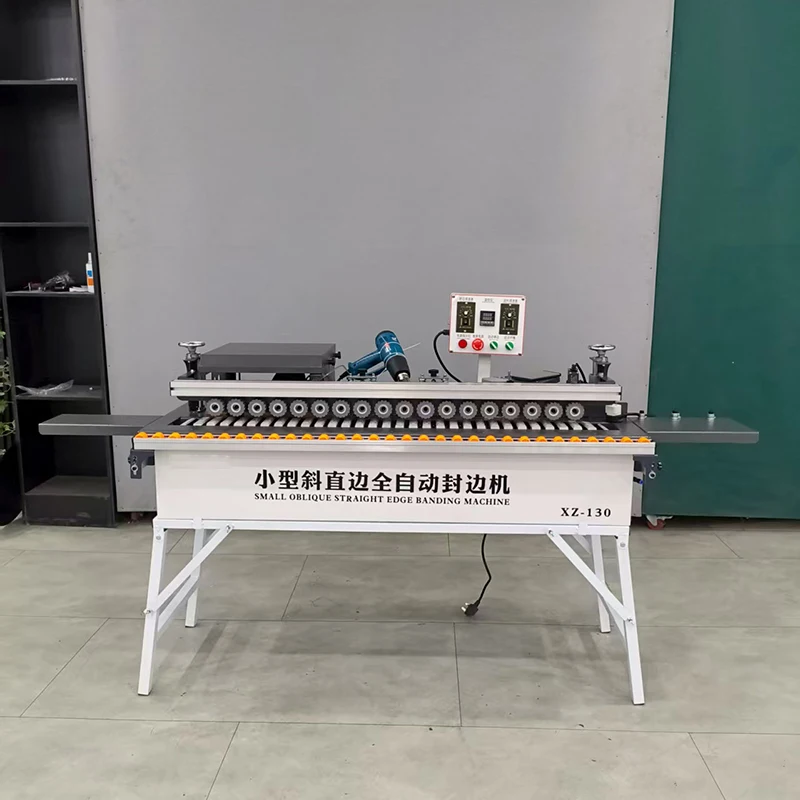
Automatic Slanted Straight Edge Banding Machine |
| Overall Dimensions (L×W×H) |
139 cm × 52 cm × 61 cm |
| Panel Thickness Range |
18–25 mm |
| Strip Thickness |
Up to 1.2 mm |
| Rated Voltage |
220 V |
| Glue Capacity |
2000 ml |
| Heating Time |
5–10 minutes |
| Glue Type |
PUR hot-melt |
| Trimming Station |
Elastic profiling trimming |
| Plate Feeding |
Automatic |
| Vacuum Device |
Self-contained |
| Pressure Beam |
Aluminum alloy, manually adjustable |
| Assembly State |
Requires on-site assembly |
| Warranty |
1 year |
Application Suitability
| Application |
Material or Output |
| Small cabinet door production |
MDF and particleboard with PVC edge banding |
| Custom joinery and built-in furniture |
Plywood panels with wood veneer strips |
| Startup workshop edge sealing |
Melamine-faced boards up to 25 mm thick |
| Angled and straight edge finishing |
PUR hot-melt glue on standard panel substrates |
Why the Voltage Question Should Come Before the Price
Confirming your local voltage and frequency before ordering prevents a machine that sits idle on arrival.
I have watched small workshop owners unpack an edge bander only to find it wired for a grid that does not exist in their facility. The unit becomes dead weight while they scramble for a transformer, and production stalls for days. This edge banding machine in stock fast delivery configuration ships at 220V, and we verify compatibility with your site's power supply before the crate is sealed [NEED_CITE: voltage and frequency standards by export market].

Stocked Configurations That Match Small Workshop Realities
Small joinery operations do not need a full-production line on day one. They need a compact edge banding machine in stock fast delivery that handles the panel sizes and strip materials they actually use. This unit covers 18–25 mm panel thickness with automatic feeding, which is the range where most custom cabinet and shelving work falls. The footprint stays under 1.5 meters in length, so it fits into tight workshop corners alongside existing table saws and drilling rigs.
From Hand-Held Tools to Consistent Machine Edging
Workshops transitioning from manual edge banding often underestimate how much glue consistency and feed stability matter once volume picks up. Hand-held units leave visible glue lines on certain substrates, and operator fatigue introduces variation across a batch. The PUR hot-melt system on this machine maintains a steady glue temperature through the full hot air heating cycle, producing uniform adhesion across MDF, particleboard, and plywood. The elastic profiling trimming station finishes each pass without scoring the panel surface, which is something entry-level machines with rigid trimmers tend to fail at [NEED_CITE: edge banding adhesion standards for panel furniture].
Reading the Specs That Matter for Daily Production
The 2000 ml glue pot capacity means operators can run through a typical small-batch order without stopping to refill, which matters when you are edging cabinet components in sequence. The 5–10 minute heating time sets the rhythm for morning startup: turn the machine on, prepare your panels, and by the time the glue reaches operating temperature the workspace is ready. The aluminum alloy pressure beam is manually adjustable, giving the operator direct control over clamping force for different panel thicknesses within the 18–25 mm range. The self-contained vacuum device means no separate dust extraction ductwork is required, keeping installation simple in workshops without centralized extraction infrastructure.
The Hidden Cost of Skipping Spare Wear Parts
I have seen small cabinet makers order an edge bander without a single spare trimming blade or glue roller, then shut down for days waiting for a parcel when the first consumable wears out. A production halt in a two-person workshop does not just cost the delayed order — it pushes back every job in the queue. Bringing an edge banding machine in stock fast delivery into your shop only works if the consumables stay in stock too [NEED_CITE: typical consumable replacement intervals for entry-level edge banders].
What Sets This Procurement Path Apart
Configuration confirmation happens before the order is finalized, not after. We check your local voltage and frequency so the machine arrives ready to plug in. The product family spans entry-level to full-function models, meaning your workshop can add capacity later without switching suppliers. Every unit goes through a four-stage quality check including a pre-shipment test run on panel material matching your specification. The engineer-led recommendation process ensures the machine you receive actually fits the panel sizes and strip materials your shop processes daily.
Documentation & Verification
- Factory test record covering your specified panel thickness range before dispatch
- Electrical schematic confirming the 220V wiring and control circuit layout
- Operation and maintenance manual in your agreed language with illustrated troubleshooting
- Machine specification sheet listing all confirmed parameters and trimming station settings
Installation, Commissioning & Support
- Requires on-site assembly with the aluminum alloy pressure beam and feed table aligned during setup
- Dedicated 220V circuit recommended to protect the PUR glue heating element from voltage fluctuation
- First-run calibration includes glue temperature verification and elastic trimming depth adjustment
- Self-contained vacuum device connects internally, eliminating external ductwork requirements
- Spare trimming blades and glue rollers listed in the included parts inventory for reorder planning
What We Need to Move Your Order Forward
Send us the panel materials and thickness range your shop works with most often, along with the edge strip type you intend to use. Confirm your facility voltage and frequency so we can validate the 220V configuration. If you have existing upstream saws or downstream boring machines, note their feed heights so we can flag any compatibility issues before the edge banding machine in stock fast delivery leaves our floor.
Frequently Asked Questions
Q: Is the 220V configuration compatible with my local power supply, and can other voltages be arranged?
A: We confirm your local voltage and frequency before dispatch to ensure the machine connects directly to your grid. The standard configuration ships at 220V. If your facility runs on a different supply, alternative voltage arrangements can be discussed during the order confirmation stage so the correct electrical components are installed before the unit leaves the factory.
Q: What panel thicknesses and edge strip materials can this machine handle?
A: The machine processes panels from 18 to 25 mm thick, which covers most MDF, particleboard, and plywood used in cabinet and joinery work. It accepts edge strips up to 1.2 mm thick and runs PUR hot-melt glue, suitable for PVC and wood veneer banding materials commonly specified by small custom furniture makers.
Q: How is the machine assembled on arrival, and is installation guidance provided?
A: The unit ships partially disassembled to reduce transport volume. On-site assembly involves mounting the pressure beam, aligning the feed table, and connecting the internal vacuum device. An operation manual with illustrated assembly steps accompanies every shipment, and remote guidance is available during your first startup.
Q: What is the lead time from order to dispatch, and is the unit currently in stock?
A: Stocked configurations are prepared for fast dispatch once voltage and specification details are confirmed. Lead time depends on any custom language or electrical adjustments requested. We provide a confirmed dispatch timeline after the pre-shipment test is completed and the factory test record is finalized for your order.
Q: What spare parts and consumables should I order with the machine?
A: I always recommend adding spare trimming blades, glue rollers, and PUR glue stock to your initial order. A dull trimming blade on a small-batch machine means stopping production entirely while you wait for replacements. Having these consumables on your shelf from day one prevents avoidable downtime during your first weeks of operation.