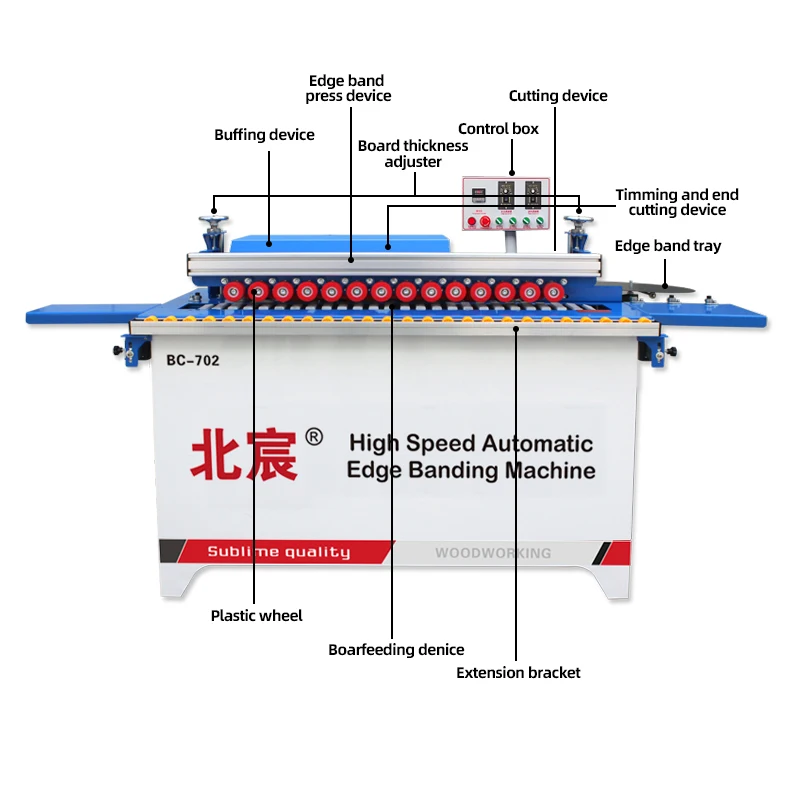
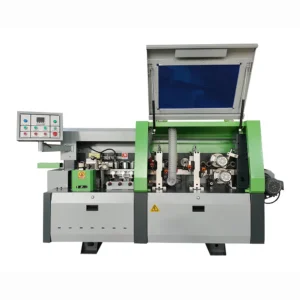
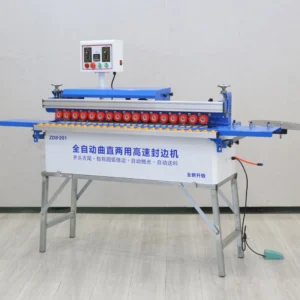
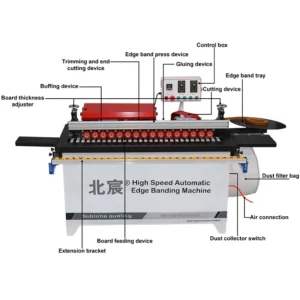
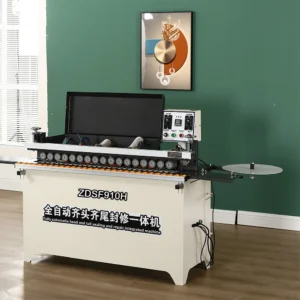
Stocked for fast dispatch — DW702 units ship within days of order confirmation, with voltage and language locked in before they leave the Shandong floor.
Technical Specifications
| Parameter |
Value |
| Model |
DW702 |
| Product Type |
Automatic Edge Banding Machine |
| Total Power |
3800W |
| Voltage Options |
220V / 380V / customization |
| Glue Pot Capacity |
1000 ml |
| Edge Banding Thickness Range |
0.3–3 mm |
| Edge Banding Height Range |
0–50 mm |
| Minimum Sheet Length |
25 cm |
| Minimum Sheet Width |
10 cm |
| Trimming Motor |
800W × 2 |
| Polishing Motor |
180W × 2 |
| Conveyor Feed Motor |
140W |
| Edge Feed Motor |
20W |
| Vacuum Motor |
1200W |
| Air Source Pressure |
0.4–0.8 MPa |
| Overall Dimensions (L×W×H) |
120 × 55 × 110 cm |
| Net Weight |
105 kg |
| Standard Operations |
Gluing, edge banding, trimming, polishing, automatic head and tail cutting, vacuum feeding |
| Control Panel Language |
Chinese and English standard; Spanish or other languages by customization |
| Plug Options |
EU / USA / AU / UK |
| Certification |
CE |
Application Suitability
| Application |
Material or Output |
| Small-batch cabinet door production |
MDF and plywood panels with PVC edge banding |
| Custom joinery and built-in shelving |
Particleboard and blockboard with veneer banding |
| Startup furniture workshop |
Solid wood panels up to 50 mm edge height |
| Polymer door panel edging |
PVC substrate with 0.3–3 mm polymer banding |
| Small-batch plywood shelving |
Plywood core with 0.3–3 mm veneer or PVC banding |
Why the Voltage Question Should Come Before the Price on a Compact Edge Bander
A machine wired for the wrong supply will sit idle on your floor until an electrician rewires it — or worse, it burns out on first power-up.
I have walked customers through commissioning calls where the very first problem was not the glue temperature or the trim quality, but the fact that the incoming supply was 50 Hz and the machine motor was wound for 60 Hz. The Automatic Edge Banding Machine compact in stock fast delivery listing promised quick shipping, and it arrived quickly — straight into a three-week delay while a local panel shop sorted out a transformer. The cost of that delay in missed delivery dates to their own customers far exceeded any price advantage they thought they had secured. [NEED_CITE: voltage and frequency standards by export market]
Stocked Models Versus Built-to-Order: What the Lead Time Actually Means
When a joinery workshop needs a machine to fill an immediate gap — a new contract, a broken-down manual edger, a seasonal spike — waiting eight to twelve weeks for a factory build slot is not an option. The DW702 sits in ready inventory, which means the bottleneck shifts from production scheduling to shipping logistics. You confirm your voltage, plug type, and control panel language, the unit is pulled from stock, pre-shipment tested, and dispatched. The Automatic Edge Banding Machine compact in stock fast delivery promise only works if the supplier actually holds finished units and does not relabel a build queue as "stock."
Matching Footprint to Workshop Reality
A 120 × 55 × 110 cm footprint fits against a wall in a two-bay joinery shop that is still running a table saw and a panel router on the same floor. The DW702 does not require a dedicated cell or a reconfigured material flow. You wheel it into position, connect the air supply at 0.4–0.8 MPa, plug into a confirmed circuit, and you are edging panels the same afternoon. For a startup that is still figuring out where the dust collector and the compressor will eventually live, that compact envelope leaves room to grow around the machine rather than forcing a floor plan redesign before the first cabinet ships. [NEED_CITE: CE machinery directive requirements for industrial equipment]

What the Trimming and Polishing Motors Actually Do to Your Edge
The two 800W trimming motors cut the overhanging PVC or veneer flush with the panel face in a single pass. If those motors are undersized for the banding thickness you are running, the cutter chatters and leaves a scalloped edge that your assembler will see when two panels meet at a carcass corner. The dual 180W polishing motors follow immediately, buffing the trimmed edge to a clean finish. On a 3 mm PVC band, the trimming load is noticeably higher than on a 0.5 mm melamine strip — which is why the spec sheet matters more than the brochure photo when you are deciding whether this machine handles your actual material list.
Selecting the Right Configuration Before You Click Order
The mistake I see most often on small-machine purchases is not the machine itself but the gap between what the buyer assumed and what the order form confirmed. The DW702 can ship with an English-only control panel or a multilingual interface, an EU plug or a NEMA 6-20, 220V single-phase or 380V three-phase. None of these are difficult to get right — they only become expensive problems when they are wrong at the dock. An Automatic Edge Banding Machine compact in stock fast delivery is only fast if the configuration conversation happened before the crate was nailed shut.
The Cost of Skipping the Material Sample Test
I had a customer last year who ordered a compact edge bander for his cabinet shop, sent a photo of his MDF board, and skipped sending actual PVC offcuts. The machine arrived, the trimming pressure was set for the standard 1 mm ABS he usually ran, and his new 2 mm PVC band — stiffer compound, different plasticizer ratio — lifted at the tail on every panel. Three days of output went to rework before we adjusted the pressure wheel and scraper settings to match his real stock. Send the actual banding material, not a datasheet link, before the machine ships. [NEED_CITE: edge banding adhesion failure causes on polymer substrates]
What You Actually Get When You Order From This Floor
The DW702 is built on the same line that runs larger pre-milling models, which means the trimming spindles and conveyor bearings come from the same supplier pools. Four-stage quality control — incoming material, in-process, finished assembly, and pre-shipment verification — applies to this compact unit the same way it applies to a full-line configuration. Voltage and plug confirmation is documented on the electrical schematic before the machine is crated, not guessed from a country dropdown. The control panel language is set and verified during the pre-shipment test, so the operator sees readable text the moment they power on. CE declaration of conformity accompanies every export unit.
Documentation & Verification
- CE declaration of conformity matched to the DW702 unit serial number
- Electrical schematic confirming your specified voltage, frequency, and plug type before crating
- Factory test record showing glue application and trim result on your panel and banding sample
- Operation and maintenance manual in English, Spanish, or your specified language with illustrated parts diagram
- Spare parts list with part numbers for trimmer blades, polishing wheels, and feed belt segments
- Pre-shipment photographs of your specific unit powered on and running test stock
Installation, Commissioning & Support
- Requires a level concrete floor section within the 120 × 55 × 110 cm footprint with clearance on both infeed and outfeed sides
- Dedicated circuit matching confirmed voltage — 220V single-phase or 380V three-phase — with appropriate breaker rating for 3800W total load
- Compressed air supply at 0.4–0.8 MPa with a clean, dry line connected to the machine inlet
- Glue pot loaded and heated to operating temperature, with trim and polish heads zeroed to your panel thickness on first startup
- Spare scraper blades and polishing pads included in the shipment for initial months of operation
- Remote commissioning guidance available via video call if no on-site technician is scheduled
What to Include With Your Inquiry
Send your actual panel material and thickness range, the PVC or veneer banding brand and thickness you plan to run, your workshop voltage and frequency, and your preferred control panel language. If you have existing upstream saws or downstream boring machines, note their feed heights so we can confirm the DW702 conveyor sits at a compatible transfer point. Samples of your banding material are always preferred over spec sheets.
Frequently Asked Questions
Q: Is the DW702 in stock and how fast can a single unit ship?
A: Finished DW702 units are held in ready inventory for dispatch. Once you confirm voltage, plug type, and control language, the unit is pulled, pre-shipment tested, and crated. Actual delivery time to your dock depends on your location and the shipping method chosen — sea freight and air freight options are both available for this weight class.
Q: Can you match my country's voltage and frequency before shipping?
A: Yes. The DW702 is configurable for 220V or 380V, and frequency is confirmed during the specification stage. The matching plug type — EU, USA, AU, or UK — is fitted before the machine is crated. An electrical schematic documenting the confirmed configuration is included in your shipment documentation.
Q: Will my operator be able to read the control panel?
A: The standard panel ships in Chinese and English. If your operator reads Spanish or another language, specify this during the order stage and the interface is configured before dispatch. The goal is zero language friction on day one of commissioning.
Q: What happens if a part wears out after installation?
A: A spare parts list with numbered references for blades, polishing wheels, and belt segments ships with the machine. Replacement parts can be ordered directly, and the illustrated parts diagram in the manual helps you identify what you need without a service call.
Q: How is the machine packed for international transit?
A: The DW702 is crated with protective blocking around the trimming heads, polishing spindles, and glue pot assembly. Packing photographs of your specific unit are provided before the crate leaves the factory so you can verify condition prior to dispatch.