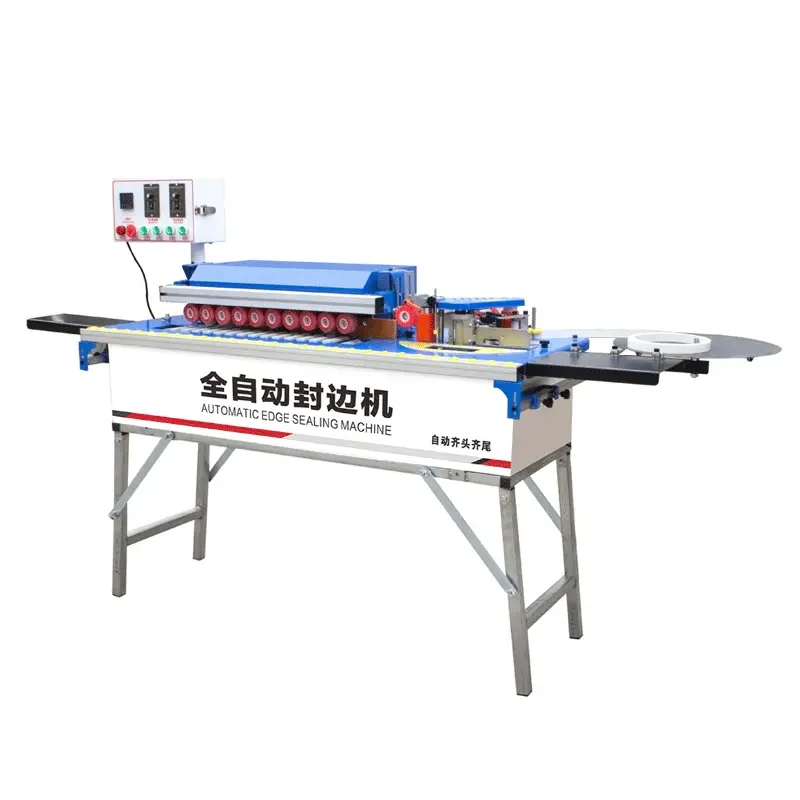
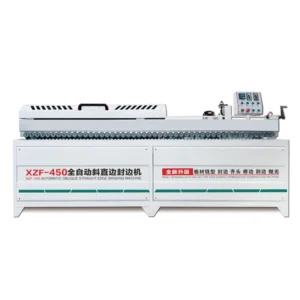
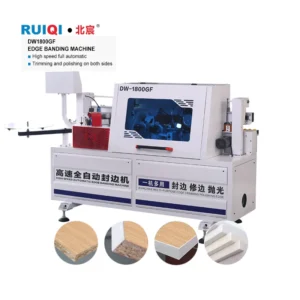
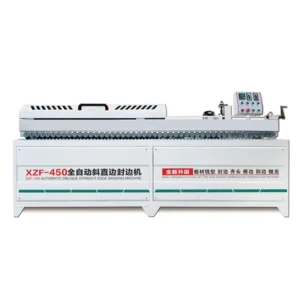
Ready from stock — dispatching a fully assembled DW102 Mini Automatic Edge Banding Machine configured to your regional voltage, so your workshop can start banding panels the week it arrives instead of waiting months for production.
Technical Specifications
| Parameter |
Value |
| Model |
DW102 |
| Product Type |
Mini Automatic Edge Banding Machine |
| Total Power |
3800W |
| Voltage Options |
220V / 380V / customization available |
| Edge Banding Height Range |
0–50 mm |
| Edge Banding Thickness Range |
0.3–3 mm |
| Minimum Sheet Length |
25 cm |
| Minimum Sheet Width |
5 cm |
| Trimming Power |
650W × 2 |
| Polishing Power |
180W × 2 |
| Vacuum Power |
1200W |
| Glue Pot Capacity |
1000 ml |
| Air Source Pressure |
0.5–0.8 MPa |
| Edge Feed Power |
20W |
| Transmission Power |
60W |
| Overall Dimensions (L×W×H) |
128 × 47 × 69 cm |
| Net Weight |
75 kg |
| Plug Options |
EU, USA, AU, UK |
| Language Options |
Chinese and English standard; other languages available on request |
| Feed Speed |
(basis not stated in source — confirm before order) |
| Panel Thickness Range |
(basis not stated in source — confirm before order) |
Application Suitability
| Application |
Material or Output |
| Small-run custom cabinet door edging |
MDF and particleboard with PVC edge banding |
| Compact workshop panel finishing |
Plywood and blockboard with straight and curved edges |
| Prototyping and sample production |
Polymer door components requiring curved edge trimming |
| Joinery startup transition from hand tools |
Standard furniture panels in limited batch sizes |
Why Voltage Confirmation Must Happen Before Dispatch
Specifying your exact voltage and frequency avoids a machine that sits idle on your shop floor.
I have watched small workshop owners plug in a newly arrived edge bander only to trip their breaker or find the glue pot will not reach temperature. The issue almost always traces back to a voltage or frequency mismatch that was never discussed before the unit left the factory. With stocked machines, this conversation tends to get skipped because the buyer assumes the unit is already configured for their region. [NEED_CITE: voltage and frequency standards by export market]
Ordering a Mini Automatic Edge Banding Machine in stock does not mean it automatically matches your electrical supply. The DW102 supports 220V and 380V configurations with EU, USA, AU, and UK plug options, but the default setting on a stocked unit may differ from what your workshop needs.

What Stock Availability Actually Means for Your Timeline
When a small cabinet maker decides to move away from hand-held edge trimmers, the lead time on a custom-built machine can stretch well beyond what their current order backlog allows. Having the DW102 Mini Automatic Edge Banding Machine in stock means the unit is physically assembled, tested, and sitting in the warehouse — not waiting on a production slot. This matters when your current edge work bottleneck is costing you completed cabinets every week.
The trade-off with ready-stock equipment is that certain configurations may be preset. Before you commit, confirm that the voltage, plug type, and control panel language on the available unit match your workshop conditions, or that modifications can be completed before dispatch.
Dispatch Speed Without Sacrificing Pre-Shipment Checks
Stocked does not mean untested. Every DW102 unit undergoes a pre-shipment verification that includes running actual edge banding material through the trimming and polishing stations. [NEED_CITE: pre-shipment inspection standards for woodworking machinery] For a small workshop receiving its first automated bander, that test record is the only assurance that the machine will produce acceptable edges on arrival rather than requiring days of on-site adjustment.
The 1000 ml glue pot capacity and 3800W total power are sized for intermittent daily use rather than continuous production runs. Understanding this before the machine ships helps you plan realistic batch sizes once it is running on your floor.
How the Compact Footprint Translates to Workshop Layout
At 128 × 47 × 69 cm and 75 kg, the DW102 fits into workshop layouts where a full-size edge bander would demand dedicated floor space and reinforced flooring. The 0.5–0.8 MPa air source requirement means you need a small compressor nearby, but the overall utility demand stays within what most single-phase workshop circuits can handle.
The 0–50 mm edge banding height range and 0.3–3 mm thickness range cover standard PVC edging used on MDF, plywood, and particleboard panels. The two 650W trimming motors and two 180W polishing motors complete the edge in a single pass, which eliminates the back-and-forth between separate trimming and finishing stations that slows down small-batch production.
The 1200W vacuum system captures trimming debris at the source, keeping your bench area clear without requiring a separate dust extraction line. For workshops where floor space is measured in square meters rather than aisles, this integrated approach matters.
The Cost of Skipping Material Compatibility Checks
One of the most common failures I see in small workshops is buying a mini bander rated for standard MDF, then feeding it high-density board without adjusting the glue temperature. The glue pot on the DW102 holds 1000 ml and reaches working temperature, but dense substrates pull heat away faster than lighter boards. The result is edge banding that lifts at the corners within hours of application.
When the substrate and glue temperature are mismatched, the trimming stage tears rather than cuts the excess banding, leaving visible ridges that no amount of polishing will hide. [NEED_CITE: substrate density effects on hot melt adhesive bonding] This is not a machine defect — it is a configuration gap that could have been caught by running a sample of your actual panel material before the machine ships.
Another overlooked issue is minimum sheet dimensions. The DW102 handles sheets as short as 25 cm and as narrow as 5 cm, which covers most cabinet component sizes. But workshops cutting very small drawer fronts or specialty inserts sometimes discover that pieces below these minimums cannot be fed reliably, forcing them back to hand trimming for those specific parts.
Why Procure This Model Through This Channel
The DW102 is manufactured in a facility with proprietary cutting mechanism patents and verified tolerance standards, meaning the trimming precision you see in the test record is repeatable in your workshop rather than a one-off demonstration result.
Voltage, plug, and control panel language customization are treated as standard order parameters rather than special requests, so a stocked unit can be reconfigured before dispatch to match your local electrical supply and operator requirements.
A four-stage quality control process covers incoming material inspection through pre-shipment verification, with each DW102 generating its own test record tied to the specific unit serial number.
The engineer-led configuration process means you receive a formal quotation with confirmed specifications within 24 hours, including voltage and frequency matched to your workshop rather than a generic default setting.
Factory visits are welcomed for buyers who want to see the assembly line and run their own panel samples through the DW102 before committing to an order.
Documentation & Verification
- Factory test record showing edge trimming on your specific panel material and thickness
- Electrical schematic confirming voltage and frequency matched to your regional supply
- Operation and maintenance manual supplied in the language your operator reads
- Spare parts list with reorder codes for trimming blades and polishing wheels
- Packing photographs documenting machine condition before crating
Installation, Commissioning & Support
- Requires a dedicated circuit matching the confirmed 220V or 380V configuration before uncrating
- 128 × 47 × 69 cm footprint allows placement against a wall with operator access on two sides
- Air compressor delivering 0.5–0.8 MPa must be connected before the first glue pot heating cycle
- Initial glue temperature calibration should run against your actual panel density, not generic settings
- Trimming blade alignment verified during pre-shipment but should be rechecked after transport vibration
What to Include in Your Inquiry
To match you with the correct stocked configuration, provide your workshop voltage and frequency, the primary panel materials you edge band, and whether your operators need a control panel language beyond Chinese or English. If you run curved edge work regularly, specify the typical curve radius so we can confirm feed path clearance.
Frequently Asked Questions
Q: Is the DW102 currently in stock and how quickly can it ship internationally?
A: Stock availability is confirmed at the time of inquiry and changes as units are reserved. Once your voltage, plug type, and language are confirmed and any pre-dispatch modifications are completed, the unit is typically crated and handed to the freight forwarder within a matter of days, with transit time depending on your destination port.
Q: What voltage and plug configuration will the stocked unit arrive with?
A: Stocked DW102 units may carry a default voltage setting that does not match your regional supply. You must specify your exact voltage, frequency, and plug type during the inquiry so that any necessary reconfiguration is completed and documented in the electrical schematic before the machine is crated for dispatch.
Q: What is the realistic daily workload this mini bander can handle?
A: The 3800W total power and 1000 ml glue pot are designed for intermittent small-batch production rather than continuous full-shift operation. Workshops running custom cabinet runs with varied panel sizes typically find the DW102 handles their daily edge banding needs comfortably, provided the machine is allowed brief cool-down intervals during extended sessions.
Q: Will the control panel language match what my operator can read?
A: Chinese and English are standard on all units. If your operator reads Spanish or another language, specify this during the inquiry so the control panel labeling and interface can be adjusted before dispatch. A manual in the matching language is included in the shipping crate.
Q: What spare parts and consumables are included, and how do I reorder?
A: The DW102 ships with a spare parts list identifying trimming blades, polishing wheels, and other wear items by reorder code. The initial package includes baseline consumables to begin production. Reordering is handled through the same channel using the codes on your spare parts list.