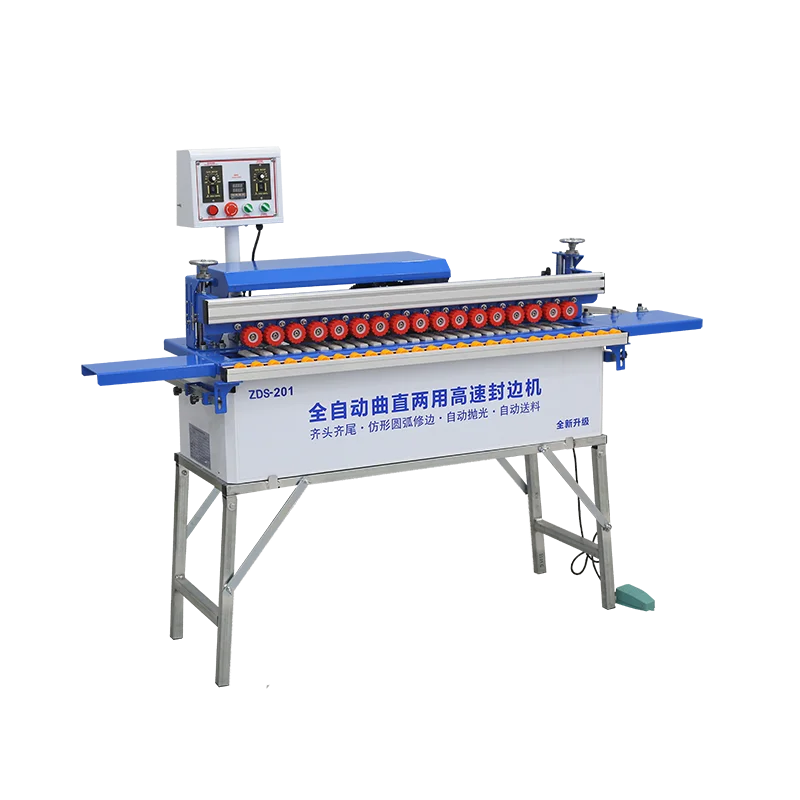
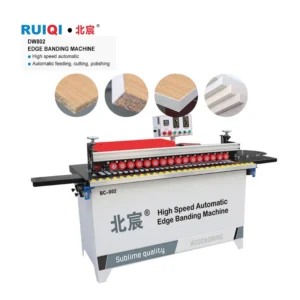
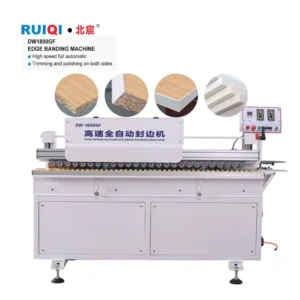
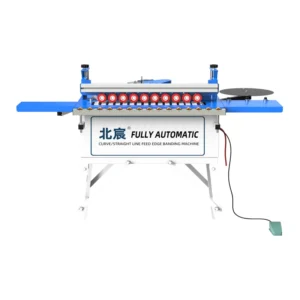
Ready-Stock Dispatch — compact straight and curved edge bander tested and verified at our Ningjin facility before crating, with voltage and manual language confirmed to your workshop's actual supply.
Technical Specifications
| Parameter |
Value |
| Product Type |
Automatic Curved and Straight Edge Banding Machine with Trimming and Buffing |
| Heating Power |
1.2 kW |
| Total Power |
3 kW |
| Edge Banding Speed |
0–26 cm/s (basis not stated in source — confirm panel material / edge thickness) |
| Edge Banding Thickness Range |
0.3–3 mm |
| Panel Thickness Range |
8–50 mm |
| Feeding Speed |
0–15 m/min (basis not stated in source — confirm straight vs curved mode) |
| Overall Dimensions (L×W×H) |
1200 × 450 × 750 mm |
| Net Weight |
85 kg |
| Transport Motor Power |
180 W |
| Trimming Mechanism |
4-blade alloy arc cutter head with square slide rail |
| Dust Extraction |
Dual large-diameter dust collectors (basis not stated in source — confirm suction fan spec and duct diameter) |
| Edge Strip Cutting |
Pneumatically controlled cutting device |
| Pressure Beam |
Adjustable aluminum alloy |
| Conveyance |
Steel rod slide rail crawler transmission |
| Control Panel |
Multi-function button operation |
| Polishing Device |
Cross polishing up and down |
Application Suitability
| Application |
Material or Output |
| Small joinery workshop edge finishing |
MDF, plywood, and particleboard panels with straight or curved profiles |
| Custom cabinet door and drawer front banding |
PVC and veneer edge strips from 0.3 to 3 mm on solid wood panels |
| Startup furniture maker transitioning from manual to machine |
Mixed board substrates requiring trimming and buffing in a single pass |
| Low-volume curved panel processing |
Shaped MDF and plywood components for bespoke furniture runs |
Why the Voltage Question Should Come Before Everything Else
Confirming your workshop's supply voltage and frequency before dispatch prevents a machine that sits idle on arrival.
I once watched a fully automatic edge bander ship to a Southeast Asian cabinet shop without a second voltage check. The inverter threw a red fault the moment the local electrician powered it up, and three weeks of rewiring later the customer had missed his container loading deadline entirely. That small workshop edge bander fast delivery promise means nothing if the machine cannot run on the power you actually have. Every unit leaving our floor now goes through a triple verification — nameplate photo, electrical cabinet photo, and written voltage confirmation — before the crate is sealed [NEED_CITE: voltage and frequency standards by export market].

One Compact Footprint for Both Straight and Curved Edges
Most entry-level workshops buy a straight-only bander first, then discover they need a second machine for curved profiles. This edge banding machine in stock handles both geometries within its 1200 × 450 mm footprint, so a small joinery shop can take on shaped cabinet doors and radius panels without doubling floor space. The 4-blade alloy arc cutter head follows curved contours on a square slide rail, producing a consistent profile without the operator switching tools mid-run.
Pneumatic Cutting and Adjustable Pressure for Mixed Panel Runs
When a workshop alternates between 10 mm shelf boards and 40 mm desktop slabs, manual edge strip cutting and fixed pressure beams create constant setup delays. The pneumatically controlled cutting device on this unit trims the strip automatically, while the adjustable aluminum alloy pressure beam stabilizes panels anywhere in the 8–50 mm range. Operators spend less time adjusting and more time feeding, which matters when a small batch of custom furniture has a tight delivery window [NEED_CITE: typical setup time losses in small-batch woodworking shops].
Reading the Specs That Actually Matter on the Shop Floor
The 0.3–3 mm edge thickness range covers the PVC and veneer strips most small workshops use daily, but the trimming result depends on how the cutter head meets the material. A 4-blade alloy arc cutter on a square slide rail maintains contact pressure across curved profiles, reducing the chatter marks that force hand-sanding downstream. Feeding speed reaches 0–15 m/min, though actual throughput depends on whether you are running straight sections or guiding curved panels by hand. The dual dust collectors are sized for the unit's trimming and buffing stations, keeping the 1200 mm work zone clear of PVC chips and adhesive residue that can interfere with the crawler transmission. Total power draw of 3 kW means the machine runs on a standard single-phase workshop circuit in many markets, but always verify your local supply before ordering [NEED_CITE: CE machinery directive requirements for industrial equipment].
What Happens When a Single Machine Is Bought Without Line Context
A joinery workshop sometimes orders a bander that matches today's panel thickness but not next quarter's thicker stock, or chooses a feed speed that bottlenecks the saw station upstream. Mismatched feed heights between a sliding table saw and an edge bander force operators to lift panels manually, introducing edge chips and inconsistent glue lines. These problems surface only after the machine is bolted to the floor, when returning it is no longer practical [NEED_CITE: common installation mismatches in small woodworking operations].
What You Actually Get Beyond the Crate
Every unit ships with a factory test record showing trimming and buffing results on the panel thickness range you specified, not a generic sample. Voltage and frequency are confirmed in writing against your local supply before production begins, so the motor and inverter match your grid. An operation and maintenance manual in your operator's language accompanies the machine, reducing the commissioning guesswork that stalls first-day output.
Documentation & Verification
- Machine specification sheet confirming voltage, frequency, and plug type for your workshop
- Factory test record on your specified panel thickness and edge material before dispatch
- Electrical schematic with circuit diagram matching the shipped control panel
- Operation and maintenance manual translated into your operator's working language
- Spare parts list covering trimming blades, buffing pads, and wear components
- Packing photographs showing crate condition and accessory placement before collection
Installation, Commissioning & Support
- Requires a level concrete floor within the 1200 × 450 mm footprint plus operator clearance on three sides
- Dedicated 3 kW circuit with correct voltage and frequency as confirmed on the nameplate
- Arrives partially assembled; pressure beam and dust collector ducts need on-site fitting
- First-run parameter setting covers feed speed, glue temperature at 1.2 kW heating, and trim depth
- Trimming blade replacement interval and buffing pad rotation schedule covered in the manual
- Spare blades and pads listed on the parts sheet shipped with the machine for quick reorder
Before You Request a Quote
Send us your most common panel material and thickness range, the edge strip type and width you run daily, and your workshop's supply voltage and frequency. If your operators speak a language other than English or Chinese, let us know so the control labels and manual match. We will then confirm stock status and the earliest dispatch date for a single-unit order.
Frequently Asked Questions
Q: Is this model stocked and what is the dispatch lead time for a single-unit order?
A: Stock availability changes with production cycles, so we confirm current inventory at the time of your inquiry. Once voltage and language are verified, a stocked unit can typically be crated and ready for collection within days rather than weeks. Single-unit orders follow the same pre-shipment test and documentation process as larger batches.
Q: Can the voltage be confirmed to match my workshop's power supply before shipment?
A: Yes. Before any unit leaves the factory, we require written confirmation of your local voltage and frequency. The nameplate, motor rating, and inverter settings are then matched to your supply, and we send photographs of the electrical cabinet and nameplate for your approval before crating.
Q: What is the maximum panel thickness and edge thickness this machine handles in curved mode?
A: The panel thickness range is 8–50 mm and the edge thickness range is 0.3–3 mm, applicable to both straight and curved profiles. Actual results on curved edges depend on the radius and material, so we recommend sending a sample panel for a test run if your contours are tight or irregular.
Q: Are spare trimming blades and buffing pads included, and how do I reorder them?
A: Each machine ships with a spare parts list identifying the trimming blades and buffing pads specific to this model. Initial consumables are included in the crate. Reorders can be placed directly using the part numbers on that list, and we keep stock of common wear items for prompt dispatch.
Q: Is there an upgrade path to a higher-throughput model as my order volume grows?
A: This unit sits at the entry point of a broader product family that extends to full-function pre-milling edge banders with higher feed speeds and additional stations. When your volume outgrows the current machine, moving to a larger model within the same family means your operator training and maintenance routines carry over with minimal relearning.