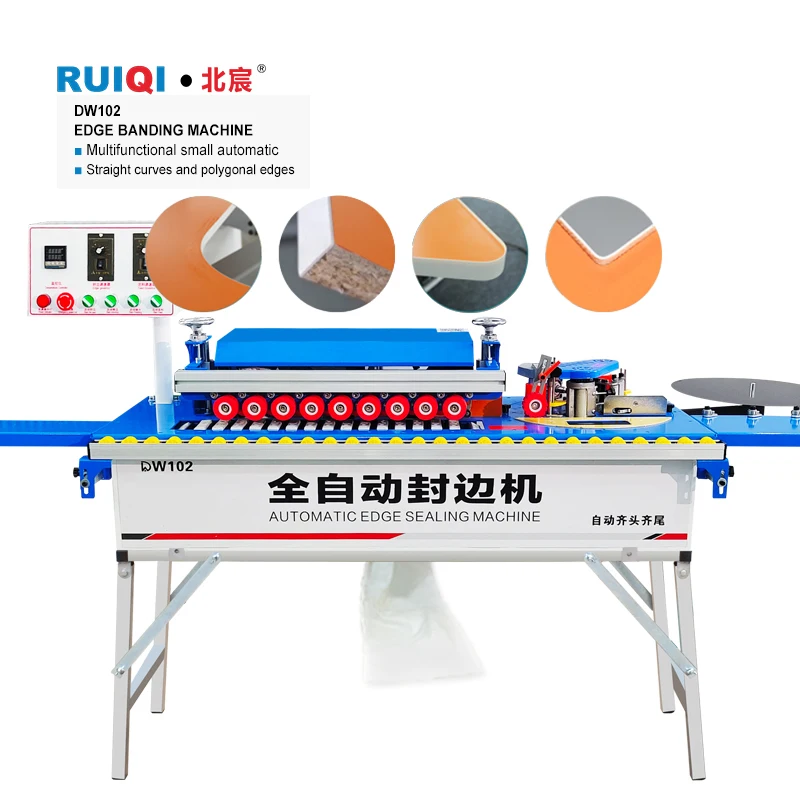
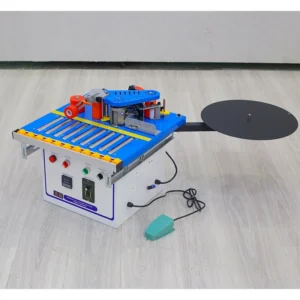
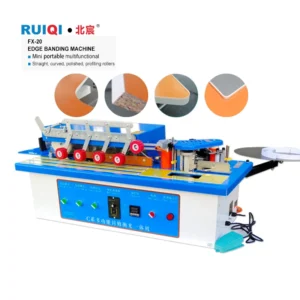
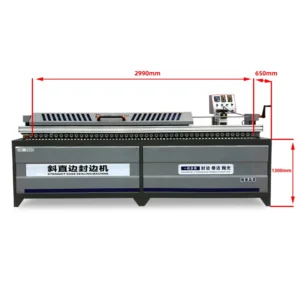
Ready-stock readiness — DW102 manual edge banding machines are dispatched directly from inventory with configurable voltage and regional plug options, so your small workshop can receive a working unit rather than a project.
Technical Specifications
| Parameter |
Value |
| Model |
DW102 |
| Product Type |
Manual Edge Banding Machine |
| Total Power |
3800W |
| Voltage & Frequency |
220V / 380V / customization |
| Control System |
Manual operation with vacuum assist |
| Edge Banding Mode |
Curved and straight |
| Edge Banding Thickness |
0.3–3 mm |
| Edge Banding Height |
0–50 mm |
| Minimum Sheet Length |
25 cm |
| Minimum Sheet Width |
5 cm |
| Trimming Power |
650W × 2 |
| Polishing Power |
180W × 2 |
| Vacuum Power |
1200W |
| Air Source Pressure |
0.5–0.8 MPa |
| Glue Pot Capacity |
1000 ml |
| Overall Dimensions (L×W×H) |
128 × 47 × 69 cm |
| Net Weight |
75 kg |
| Plug Options |
EU, USA, AU, UK |
| Language Options |
Chinese, English (other languages customizable) |
| Key Features |
Curved and straight edge banding, edge trimming, polishing, automatic head and tail |
Application Suitability
| Application |
Material or Output |
| Small-batch cabinet panel edging |
Medium density fiberboard and particleboard with PVC or veneer banding |
| Curved-profile furniture components |
Plywood and blockboard with curved edge contours |
| Custom joinery startup production |
Polymer doors and solid wood panels requiring straight and curved finishing |
| Workshop transition from hand trimming |
MDF shelving and cabinet sides in low-volume runs |
Why the Voltage Question Should Come Before the Price
A manual edge banding machine in stock is only useful if it actually runs when you plug it in. Confirm your workshop voltage and frequency before you confirm your order — the DW102 ships configured to your grid, not a default setting.
I once walked into a joinery shop in Shandong where a freshly delivered edge bander sat silent under a tarp. The buyer had ordered based on price and delivery speed, never mentioning his workshop ran on a single-phase 220V line. The machine arrived wired for three-phase 380V. By the time an electrician reconfigured the internal transformer, the project was weeks behind. Small workshops frequently operate on mixed or older electrical infrastructure, and assuming a standard industrial supply is a common misstep [NEED_CITE: voltage and frequency standards by export market]. The DW102 supports 220V, 380V, and custom configurations, but only if the conversation happens at the quotation stage.

Dispatch Without the Waiting Game
When a joinery startup lands its first cabinet contract, waiting weeks for a machine to enter production is not an option. The DW102 manual edge banding machine in stock status means the unit is assembled, tested, and available for immediate packing. This matters most for workshops that are transitioning from hand-held routers and trimmers to their first dedicated edge finishing station. The compact 128 × 47 × 69 cm footprint and 75 kg weight allow placement on a standard workshop floor without structural reinforcement or a dedicated machine pit.
The machine handles both curved and straight edge profiles within a single setup, which eliminates the need for two separate workstations in a space-constrained shop. Operators feed panels manually while the vacuum assist holds the workpiece steady, and the automatic head-and-tail trimming removes overhang without a second pass.
What "Entry-Level" Actually Covers — and Where It Stops
The DW102 is designed for small batches and varied panel shapes, not continuous high-volume production. Edge banding thickness from 0.3 to 3 mm covers standard PVC and wood veneer materials used in custom cabinetry. The glue pot holds 1000 ml, which is sufficient for intermittent runs but requires refilling during longer sessions [NEED_CITE: glue consumption rates for manual edge banding on MDF substrates].
A manual edge banding machine in stock at this tier serves workshops producing dozens of panels per day, not hundreds. When your daily volume starts demanding continuous feed and automatic glue application across multiple stations, that is the signal to evaluate a full-function automatic line. The upgrade path exists within the same product family, but it begins with understanding where the DW102 fits today.
Reading the Specs That Matter for Panel Quality
The dual trimming motors at 650W each provide the torque needed for clean cuts on both MDF and denser particleboard, where underpowered trimmers leave chipped edges that fail during assembly. The 180W × 2 polishing units smooth the trimmed edge to a finish that accepts no visible glue line when the panel is inspected at arm's length.
The 0.5–0.8 MPa air source pressure requirement means your existing workshop compressor must deliver consistent pressure — a fluctuating supply causes uneven trimming depth, particularly on curved profiles where the cutter follows the contour. The vacuum assist at 1200W holds lighter MDF panels securely, but heavier blockboard may require operator hand support on the infeed side.
Edge banding height from 0 to 50 mm accommodates standard cabinet panel thicknesses, and the minimum sheet dimensions of 25 cm length by 5 cm width allow small offcut pieces to be edged for drawer components and filler strips [NEED_CITE: minimum panel dimension requirements for vacuum-assisted edge banders].
What Happens When the Machine Exceeds Its Design Intent
A small workshop that lands a large contract may be tempted to push a manual edge bander through extended shifts with minimal breaks. The glue pot at 1000 ml capacity was dimensioned for intermittent use — running it dry during a long batch introduces air into the glue line, causing weak bonds that only reveal themselves when the cabinet is assembled and stressed.
I have seen edge banders of this class develop uneven polishing wear when operators skip the recommended cool-down between batches. The result is visible banding lines on finished panels that pass visual inspection at the machine but fail under the LED lighting in a client's showroom. These failures do not appear in the factory — they appear at the installation site, where rework is costly [NEED_CITE: edge banding adhesion failure patterns in small workshop environments].
Why This Is the Right Source for a First Machine
The DW102 ships with voltage pre-configured to your specification — 220V, 380V, or a custom arrangement — with the matching plug (EU, USA, AU, or UK) already fitted before dispatch.
The operation manual arrives in your agreed language, so the operator can read the setup instructions on day one rather than guessing at unlabeled controls.
A four-stage quality check runs from incoming material inspection through pre-shipment verification, with a factory test record documenting performance on your specified panel material.
The machine sits within a broader product family, so when your volume outgrows manual operation, the transition to an automatic edge bander involves a familiar supplier relationship and compatible tooling standards.
Regional plug options and multilingual control panels are treated as standard configurations, not special requests that add lead time.
Documentation & Verification
- CE declaration of conformity specific to manual edge banding equipment
- Factory test record on your panel material and edge thickness before dispatch
- Electrical schematic confirming your ordered voltage and plug configuration
- Operation and maintenance manual in your agreed language
- Spare parts list with part numbers matching your unit's build
- Pre-shipment packing photographs for your records
Installation, Commissioning & Support
- Requires a stable 220V or 380V circuit matching the ordered configuration, with a dedicated breaker for the 3800W total load
- Place on a level floor within the 128 × 47 × 69 cm footprint — no anchor bolts or foundation pad required at 75 kg
- Connect to a workshop compressor delivering 0.5–0.8 MPa with a regulated line to the machine inlet
- First run should use scrap panels of your production material to verify trimming depth and glue temperature
- Polish wheel replacement and trimming blade adjustment covered in the included language-specific manual
- Glue pot cleaning after each session prevents residue buildup that affects bond quality on subsequent runs
Before You Request a Quote
To match the right configuration to your workshop, we need to know the panel materials you run most often and the edge banding thickness you use. Share your local voltage and frequency, and whether your compressor already meets the 0.5–0.8 MPa requirement. If you process curved profiles regularly, include the tightest radius you expect to edge so we can confirm the DW102 covers your range.
Frequently Asked Questions
Q: Is this manual edge banding machine in stock and how fast can it ship?
A: The DW102 is held in ready-stock status for prompt dispatch. Lead time depends on your selected voltage configuration and plug type, which are set before packing. Typical turnaround from confirmed specification to dispatch is measured in days rather than weeks, though exact timing should be confirmed at the quotation stage.
Q: Can I run both curved and straight panels on the same machine?
A: Yes. The DW102 handles both curved and straight edge profiles within a single setup. Minimum panel dimensions are 25 cm in length and 5 cm in width, with edge banding height up to 50 mm. The vacuum assist and manual feed allow operators to follow curved contours without switching machines or tooling.
Q: What voltage and plug options are available for my workshop?
A: The DW102 is configurable for 220V, 380V, or custom voltage arrangements. Plug options include EU, USA, AU, and UK standards. Specify your local voltage and frequency at the inquiry stage so the machine ships wired and plugged for your facility — this avoids rewiring delays after arrival.
Q: What is the upgrade path when order volume grows beyond manual operation?
A: The DW102 sits within a product family that extends to full-function automatic edge banders. When your daily panel volume demands continuous feed, pre-milling, and multi-stage finishing, the transition stays within the same supplier and tooling ecosystem. Your production data from the manual stage helps configure the automatic upgrade correctly.
Q: Does a single-unit order include the manual and spare parts list?
A: Every DW102 ships with an operation and maintenance manual in your agreed language, a spare parts list with part numbers specific to your build, and a factory test record. These documents are included with single-unit orders at no additional request, so commissioning can begin immediately on delivery.