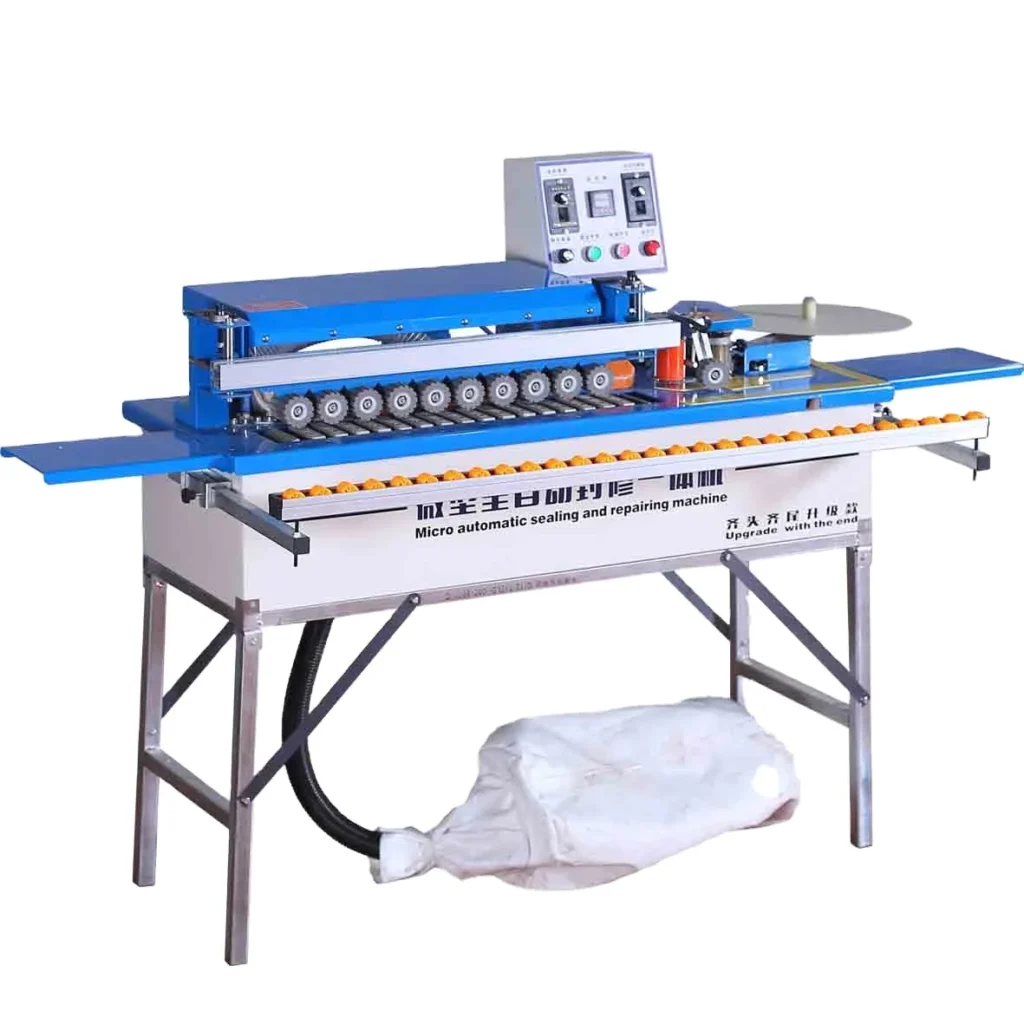
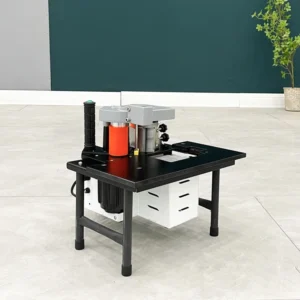
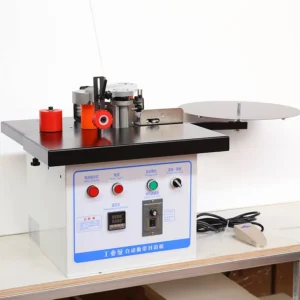
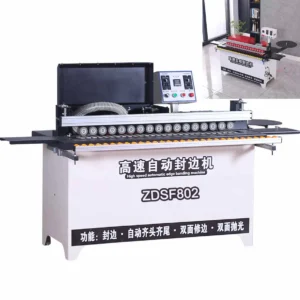
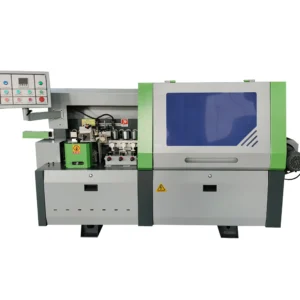
Rapid Dispatch Guarantee — Stocked miniature edge banders ready for immediate packing and shipment, cutting multi-week lead times down to days for small workshops ready to start producing.
Technical Specifications
| Parameter |
Value |
| Product Type |
Miniature Fully Automatic Edge Banding Machine |
| Voltage |
220V |
| Total Suction Power |
1200W |
| Belt Power |
25W |
| Transmission Power |
60W |
| Polishing Power |
180W × 2 |
| Trimming Power |
800W × 2 |
| Conveying Speed |
0–15 m/min |
| Edging Speed |
0–6 m/min |
| Edge Height Range |
10–60 mm |
| Edge Thickness Range |
0.6–2 mm |
| Overall Dimensions (L×W×H) |
120 × 54 × 72 cm |
| Net Weight |
81 kg (source value — verify against manufacturer catalog) |
| Control System |
Independent function control panel |
| Gluing Method |
Double-sided adhesive application |
| Gluing Device Rotation |
180° |
| Trimming Stations |
Up and down trimming with dust suction device |
| Polishing Stations |
Cross polishing up and down (2 × 180W motors) |
| Board Feeding |
Automatic with double-row rubber pressure wheels |
| Function |
Curved and straight line dual purpose |
| Warranty |
1 year |
Application Suitability
| Application |
Material or Output |
| Small joinery shops transitioning from manual tools |
PVC and veneer edge banding (0.6–2 mm) on custom cabinet components |
| Startup custom furniture makers |
MDF and plywood panels with both curved and straight edge profiles |
| Limited-floor-space cabinet workshops |
Particleboard and solid wood panels for small-batch production runs |
Why the Voltage Question Must Precede the Purchase Order
A machine that cannot plug into your workshop's existing supply is dead weight until an electrician rewires the shop.
I once specified a 380V unit for a startup cabinet shop in Vietnam where the facility only had 220V single-phase drops. The compact edge banding machine in stock sat in its crate for three weeks while local contractors ran new conduit and installed a transformer. That delay cost the owner his first two delivery deadlines. This miniature unit is configured for 220V operation, matching the standard supply in many Southeast Asian and South American workshops, but verification before dispatch is non-negotiable. [NEED_CITE: voltage and frequency standards by export market]

Ready-to-Ship Availability for Small-Batch Producers
When a joinery workshop decides to move from hand-held routers and manual edge banding to automated equipment, waiting six to eight weeks for a machine to be built and shipped is often not viable. This compact edge banding machine in stock is held in inventory, meaning dispatch timelines are measured in days rather than months. The 120 × 54 cm footprint fits against a wall in a crowded shop, requiring no dedicated floor zone or foundation work beyond a level surface and a dedicated circuit.
Dual-Purpose Curved and Straight Capability in One Footprint
Small custom furniture makers frequently encounter curved cabinet doors and radiused shelf ends that demand edge banding on non-linear profiles. The 180° rotatable gluing device on this unit allows the operator to swing the adhesive application head to follow a curved contour, eliminating the need for a separate manual fixture. Straight panel runs feed through the double-row rubber pressure wheels at up to 15 m/min, while curved work proceeds at up to 6 m/min for controlled adhesion. This flexibility means a startup shop does not need to purchase two machines to cover its full product range.
How Trimming and Polishing Specs Translate to Finished Edge Quality
The dual 800W trimming motors handle both top and bottom edge overhang in a single pass, removing excess PVC or veneer material flush with the panel surface. Integrated dust suction at the trimming station captures shavings before they can settle on the glue pot or polishing wheels, a practical necessity in a small shop where one operator may be managing multiple processes. The two 180W cross-polishing motors then burnish the trimmed edge to remove any residual adhesive smear. For panels in the 10–60 mm height range and 0.6–2 mm banding thickness, this station sequence produces an edge finish that does not require secondary hand-cleanup before assembly. [NEED_CITE: edge banding quality standards for custom furniture assembly]
The Hidden Cost of Specifying Beyond Your Actual Throughput
Buying an industrial-grade edge bander rated for continuous production when your shop runs fifty panels a day leads to oversized motors drawing current your facility cannot supply, larger glue pots wasting adhesive on small batches, and complex PLC systems your operator cannot troubleshoot. The pain point is not just the purchase price — it is the ongoing cost of unused capacity and the maintenance burden of systems that never run within their designed parameters. A miniature machine matched to small-batch volumes avoids these mismatches. [NEED_CITE: machinery oversizing consequences in small manufacturing operations]
Why Procurement Through This Channel Works for Small Shops
Stocked inventory means you can inspect machine specifications against your panel sizes before committing, rather than waiting for a production run to see the equipment. The independent function control panel allows individual station adjustments without navigating nested PLC menus, matching the skill level of a workshop operator moving from manual processes. Double-sided adhesive application reduces glue preparation time compared to hot-melt pot systems, and the 81 kg net weight means the machine can be repositioned within the shop without a forklift. Voltage confirmation and electrical schematics are provided before shipment to prevent the dead-on-arrival scenario. Single-unit orders are accepted without minimum quantity requirements, aligning with the purchasing pattern of a small shop buying its first automated edge bander.
Documentation & Verification
- CE declaration of conformity matching the machine's electrical and mechanical safety classification
- Electrical schematic and voltage confirmation document for your 220V supply verification
- Operation and maintenance manual in your agreed language with station-by-station setup procedures
- Factory test record on your specific edge height range and banding material before dispatch
- Spare parts list identifying trimming blades, polishing wheels, and pressure wheel replacements
- Packing photographs showing crate condition and accessory inclusion prior to container loading
Installation, Commissioning & Support
- Requires a level floor surface with 120 × 54 cm clear space and wall access for dust extraction ducting
- Dedicated 220V circuit with appropriate breaker rating for the combined 1200W suction and motor loads
- Arrives assembled; operator mounts dust extraction hose and fills adhesive reservoir before first run
- Initial trimming depth and polishing pressure calibration performed on sample panels from your stock
- Double-row rubber pressure wheel tension adjustment demonstrated for your specific panel thickness range
- Trimming blade and polishing wheel replacement intervals documented with spare part reorder codes
What to Include in Your Inquiry
To confirm this compact edge banding machine in stock matches your production requirements, provide your typical panel thickness range and the edge banding materials you run most frequently. Specify your workshop's existing voltage and phase configuration so we can verify compatibility before generating a quotation. If you process curved components, note the minimum radius and the banding thickness you intend to apply so the 180° gluing device configuration can be confirmed.
Frequently Asked Questions
Q: Is this compact edge banding machine in stock and what is the dispatch lead time?
A: This miniature edge bander is held in ready stock, allowing dispatch within days of order confirmation rather than the typical multi-week production lead. Packing and crating proceed once voltage and documentation requirements are confirmed. Shipping transit time depends on your destination port and chosen freight method.
Q: Will the 220V voltage work in my country, or do I need a different configuration?
A: The machine is wired for 220V operation. Before ordering, confirm your workshop's supply voltage and frequency with a local electrician. We provide the electrical schematic and voltage confirmation document with every shipment. If your facility runs a different voltage, discuss configuration options during the inquiry stage.
Q: What panel thickness and edge banding materials does this compact machine handle?
A: The edge height range covers 10–60 mm panels, and the banding thickness range accepts 0.6–2 mm PVC and veneer materials. This covers standard MDF, plywood, and particleboard stock used in custom cabinet and furniture production. Confirm your specific panel dimensions against these ranges before ordering.
Q: How does curved edge banding work on this machine — is a separate fixture needed?
A: The gluing device rotates 180° to accommodate curved panel edges, allowing adhesive application along radiused contours without a separate fixture. Curved work feeds at up to 6 m/min for controlled adhesion. The operator manually guides the curved panel through the pressure wheels while the glue head tracks the contour.
Q: What spare parts are included, and how do I order replacements?
A: The spare parts list shipped with the machine identifies trimming blades, polishing wheels, and pressure wheel assemblies subject to normal wear. Replacement parts are available through the same ordering channel. Consumable reorder intervals depend on your daily panel volume and banding material abrasiveness.