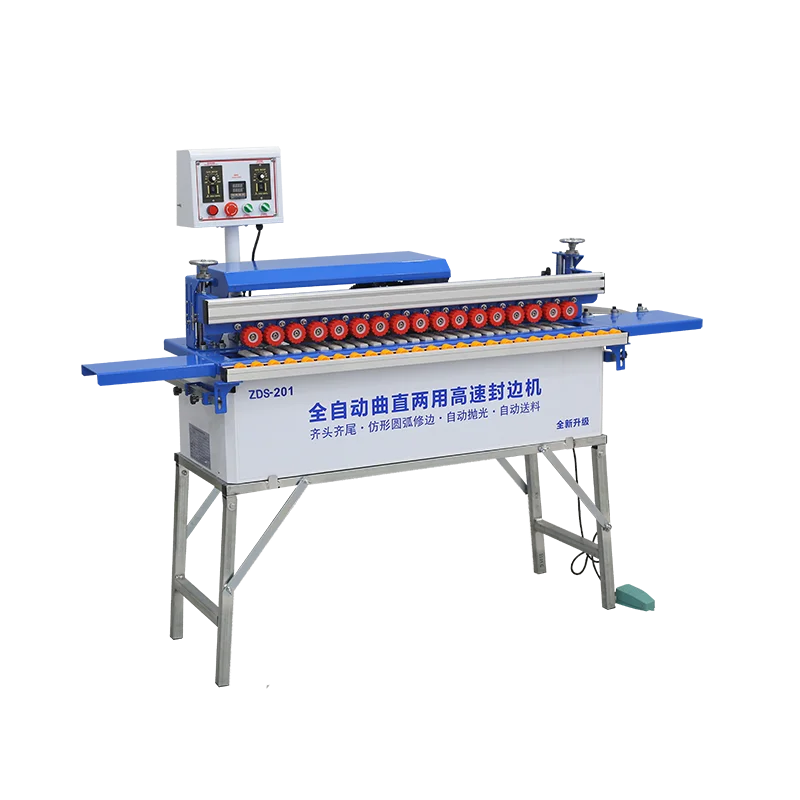
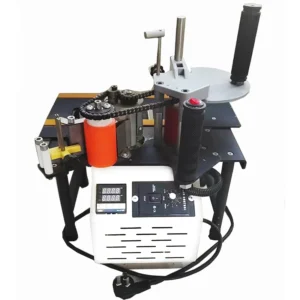
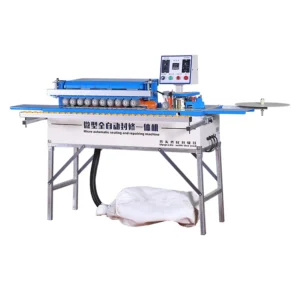
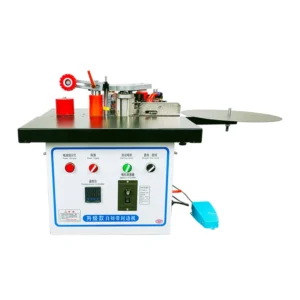
In-Stock Readiness, Dispatched Fast — This curved and straight edge banding machine ships from ready stock so small workshops avoid multi-week factory lead times and get producing within days, not months.
Technical Specifications
| Parameter |
Value |
| Product Type |
Curved and Straight Edge Banding Machine |
| Total Power |
3 kW |
| Heating Power |
1.2 kW |
| Transport Power |
180 W |
| Edge Banding Speed |
0–26 cm/s |
| Feeding Speed |
0–15 m/min |
| Edge Banding Thickness |
0.3–3 mm |
| Panel Thickness Range |
8–50 mm |
| Overall Dimensions (L×W×H) |
1200×450×750 mm |
| Net Weight |
85 kg |
| Trimming Cutter |
4-blade alloy arc knife |
| Edge Strip Cutting |
Pneumatically controlled |
| Polishing |
Cross polishing, up and down |
| Slide Rail |
Square rail for profiling; steel rod rail for crawler transmission |
| Pressure Beam |
Adjustable aluminum alloy |
| Curved Edge Banding |
Available after rotating machine 180° |
| Dust Collection |
Dual large-diameter collectors, 99% collection effect (basis not stated in source) |
| Control Panel |
Multi-function button operation |
| Voltage & Frequency |
Configurable from 110V to 440V (confirm local supply before dispatch) |
| Certification |
CE, ISO 9001 (company-level; verify model-specific declaration) |
Application Suitability
| Application |
Material or Output |
| Small cabinet shop edge banding |
MDF and plywood panels with PVC edge banding |
| Custom furniture curved edges |
Rounded table tops and radius panels with veneer banding |
| Joinery workshop first-machine setup |
Particleboard shelving and carcass panels |
| Low-volume solid wood edging |
Solid wood panels with matching wood veneer strip |
Why the Voltage Question Must Come Before You Hit "Buy"
Confirming your workshop's voltage and frequency before ordering is the single most important step in avoiding a machine that sits idle on arrival.
I once watched a small cabinet maker in the Yangtze Delta region take delivery of a compact edge bander wired for 220V single-phase, only to find their shop ran 380V three-phase. The transformer took two weeks to source. During that window, cut panels stacked up until there was barely room to walk — and customers were calling daily for delivery updates. When you source a curved and straight edge banding machine in stock from overseas, voltage confirmation is not a footnote. It is the entire first conversation. [NEED_CITE: voltage and frequency standards by export market]

Ready Stock Means Your Workshop Starts Sooner
Most small joinery shops cannot afford to wait six or eight weeks for a machine to be built from scratch. This unit sits in ready inventory and can be dispatched once voltage and control panel language are confirmed. For a startup furniture maker transitioning from hand-applied edge banding to their first automated pass, that difference in timing often means the difference between accepting the next order or turning it away.
One Machine Covers Both Straight and Curved Edges
The ability to handle straight and curved edge banding on a single footprint is what makes this unit practical for shops with limited floor space. Straight edge banding runs as default. Rotate the machine 180 degrees and you are set up for curved work — rounded table tops, radius cabinet doors, shaped shelving. There is no second machine to buy, no second power circuit to install, and no second learning curve for the operator.
How Feed Speed, Panel Range, and Trimming Shape Your Output
The 0–15 m/min feeding speed and 8–50 mm panel thickness range place this machine squarely in the small-workshop bracket — thick enough for standard carcass panels and shelving, but not designed for high-volume continuous runs where industrial feed speeds matter more. The 4-blade alloy arc trimming cutter is the component that actually defines edge quality: it follows the contour on curved profiles and trims flush on straight runs. If you are running PVC banding between 0.3 mm and 3 mm, the pneumatic strip cutter gives you consistent end cuts without the operator fighting the material by hand. The adjustable aluminum alloy pressure beam keeps panels flat against the feed bed, which matters especially on thinner 8 mm stock that can otherwise lift during the banding pass. Dust collection through dual large-diameter ports reduces airborne particle buildup around the trimming zone [NEED_CITE: CE machinery directive requirements for dust extraction on woodworking equipment].
What Happens When a Small Shop Skips Configuration Checks
Buying an entry-level edge bander without verifying feed height compatibility with your existing panel saws is a pattern I have seen more than once. The machine arrives, the operator feeds a panel, and the edge band sits proud or gets crushed. Similarly, a control panel printed in a language the operator cannot read stalls commissioning entirely — the manual sits on a desk while the shop owner tries to translate error codes on a phone screen. These are not machine defects. They are configuration oversights that turn a productive week into a frustrating one. [NEED_CITE: common commissioning delays in imported woodworking machinery]
Why Buyers Source This Model Here
Engineers review your panel material, edge band type, and local voltage before confirming a configuration, which means you receive a quotation matched to your actual workshop conditions rather than a generic catalogue price. Pre-shipment testing on your specified material gives you a verified sample before the crate closes. Voltage customization from 110V to 440V is handled as a standard option, not a special request. The four-stage quality check — incoming material through pre-shipment verification — applies to every unit before it leaves the factory floor.
Documentation & Verification
- CE declaration of conformity covering this edge bander model class
- Factory test record on your specified panel thickness and edge band material
- Electrical schematic with confirmed voltage and frequency for your site
- Operation and maintenance manual in your agreed language
- Spare parts list matched to consumable components on this machine
Installation, Commissioning & Support
- 3 kW total power requires a dedicated circuit matching confirmed voltage and frequency
- 1200×450 mm footprint fits standard workshop aisles; allow clearance for 180° rotation on curved work
- 85 kg net weight allows two-person placement without overhead lifting equipment
- Pneumatic edge strip cutting requires connection to a workshop compressed air supply
- Multi-function control panel configured to operator language before dispatch
- Spare trimming blades and buffing pads included in first-shipment parts list
What We Need to Prepare Your Quotation
Share your workshop's local voltage and frequency, the panel materials and thicknesses you run most often, and the edge banding type — PVC, veneer, or both. If you have a target daily volume or an existing panel saw feeding this machine, let us know so we can confirm throughput alignment before dispatch.
Frequently Asked Questions
Q: What voltage and frequency options are available for my country?
A: This curved and straight edge banding machine supports voltage configuration from 110V to 440V. Before we confirm your order, our engineers will verify the exact voltage, phase, and frequency your workshop uses so the machine ships ready to connect. This step prevents the costly delays that come from arriving with incompatible wiring.
Q: How do I switch between straight and curved edge banding on this machine?
A: Straight edge banding runs in the default orientation. To process curved edges, rotate the machine 180 degrees on its base. The square slide rail supports profiling and trimming in both modes, and the 4-blade alloy arc cutter follows curved contours without requiring a separate tooling change.
Q: What panel thickness and edge band thickness range does it support?
A: The machine accepts panel thickness from 8 mm to 50 mm and edge banding thickness from 0.3 mm to 3 mm. This range covers standard MDF, plywood, and particleboard panels used in cabinet and furniture work, with both PVC and veneer banding materials within spec.
Q: What is the lead time for ready-stock dispatch to my port?
A: Because this model is held in ready stock, dispatch follows once voltage confirmation, language preference, and pre-shipment testing are complete. Exact shipping timelines depend on your destination port and the carrier schedule available at the time of order confirmation.
Q: Is the control panel available in my local language?
A: Yes. The multi-function button control panel can be configured with labeling and interface language matching your operator's requirements. Confirming the language preference during the quotation stage ensures the machine arrives ready for immediate commissioning without translation delays.