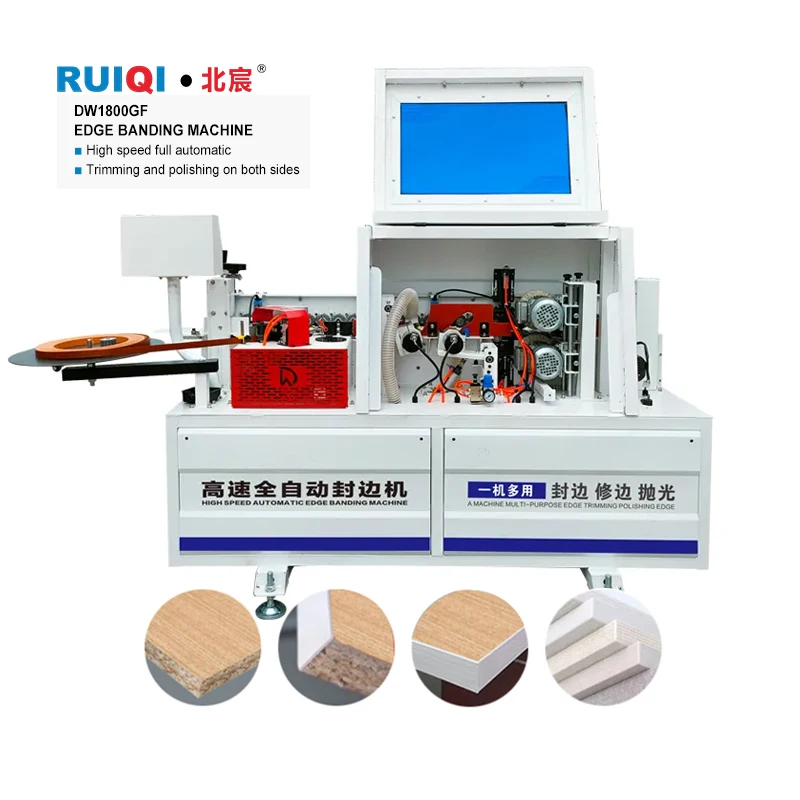
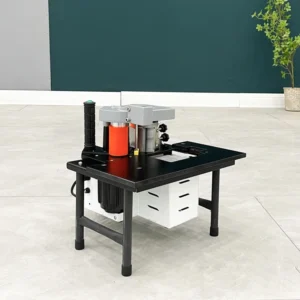
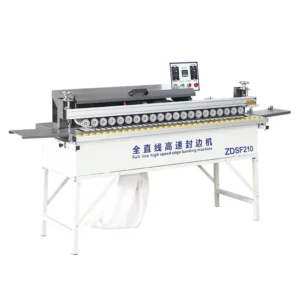
Compact, Ready to Ship — the DW1800 arrives fully assembled with voltage confirmed before dispatch, so a small workshop can go from uncrating to edge banding without electrical surprises.
Technical Specifications
| Parameter |
Value |
| Model |
DW1800 |
| Product Type |
Automatic Edge Banding Machine |
| Total Power |
4.9 kW |
| Voltage Options |
380V / 220V / 415V (frequency to be confirmed per destination) |
| Overall Dimensions (L×W×H) |
220 × 65 × 125 cm |
| Net Weight |
320 kg |
| Feed Speed |
0–14 m/min (adjustable) |
| Minimum Sheet Length |
20 cm |
| Minimum Sheet Width |
10 cm |
| Edge Banding Height Range |
0–50 mm |
| Edge Banding Thickness Range |
0.3–3 mm |
| Trimming Power / Speed |
800 W × 2 / 24,000 r/min |
| Polishing Power |
380 W × 2 |
| Vacuum Power |
550 W |
| Glue Pot Capacity |
4,000 ml |
| Air Source Pressure |
0.4–0.6 MPa |
| Profile Tracking |
Yes — rounds four corners |
| Standard Functions |
Double-sided gluing, top & bottom trimming, top & bottom polishing, front & rear alignment, flexible edge scraping, dust extraction |
| Assembly State |
Fully assembled |
| Language Options |
Chinese, English (standard); Spanish and other languages customizable |
| Plug Options |
EU, USA, AU, UK |
Application Suitability
| Application |
Material or Output |
| Cabinet door and panel edge finishing |
MDF and particleboard with PVC or veneer banding |
| Small-batch custom furniture production |
Plywood and ABB boards with 0.3–3 mm edge material |
| Workshop transition from manual to machine banding |
Solid wood panels and organic glass plates requiring corner tracking |
| Shelving and drawer component banding |
Narrow stock down to 20 cm length and 10 cm width |
Why the Voltage Question Must Come Before the Price
An automatic edge banding machine for small workshop use is only as useful as the power supply it connects to.
Early in my career I shipped a PVC edge bander to Colombia without locking down the final voltage and frequency with the buyer. The machine left the factory at 380V standard, but the workshop ran 220V/60Hz. The motor hummed and refused to turn. The customer lost three production weeks waiting for a step-up transformer, and my WhatsApp thread with them ran longer than the shipping documents. Since then, every contract I handle lists voltage and frequency on the confirmation sheet, checked line by line before signing [NEED_CITE: voltage and frequency standards by export market]. Getting this wrong on a compact machine is especially painful because small workshops rarely keep spare transformers on hand.

Footprint That Fits Without Sacrificing Stations
The DW1800 measures 220 cm in length — short enough to sit against a wall in a tight joinery shop while still carrying a full sequence of work stations. Double-sided gluing, top and bottom trimming, flexible scraping, and polishing all run in one pass. For a workshop moving from hand-applied banding to an automatic edge banding machine for small workshop volumes, that single-pass sequence means operators spend less time handling each panel and more time feeding the next one.
Corner Tracking on Small Panels
Profile tracking rounds all four corners automatically, which matters most when the panels themselves are small. Cabinet sides, drawer fronts, and shelf components often measure under 40 cm on one axis. Without corner rounding, the banding material leaves sharp overhangs that catch during assembly or scratch adjacent surfaces. The DW1800 handles sheet lengths down to 20 cm and widths down to 10 cm, covering most cabinet component sizes a small furniture shop produces. [NEED_CITE: woodworking machinery safety standards for panel edge finishing]
What the Spec Numbers Mean on the Shop Floor
Feed speed adjusts from 0 to 14 m/min, letting the operator slow down for thick PVC banding on particleboard and speed up for thin veneer on plywood. Running the wrong speed creates chatter marks on the trimmed edge or causes the glue to set before full contact. The 24,000 r/min trimming motors cut cleanly through banding up to 3 mm thick, leaving a flush edge that needs only the polishing pass to finish. Air pressure at 0.4–0.6 MPa drives the pneumatic clamps and scraper cylinders; dropping below that range causes the scraper to skip, leaving glue residue that shows up under LED lighting during final inspection. The 4,000 ml glue pot holds enough adhesive for a typical half-day run before needing a refill, reducing interruptions during batch work.
The Hidden Cost of Skipping Configuration Checks
When a small workshop orders an edge bander without matching the spec to its actual material mix, the problems surface weeks after installation. Running 3 mm PVC on a machine set up for thin veneer wears the trimming blades prematurely and leaves visible chatter on the cut face. Operators who cannot read the control panel language stall at basic parameter changes, calling for translation help instead of adjusting feed speed on the fly [NEED_CITE: operator training requirements for woodworking machinery]. These issues compound: blade wear degrades edge quality, which triggers rework, which consumes more banding material and glue than the job should require.
Why Procurement Through This Channel Works
Every DW1800 ships with a voltage confirmation sheet matched to your local supply before the machine leaves the factory — no guesswork at the plug. The unit arrives fully assembled, so there is no multi-day mechanical build in your shop; you connect power, air, and start running test panels. Language on the control panel is set to your specification before dispatch, meaning your operators read instructions and error codes in a language they actually understand. Pre-shipment testing includes a factory run on material thicknesses that match your typical board stock, documented in a test record that ships with the machine. If your production grows, the same product family offers higher-capacity models with compatible tooling and consumables, so your team reuses what it already knows.
Documentation & Verification
- CE declaration of conformity covering the DW1800 edge banding platform
- Factory test record run on your specified panel thickness and banding material
- Electrical schematic with confirmed voltage, frequency, and plug type for your site
- Operation and maintenance manual in your agreed language covering all function stations
- Spare parts list with trimming blades, scraper elements, and glue pot components identified
- Packing photographs showing the fully assembled machine before crate closure
Installation, Commissioning & Support
- Floor space of 220 × 65 cm plus operator clearance on feed and exit sides
- Dedicated circuit matching confirmed voltage (380V / 220V / 415V) at 4.9 kW total draw
- Machine ships fully assembled; remove crate, connect power and 0.4–0.6 MPa air line
- First-run commissioning includes feed speed calibration and trimming head alignment on your stock
- Operator walk-through covers glue pot refill, banding thread path, and control panel navigation
- Spare trimming blades and scraper elements included for initial production weeks
Before You Send the Inquiry
Tell us the panel materials you run most often — MDF, particleboard, plywood, or solid wood — along with the edge banding type and thickness you typically apply. Share your workshop's exact voltage and frequency so the confirmation sheet matches reality. If you have existing upstream saws or downstream boring machines, mention their feed height so we can flag any compatibility points before the order is placed.
Frequently Asked Questions
Q: What is the smallest board this machine can handle, and does it cover typical cabinet panel sizes?
A: The DW1800 accepts sheet lengths down to 20 cm and widths down to 10 cm, with edge banding height from 0 to 50 mm. Most cabinet sides, drawer fronts, and shelving components fall within these limits. For unusually narrow or short specialty pieces, confirm dimensions with our engineering team before ordering so we can verify feed stability on your smallest stock.
Q: Can the control panel be set to a language my operators actually read?
A: Chinese and English are standard on the DW1800. Spanish and other languages are customizable before the machine ships. We confirm the language during the specification review stage so the panel arrives ready for your team, eliminating the commissioning delays that happen when operators cannot read error codes or parameter menus.
Q: How do I confirm voltage and plug match my workshop's electrical supply before shipping?
A: During the inquiry we collect your site voltage, frequency, and plug standard. A voltage confirmation sheet listing these values becomes part of the signed contract. The DW1800 is available in 380V, 220V, and 415V configurations with EU, USA, AU, or UK plugs. The machine does not ship until this sheet is verified and signed.
Q: What edge banding materials and thicknesses work reliably on this model?
A: The DW1800 handles PVC, veneer, and similar materials from 0.3 to 3 mm thick across MDF, particleboard, plywood, ABB boards, and solid wood panels. The double-sided gluing system and 24,000 r/min trimming motors maintain clean edges across this range. For specialty banding outside these parameters, a sample processing test confirms compatibility before order commitment.
Q: If my production volume grows, what is the upgrade path within the same product family?
A: The DW1800 sits at the entry point of a product family that extends to higher-feed-speed and additional-function models. Operators already trained on the DW1800 control interface and maintenance routines transfer those skills directly. Consumables like trimming blades and scraper elements remain compatible, so your existing spare parts inventory carries forward.