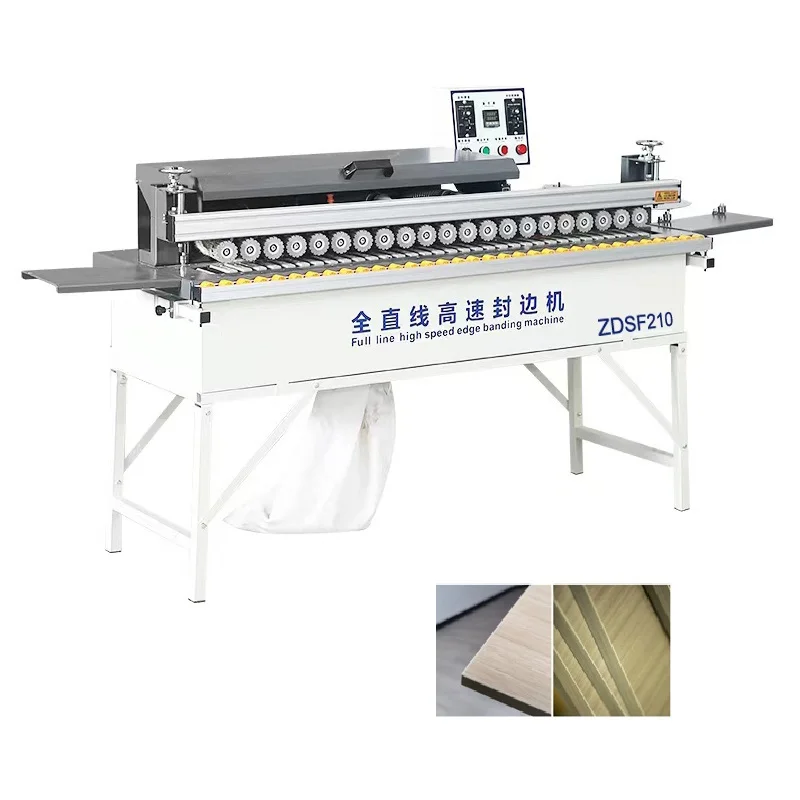
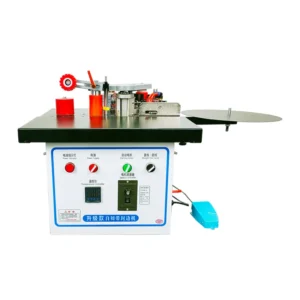
Fast Dispatch Readiness — voltage confirmed via three-photo verification and video call before any ZDSF210 unit leaves the floor, preventing the two-week transformer delay that once stalled a small workshop commissioning.
Technical Specifications
| Parameter |
Value |
| Model |
ZDSF210 |
| Product Type |
Automatic Edge Banding Machine |
| Edge Banding Speed |
6 m/min |
| Belt Feed Motor |
25 W |
| Board Feed Motor |
120 W |
| Trimming Motor |
800 W × 2 |
| Heating Motor |
800 W |
| Vacuum Fan |
1200 W |
| Overall Dimensions (L×W×H) |
1500 × 570 × 630 mm |
| Net Weight |
155 kg |
| Glue Capacity |
1000 ml |
| Guide Rail Type |
Steel rod guide rail |
| Trimming |
Up/down, left/right profiling trimming |
| Pressing |
Elastic device secondary pressing |
| Dust Collection |
Airtight dust collection and cleaning function |
| Polishing |
Cross polishing |
| Scraping |
Flexible edge scraping and glue line cleaning |
| Motor Base |
Frame type motor base |
| Warranty |
1 Year |
| Voltage & Frequency |
Configurable from 110V to 440V (basis to be confirmed before dispatch) |
| Assembly State |
Requires assembly (user manual and video provided) |
Application Suitability
| Application |
Material or Output |
| Small-batch MDF cabinet door edge banding |
MDF panels with PVC edge banding |
| Startup joinery workshop transition from manual to machine banding |
Particleboard and plywood with PVC or veneer strips |
| On-site furniture repair and refurbishment edge finishing |
Solid wood panels with matching edge strips |
| Custom furniture prototype and sample production |
Small-format boards requiring profiling trim and polish |
Why the Voltage Question Must Come Before the Purchase Order
Confirming local voltage and frequency before dispatch prevents a small workshop from receiving an automatic edge banding machine in stock that cannot run without a costly transformer.
I once had a compact 45-degree automatic bander shipped urgently to a buyer overseas. The local supply was 110V, but the confirmation step was rushed. The machine sat idle for two weeks waiting for a step-up transformer, and the workshop lost an entire production cycle. Since then, every compact unit I schedule for dispatch goes through a three-photo voltage label check and a live video confirmation with the buyer before it is crated. This is not an isolated case — mismatched electrical supply remains one of the most frequent commissioning delays for small shops ordering their first machine from overseas [NEED_CITE: voltage and frequency standards by export market].

The Smallest Step Up From Hand Banding
A joinery workshop moving from manual edge application needs a machine that occupies minimal floor space and runs on existing electrical circuits. The ZDSF210 measures 1500 × 570 × 630 mm and weighs 155 kg, meaning two people can reposition it within a small shop. This compact automatic edge banding machine in stock configuration lets a startup allocate floor area to material storage and assembly benches rather than dedicating an entire bay to edge finishing.
Modest Power Draw Keeps the Workshop Running
The combined motor load — 25 W belt feed, 120 W board feed, 800 W heating, 1600 W trimming, and 1200 W vacuum — stays within a range that most small workshops can support without a dedicated industrial circuit upgrade. This matters when the ZDSF210 shares a panel with a sliding table saw and a drill press, all drawing from the same workshop supply. Lower total power draw also simplifies the voltage confirmation process, since the machine does not demand heavy-gauge wiring or a separate breaker panel [NEED_CITE: typical small workshop electrical load planning].
Profiling Trim and Cross Polish at Bench Level
The up/down and left/right profiling trimming combined with flexible scraping and cross polishing delivers a finished edge in a single pass. For a small cabinet maker producing MDF doors with PVC banding, this means the panel goes straight from the ZDSF210 to assembly without a hand-scraping or hand-sanding step in between. The elastic device secondary pressing stabilizes the strip during trimming, reducing chatter marks that would otherwise require manual cleanup.
Understanding Feed Speed and Panel Compatibility
At 6 m/min, the feed rate is calibrated for small-batch production where each panel may differ in thickness and edge profile. The 1000 ml glue pot holds enough adhesive for a sustained run of standard PVC banding on MDF without frequent refills, and the steel rod guide rail maintains strip alignment across the working width. The airtight dust collection and cleaning function captures trimming debris at the source, which matters in a compact workspace where airborne particle accumulation can affect both the operator and nearby finishing stations. The frame type motor base reduces vibration transfer to the bench or floor, keeping the trimming blades stable during profiling cuts [NEED_CITE: edge banding quality factors for PVC on MDF substrates].
The Hidden Cost of Skipping Pre-Dispatch Verification
When a small workshop orders an entry-level bander without confirming panel thickness range, feed height compatibility, or utility requirements upfront, the consequences surface only after unpacking. A machine designed for 18 mm MDF may not grip 8 mm plywood reliably, and a unit shipped without the correct plug type or frequency setting stalls commissioning entirely. These are not manufacturing defects — they are configuration oversights that could have been resolved during the quotation stage. For a startup with tight cash flow, a two-week delay waiting for a transformer or a replacement guide shoe can push delivery commitments past the breaking point [NEED_CITE: common commissioning delays for imported woodworking machinery].
What Makes Ordering This Unit Straightforward
In-house manufacturing with patented cutting mechanisms ensures the profiling trimming on each ZDSF210 meets the stated tolerance before it leaves the factory. Full voltage and language customization is treated as a standard step in the order process, not an afterthought — the operator receives a control panel in the agreed language from day one. Every unit undergoes four-stage quality control including a pre-shipment verification run, so the test record you receive reflects your actual panel material. Engineer-led configuration recommendation means the quotation accounts for your workshop's panel formats and production volume, not just the machine price. Ready-to-ship models reduce the typical multi-week lead times associated with custom-built woodworking equipment.
Documentation & Verification
- CE declaration of conformity covering the ZDSF210 mechanical and electrical safety requirements
- Factory test record run on your specified panel thickness and PVC banding material before dispatch
- Electrical schematic with confirmed voltage and frequency matching your local supply
- Operation and maintenance manual written in the language your operator reads
- Spare parts list identifying trimming blades, scraping elements, and glue pot wear components
- Packing photographs documenting the unit condition at the point of crating
Installation, Commissioning & Support
- Floor space requirement based on 1500 × 570 × 630 mm footprint with operator clearance on three sides
- Power connection matched to confirmed voltage, drawing on combined motor load below 4 kW total
- Assembly required on arrival with video guidance covering guide rail alignment and motor base leveling
- First-run parameter setting for glue temperature, feed speed, and trimming depth on your panel stock
- Wear item replacement schedule for the 800 W × 2 trimming motors and flexible scraping elements
- Dust collection port connection to your existing extraction system using the airtight cleaning function interface
What to Share When Requesting a Quotation
To match the right configuration to your workshop, provide your primary panel material and thickness range, the PVC or veneer banding width you use most often, and your local voltage and frequency. Include your daily panel count so we can confirm whether the ZDSF210 output fits your volume or if a higher-tier model is more appropriate. If you have existing upstream saws or downstream assembly stations, share their feed height and throughput so the line flows without bottlenecks.
Frequently Asked Questions
Q: What panel thickness and material can the ZDSF210 handle, and what is its realistic daily output?
A: The machine processes MDF, particleboard, plywood, and solid wood panels with PVC or veneer edge banding. At 6 m/min feed speed, output depends on panel size and operator loading rhythm. For precise thickness range and daily capacity matched to your board format, share your panel dimensions during the quotation stage so the engineer can confirm suitability.
Q: Is the voltage matched to my country, and will I need a transformer?
A: Voltage is configurable from 110V to 440V and confirmed before dispatch through a three-photo label check and video call. When you provide your local voltage and frequency at the inquiry stage, the machine ships with the correct motor winding and plug configuration, eliminating the need for an external transformer.
Q: How much floor space and electrical capacity does this machine need in a small workshop?
A: The ZDSF210 footprint is 1500 × 570 × 630 mm with 155 kg weight, fitting within a compact bench area. Total motor load across feed, trimming, heating, and vacuum stays within a modest range suitable for standard workshop circuits. Confirm your available breaker capacity during ordering.
Q: How do I assemble and commission it myself, and what tools are required?
A: The unit ships requiring assembly with a user manual and video guide covering rail alignment, motor base leveling, and glue pot setup. Standard hand tools are sufficient. The pre-shipment test record confirms the machine ran correctly at the factory, so commissioning focuses on tuning trim and polish settings to your specific panel stock.
Q: When will this machine outgrow my production volume, and what is the upgrade path?
A: The ZDSF210 serves small-batch and startup production well. When your daily panel count consistently exceeds what a 6 m/min feed rate supports, moving to a higher-speed model within the same product family keeps your operator training and spare parts supply continuous, avoiding a full re-learning curve.