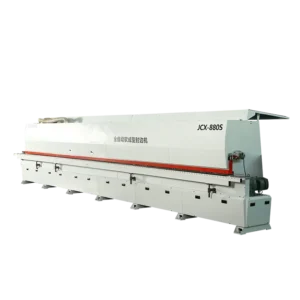
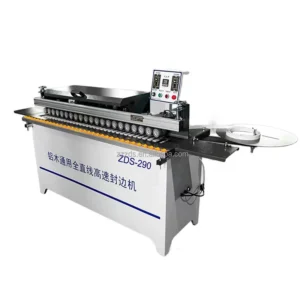
Rapid Dispatch Readiness — stock units configured for small workshops ship with verified voltage and language settings, eliminating commissioning delays upon arrival.
Technical Specifications
| Parameter |
Value |
| Model |
WF-2000 |
| Product Type |
Automatic Edge Banding Machine |
| Overall Dimensions (L×W×H) |
2100×600×630mm |
| Net Weight |
137kg |
| Panel Thickness Range |
18-25mm |
| Edge Strip Thickness |
Up to 1.2mm |
| Rated Voltage |
220V |
| Rated Power |
6.17kW |
| Rated Air Pressure |
0.4-0.6MPa |
| Feed Speed |
0-14m/min |
| Control System |
Manual control panel |
| Trimming Stations |
Elastic profiling trimming, polishing device |
| Gluing System |
Hot air heating process |
| Pressing System |
8 pressing rollers |
| Vacuum Device |
Self-contained vacuum device |
| Plate Feeding |
Automatic plate feeding |
| Pressure Beam |
Aluminum alloy, manually adjustable up and down |
| Certification |
CE, ISO 9001 |
Application Suitability
| Application |
Material or Output |
| Custom cabinet edge finishing |
MDF and particleboard panels with PVC edge banding |
| Small-batch furniture production |
Plywood shelving and carcass components |
| Joinery workshop transition to semi-automation |
Straight-edge panels in the 18-25mm thickness range |
| Startup woodworking operations |
Veneer and PVC banding on panel substrates |
Why the Voltage Question Must Come Before You Place the Order
A machine that arrives with the wrong voltage specification is an expensive floor anchor, not a production asset.
I spent several seasons helping buyers at European trade fairs source compact edge banders, and the most common post-delivery failure had nothing to do with the machine itself. The workshop had 415V three-phase supply; the machine was wound for 380V. The control panel language was set to Chinese because nobody asked. These are not manufacturing defects — they are configuration oversights that happen when the purchasing conversation skips the electrical infrastructure check. An Automatic Edge Banding Machine in stock at 220V single-phase solves this for most small joinery shops, but only if someone confirms the match before crating [NEED_CITE: voltage and frequency standards by export market].

The Smallest Footprint That Still Counts as a Real Machine
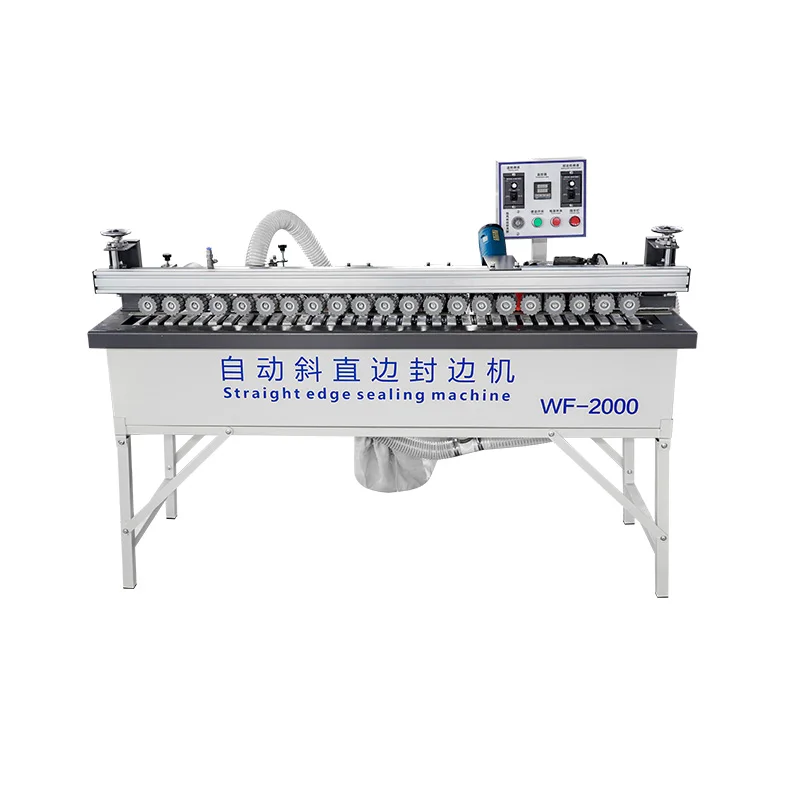
Workshops moving from handheld edge banders to their first fixed machine face a spatial dilemma. The machine must be substantial enough to produce consistent results, yet compact enough to fit an existing bay without knocking out walls. The WF-2000 occupies a 2.1-meter length with a 600mm width — roughly the footprint of a large workbench. At 137kg net weight, it can be repositioned with a pallet jack if the shop layout changes. This matters for operations that are still figuring out their material flow, where today's layout may not survive next quarter's volume increase.
Self-Contained Infrastructure Cuts Installation Complexity
Most edge banders in this class require a separate dust extraction hookup, which means additional ductwork, a dedicated extractor unit, and another power circuit. The WF-2000 carries its own vacuum device onboard. For a small workshop with a single 220V circuit available, this eliminates one entire category of infrastructure work. The hot air gluing system similarly avoids the need for an external glue pot heater or heated hose assembly. You uncrate the Automatic Edge Banding Machine in stock, level it, connect compressed air at 0.4-0.6MPa, and the core production loop is functional [NEED_CITE: typical compressed air requirements for small workshop pneumatic tools].
Reading the Spec Sheet Against Your Actual Panels
Panel thickness range and feed speed are not independent variables — they interact through the pressing roller geometry. The WF-2000 handles 18-25mm panels with 8 pressing rollers distributed along the feed path. For a joinery shop running 18mm MDF carcass panels and occasional 25mm solid-core shelving, this roller count maintains even pressure across both thicknesses without manual reconfiguration between jobs. The elastic profiling trimming station follows the panel contour rather than forcing a flat cut, which matters when your edge banding stock has a slight radius or when MDF edges are not perfectly square after the panel saw. Feed speed up to 14m/min gives you throughput headroom for batch days without pushing the gluing contact time below what PVC banding needs to bond reliably.
What Happens When the Entry Machine Meets Production Volumes It Was Not Designed For
The buyer pain point here is specific and costly: a workshop purchases a compact edge bander rated for small-batch work, then runs it at continuous full-speed production for eight-hour shifts. The pressing rollers wear unevenly, the hot air system cannot maintain consistent temperature at maximum feed rate, and edge adhesion degrades without triggering an obvious alarm. Operators compensate by slowing the feed, which then creates a bottleneck the original purchasing plan never anticipated. The WF-2000 is built for the transition phase — it handles daily batch work at moderate duty cycles. If your volume trajectory points toward continuous line operation, that is a different machine category entirely, and identifying that threshold early prevents the double-purchase trap [NEED_CITE: equipment duty cycle classifications in woodworking machinery].
Why Procurement Through This Channel Works for Compact Machines
Every WF-2000 ships from a facility that has produced woodworking machinery for roughly two decades, with a four-stage quality control process covering incoming material through pre-shipment verification. The in-house manufacturing means replacement trimming blades and pressing rollers are sourced from the same production line, not a third-party catalog. Voltage confirmation happens during the order stage — not after crating — so a 220V unit arrives wired for your actual supply. The manual control panel is supplied in the language you specify, which means your operator can commission the machine without a translator present. Engineer-led configuration recommendations arrive as a formal quotation within 24 hours of your initial inquiry, which is the pace a small workshop needs when production capacity has a gap that must close.
Documentation & Verification
- CE declaration of conformity specific to the WF-2000 configuration shipped
- ISO 9001 certificate covering the manufacturing process for this model
- Factory test record demonstrating edge quality on your submitted panel samples
- Electrical schematic confirming 220V wiring and 6.17kW circuit requirements
- Operation and maintenance manual in your specified language
- Spare parts list with part numbers for trimming blades and pressing rollers
Installation, Commissioning & Support
- Requires a level concrete floor supporting the 137kg static load across the 2100×600mm base
- Dedicated 220V circuit rated for the 6.17kW draw with appropriate breaker sizing
- Ships fully assembled — connect compressed air supply at 0.4-0.6MPa and power on
- First-run parameter setting covers pressure beam height adjustment for your 18-25mm panel range
- Operator training covers manual control panel functions and elastic trimming station adjustment
- Recommended spare stock includes trimming blades, pressing roller surfaces, and gluing system seals
- Daily maintenance covers vacuum device filter cleaning and pressing roller surface inspection
What to Prepare Before Requesting a Quotation
Send your primary panel material type and the exact thickness range you run most often — the 18-25mm envelope covers most MDF and particleboard, but confirming your specific stock prevents feed height mismatches. Include your workshop voltage and frequency so the 220V configuration can be verified against your local supply [NEED_CITE: CE machinery directive requirements for industrial equipment]. Specify the language your operators read for the manual control panel. If you have upstream panel saws or downstream assembly stations, note their feed heights and throughput rates so this Automatic Edge Banding Machine in stock integrates without creating a bottleneck or height mismatch.
Frequently Asked Questions
Q: What panel thickness and edge strip materials can this machine handle?
A: The WF-2000 processes panels from 18mm to 25mm thick with edge strip material up to 1.2mm. PVC banding on MDF and particleboard is the primary application, and the hot air gluing system bonds reliably to these substrates. Veneer banding is also compatible within the thickness limit, though surface preparation and feed speed adjustment may be needed for consistent adhesion on natural veneer.
Q: Is the 220V voltage standard compatible with my country's electrical system?
A: Many regions operate on 220V single-phase supply, but frequency and plug configurations vary. The order process includes voltage and frequency confirmation for your specific location before production or dispatch. If your workshop runs a different standard, alternative voltage configurations are available. Providing your exact supply details at inquiry stage ensures the Automatic Edge Banding Machine in stock arrives ready to connect.
Q: How long does delivery take from order placement?
A: Stock units are available for rapid dispatch once voltage and language specifications are confirmed. Lead time depends on your destination port and shipping method. The quotation provided within 24 hours of your inquiry will include estimated dispatch timing and transit duration so you can plan installation around your production schedule.
Q: What is included in the warranty and spare parts support?
A: The WF-2000 ships with a spare parts list covering consumable trimming blades, pressing roller components, and gluing system elements. Parts are manufactured in-house, which supports availability and specification matching. Warranty terms are confirmed in the formal quotation and cover manufacturing defects under normal operating conditions. Ongoing parts supply is supported through the same factory channel.
Q: Can I upgrade to higher throughput as my production volume grows?
A: The WF-2000 serves the transition from manual to semi-automated edge banding. As batch volumes increase toward continuous production demands, a larger machine with additional trimming stations and higher feed speeds becomes appropriate. The manufacturer offers a full product family spanning entry-level to full-function pre-milling models, allowing you to scale within the same supplier relationship and maintain consistency in control systems and maintenance practices.