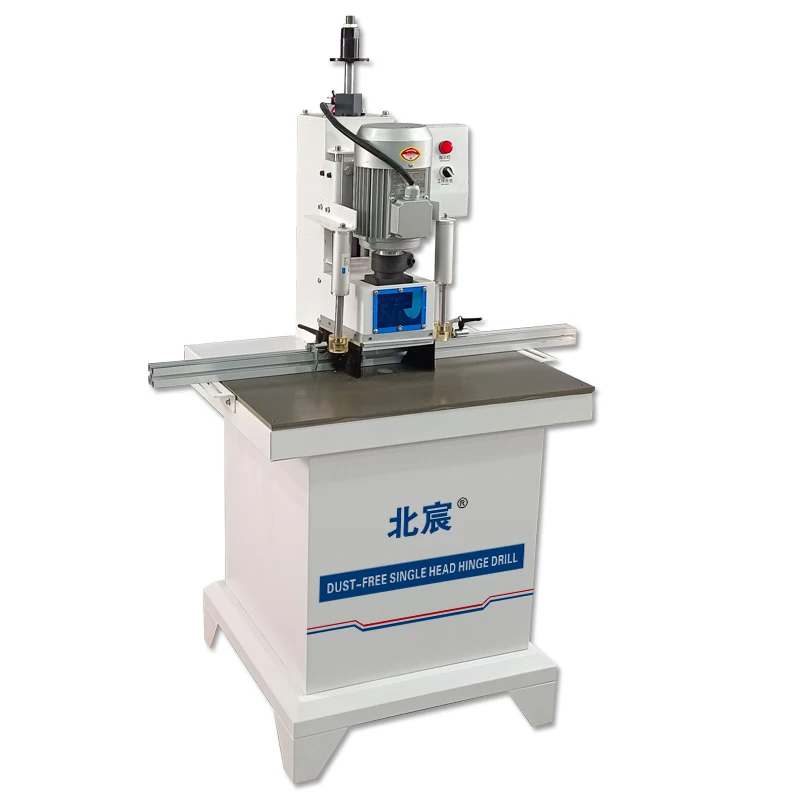
Voltage confirmed, panel tested — Every JL-1 single head hinge boring machine is cross-checked against your workshop's actual electrical supply and a sample drilling run before dispatch, so commissioning starts the moment it is uncrated.
Technical Specifications
| Parameter |
Value |
| Model |
JL-1 |
| Product Type |
Single Head Cabinet Hinge Drilling Machine |
| Total Power |
1.5 kW |
| Voltage & Frequency |
380V/415V three-phase four-wire (configurable) |
| Drill Sizes |
Large drill 35 mm, small drill 3 mm |
| Control Method |
Foot switch |
| Motor Type |
Pure copper motor |
| Sliding Mechanism |
Precision guide rails |
| Vacuum Power |
External vacuum connection |
| Product Size |
70 × 56 × 145 cm |
| Product Weight |
55 kg |
| Language Options |
Chinese and English (customizable to Spanish or other languages) |
| Assembly State |
Fully assembled |
Application Suitability
| Application |
Material or Output |
| Cabinet door hinge cup drilling |
MDF and particleboard panels |
| Wardrobe hinge hole preparation |
Plywood and blockboard substrates |
| Loose leaf hinge boring for doors |
Solid wood panels |
| Small-batch furniture joinery |
Laminated and veneered boards |
Why the Voltage Question Should Come Before the Price
A Single Head Hinge Boring Machine in stock means little if it trips the breaker the first time you switch it on. I learned this the hard way early in my career when a shipment arrived at a small Dubai joinery shop wired for 415V three-phase, only to find the machine had been dispatched for a standard 380V supply — the workshop sat idle for two weeks waiting for a step-down transformer. [NEED_CITE: voltage and frequency standards by export market]
Matching the machine to your workshop's supply is not optional paperwork; it is the first real specification decision.
Small workshops scaling up from manual hinge drilling rarely have the luxury of reconfiguring their electrical infrastructure around a new piece of equipment. Confirming voltage and frequency before production, rather than after the crate arrives, prevents stalled commissioning, protects the motor winding from under-voltage damage, and keeps the project on schedule.

Dispatch Speed Without Configuration Guesswork
Keeping a Single Head Hinge Boring Machine in stock only creates value when each unit is held in a configuration-neutral state until the buyer's electrical and language requirements are locked in. The JL-1 is warehoused fully assembled, but the motor winding specification and control panel language are finalized during the order confirmation step, not assumed from a default build. This approach allows fast dispatch while still eliminating the two most common causes of on-site failure in entry-level woodworking equipment: wrong voltage and unreadable instructions.
Compact Footprint for Workshops Still Finding Their Layout
A joinery shop moving from hand-held routers and drill presses to dedicated boring equipment rarely has a pre-planned machine cell waiting. The JL-1 occupies a 70 × 56 cm floor area at a working height of 145 cm, fitting into gaps between existing bench stations or against a wall where floor space was never intended for production machinery. The 55 kg weight means two people can reposition it during layout adjustments, a practical advantage in workshops still evolving their material flow. [NEED_CITE: small workshop space planning for woodworking machinery]
Reading the Spec Sheet Against Real Panel Work
The 35 mm large drill matches the industry-standard hinge cup diameter used across most European and Asian hardware systems, while the 3 mm small drill handles the pilot holes for hinge arm mounting screws. The precision guide rail sliding mechanism allows the operator to set horizontal and vertical drill positions against a scale, then lock them in for repeatable hole placement across a batch of doors. Foot switch control keeps both hands free to hold and align the panel, which matters when a small workshop is processing a run of kitchen cabinet doors where hinge alignment directly determines whether the doors close square.
What Happens When Configuration Details Are Skipped
Ordering a Single Head Hinge Boring Machine in stock without verifying whether the control panel language matches your operator's literacy is a surprisingly common mistake. I have watched commissioning stall for days because the depth adjustment markings and fault indicators were in a language the shop floor team could not read. Similarly, buying a single machine on price alone and later discovering its feed height or drill travel does not match the thickness range of your panel stock turns a capital investment into a workshop ornament. [NEED_CITE: common commissioning delays in exported woodworking equipment]
Why Procurement Through This Channel Works
Every JL-1 leaves with a factory test record run on a panel thickness range specified by the buyer, not a generic demonstration. Voltage and frequency are confirmed against a photograph of the workshop's distribution board before the order enters production. Operation and maintenance manuals ship in the agreed language, matching the control panel labels. The machine carries a CE declaration of conformity for markets that require it. Engineer-led configuration recommendation and formal quotation are provided within 24 hours of inquiry, keeping pace with workshops that need equipment on the floor, not in a long negotiation cycle.
Documentation & Verification
- Factory test record on buyer-specified panel thickness and hinge cup depth before dispatch
- Electrical schematic confirming wound voltage and frequency for your workshop supply
- Operation and maintenance manual in the agreed language matching control panel text
- CE declaration of conformity included with shipment documentation
- Spare parts list identifying drill bits, guide rail wear components, and motor consumables
Installation, Commissioning & Support
- Requires a dedicated 1.5 kW three-phase circuit matching confirmed 380V or 415V supply
- Arrives fully assembled; only external vacuum hose and power connection needed on site
- Foot switch positioning calibrated during pre-shipment test for consistent drill engagement
- Precision guide rails inspected for lateral play and re-lubricated before crating
- First-batch drilling parameters documented and included for operator reference
What to Share With Your Inquiry
To configure the JL-1 correctly for your workshop, include the panel materials and thickness range you process most often, the hinge hardware system you use, and a photograph of your workshop's electrical distribution board showing voltage and frequency. If you need the control panel and manual in a language other than English or Chinese, specify this at inquiry stage. Mention whether this machine will operate as a standalone hinge station or integrate into a sequence with existing saws and edge banders.
Frequently Asked Questions
Q: What voltage options are available and how is compatibility confirmed before shipping?
A: The JL-1 supports 380V and 415V three-phase four-wire configurations, with other voltages available on request. Before production, we ask buyers to send a photograph of their workshop distribution board. The motor winding and electrical schematic are then matched to the confirmed supply, and this confirmation is documented in the pre-shipment file.
Q: Can the control panel and manual be supplied in English or other languages?
A: Standard language options are Chinese and English. Spanish and other languages are available upon request. The control panel labels and the operation manual are produced in the same agreed language so that operators can cross-reference instructions with the machine interface without translation gaps.
Q: What is the lead time from order to dispatch for the JL-1?
A: Because the JL-1 is held as a Single Head Hinge Boring Machine in stock in a pre-assembly state, final configuration of voltage and language is completed during order confirmation. Dispatch follows shortly after pre-shipment testing, keeping lead times measured in days rather than weeks once specifications are locked.
Q: How do I adjust drill position for different hinge sizes and panel thicknesses?
A: The precision guide rail sliding mechanism allows horizontal and vertical adjustment against a graduated scale. Once the correct position for a given hinge format is found, the mechanism locks in place for repeatable drilling across a production run, removing the need to remeasure for each panel.
Q: Is a sample drilling test available before I commit to an order?
A: Yes. Buyers can submit a sample panel or specify the exact material and thickness. The factory runs a drilling test on the configured JL-1, and the test record along with photographs of the bored panel are shared for review before the order is finalized.