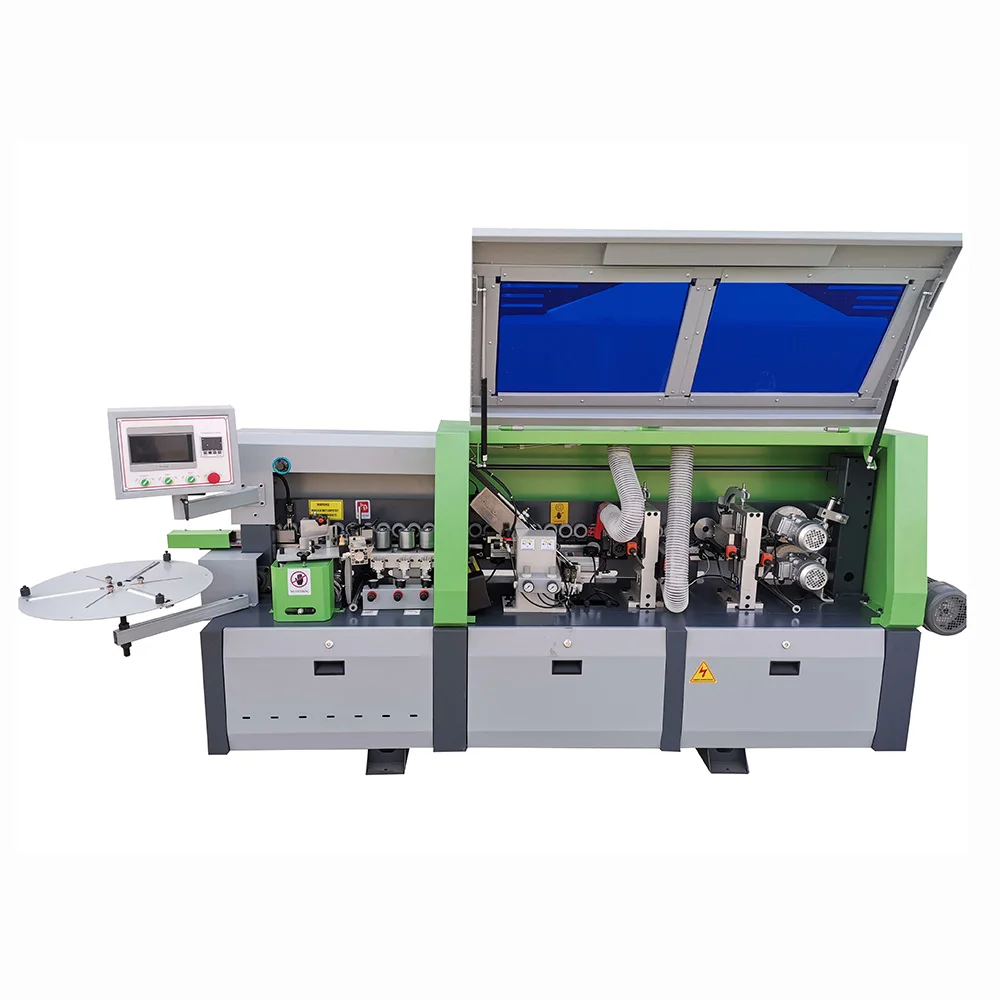
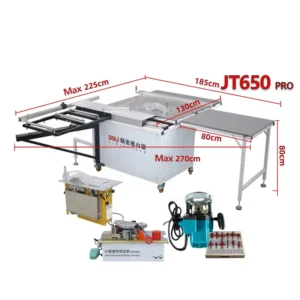
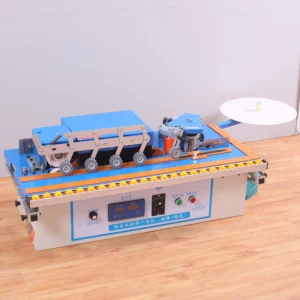
In-Stock Compact Edge Bander — ZDS280D units staged for rapid dispatch, configured to your local voltage and control language before the crate closes.
Technical Specifications
| Parameter |
Value |
| Model |
ZDS280D |
| Product Type |
Automatic Edge Banding Machine |
| Main Functions |
Gluing, End Trimming, Fine Trimming, Scraping, Buffing (5-station) |
| Panel Thickness Range |
10–55 mm |
| Edge Thickness Range |
0.4–3 mm |
| Feed Speed |
15 m/min |
| Min. Panel Width |
60 mm |
| Min. Panel Length |
150 mm |
| Working Pressure |
0.6–0.8 MPa |
| Voltage |
380V, 3-Phase |
| Rated Power |
7.5 kW |
| Net Weight |
700 kg |
| Overall Dimensions (L×W×H) |
3100 × 700 × 1400 mm |
| Fuselage Construction |
14 mm high-strength steel plate, frame-type, high-temperature quenching |
| Conveyor Guide Rail |
HT260 cast iron |
| Conveying Motor |
Taiwan brand with thermal protection |
| Head Guide Rail |
Taiwan brand |
| Pneumatic Components |
German Festo or Taiwan AirTAC cylinders, AirTAC magnetic switches |
| Electrical Components |
Delixi / Chint contactors, Japanese Omron travel switches |
| Warranty |
1 year |
Application Suitability
| Application |
Material or Output |
| Custom cabinet door edge finishing |
MDF and particleboard with PVC edge banding |
| Small-batch plywood furniture panels |
Plywood with veneer or PVC banding, 0.4–3 mm |
| Joinery workshop panel processing |
Solid wood panels up to 55 mm thickness |
| Startup furniture production line |
Melamine-faced board with pre-milled edges |
Why Voltage Confirmation Must Come Before the Crate Closes
Ordering an Automatic Edge Banding Machine in stock for fast delivery only matters if it actually runs when it arrives. A 380V, three-phase machine plugged into a single-phase workshop supply will not start — and modifying it on-site is neither safe nor practical.
I once shipped a compact edge bander to a small cabinet shop in Southeast Asia. The unit was mechanically perfect, but the local electrician spent two days trying to figure out why the conveyor motor hummed without turning. The problem was a voltage mismatch that should have been caught during the order confirmation stage. Since that experience, I ask every buyer for their supply voltage and frequency before any machine leaves the floor [NEED_CITE: voltage and frequency standards by export market]. The ZDS280D ships configured for 380V three-phase as standard, and confirming your site supply before dispatch is a non-negotiable step.

Five Stations in One Compact Footprint
The ZDS280D integrates gluing, end trimming, fine trimming, scraping, and buffing into a single 3.1-meter frame. For a small workshop moving away from hand-held routers and manual glue application, this means one operator feeds a panel in at one end and collects a finished, edge-banded board at the other. No intermediate handling, no secondary machines to align.
This five-station configuration suits shops processing panel widths down to 60 mm and lengths from 150 mm, covering everything from small drawer fronts to full cabinet sides. The compact footprint fits workshops where floor space dictates the difference between a viable production cell and a congested floor.
From Manual Trimming to Consistent Machine Output
Joinery startups often reach a point where hand-applied edge banding becomes the bottleneck — inconsistent glue lines, visible trimming marks, and buffing that varies from piece to piece. The ZDS280D addresses each of these variables with dedicated stations. The scraping station removes residual adhesive after fine trimming, and the buffing station delivers a uniform surface finish across the batch [NEED_CITE: edge banding quality standards for panel furniture].
For a custom cabinet maker producing mixed batches of MDF and plywood components, having an Automatic Edge Banding Machine in stock means you can start finishing panels within weeks of ordering rather than waiting through a full production cycle. Ready-stock availability eliminates the typical multi-week build lead for entry-level configurations.
How Frame Mass and Rail Material Affect Edge Quality
The 14 mm high-strength steel fuselage with high-temperature quenching is not a cosmetic spec — it directly controls vibration transfer to the trimming heads. Lighter frames flex under the lateral pressure of end trimming, causing chatter marks on the panel edge. At a 15 m/min feed speed, that vibration compounds over hundreds of panels in a batch.
The HT260 cast iron conveyor guide rail provides a damping coefficient that steel rails cannot match, keeping the panel flat and square against the fence throughout the five stations. Combined with the Taiwan-brand conveying motor's thermal protection system, the feed remains stable during continuous small-batch runs without the belt drifting or the motor overheating mid-shift.
The Cost of Skipping Compatibility Checks
Buying an entry-level edge bander without confirming material compatibility leads to problems that surface only after installation. PVC edge banding and wood veneer behave differently under the trimming heads — veneer chips if the fine trim cutter angle is wrong, while PVC melts if the glue pot runs too hot. The ZDS280D handles both materials within its 0.4–3 mm edge thickness range, but the operator must know which settings apply to which material.
Shops that skip pre-shipment testing often discover that their most common panel thickness sits outside the machine's effective range, or that their edge banding supplier's PVC formulation requires a different glue temperature [NEED_CITE: hot melt adhesive compatibility with PVC edge banding substrates]. Asking for a sample processing test on your actual materials before dispatch eliminates most of these surprises.
Why Small Workshops Source Here
Stocked ZDS280D units ship without the production delay that custom-built machines carry, so your workshop starts finishing panels sooner. Every unit is tested on your specified panel thickness and edge material before packing, with photographs and a test record included in the documentation.
Control panels and operation manuals are supplied in your agreed language, so your operator reads the interface on day one instead of guessing at unfamiliar characters. Voltage is confirmed to your local supply before dispatch — no rewiring, no transformers, no idle machine sitting on the floor.
Documentation & Verification
- CE declaration of conformity covering the ZDS280D five-station configuration
- Factory test record on your panel thickness range and edge material before dispatch
- Electrical schematic with confirmed voltage and phase matching your site supply
- Operation and maintenance manual in your agreed language with illustrated settings
- Spare parts list identifying wear items and reorder intervals for trimming cutters and glue rollers
- Packing photographs documenting crate condition and component securing before shipment
Installation, Commissioning & Support
- Requires a level concrete floor with 3.1 m × 0.7 m clear footprint and overhead clearance above 1.4 m
- Dedicated 380V three-phase circuit rated for 7.5 kW with proper earthing before connection
- Arrives partially assembled; conveyor and trim stations need alignment and belt tensioning on site
- First run includes glue pot temperature calibration and feed speed verification at 15 m/min
- Operator training covers station-by-station adjustment for PVC and veneer edge materials
- Wear parts kit includes spare trimming blades and buffing wheels for initial production period
What to Share With Your Inquiry
To match the right configuration to your workshop, share your primary panel materials and their typical thickness range, your local voltage and phase supply, and your preferred language for the control interface. If you are running upstream cutting or downstream boring equipment, mention those so the feed height and throughput align across your production cell.
Frequently Asked Questions
Q: What voltage options are available and how do I confirm the right one for my country?
A: The ZDS280D is configured for 380V three-phase as standard. Before dispatch, we confirm your workshop's actual supply voltage and frequency. If your site runs a different standard, let us know at the inquiry stage so the electrical system is built to match. Shipping a machine to the wrong voltage is the most common cause of commissioning delays.
Q: What is the dispatch lead time for stocked ZDS280D units?
A: Stocked ZDS280D units are prepared for shipment without a full production build cycle. After voltage and language confirmation, the machine goes through a pre-shipment test on your materials, then crating and customs documentation. Total lead time from confirmed order to dispatch is typically measured in days rather than weeks, depending on destination port requirements.
Q: Can this machine handle both PVC and veneer edge banding?
A: Yes. The ZDS280D processes edge banding from 0.4 to 3 mm thickness, covering standard PVC, ABS, and wood veneer strips. Glue pot temperature and trimming head settings differ between materials, and the operation manual covers the adjustment procedure for each. Confirm your edge banding supplier's specifications so we can validate settings during the pre-shipment test.
Q: How do I commission the machine on arrival?
A: The ZDS280D arrives partially assembled with the conveyor, trim stations, and buffing unit requiring on-site alignment. Video-guided installation support walks your team through belt tensioning, glue pot calibration, and first-panel test runs. The operation manual in your agreed language covers each adjustment step with illustrated references for the five processing stations.
Q: What spare parts come with the machine and how do I reorder?
A: Each ZDS280D ships with a wear parts kit including trimming blades, buffing wheels, and glue application components. The spare parts list included in your documentation identifies each item with reorder intervals based on typical usage. Consumables can be sourced through standard industrial supply channels using the specifications provided in the manual.