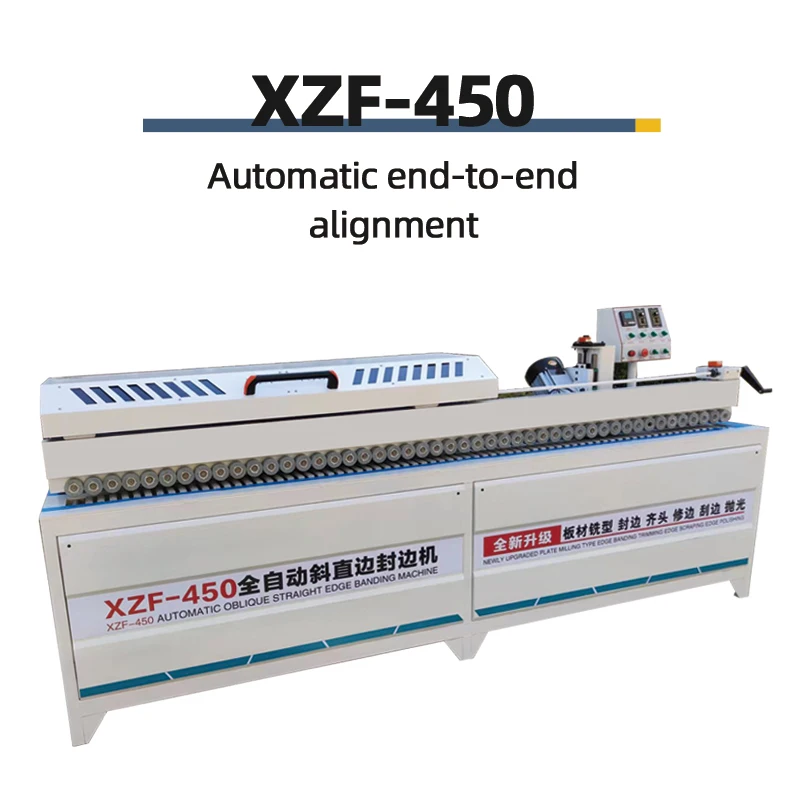
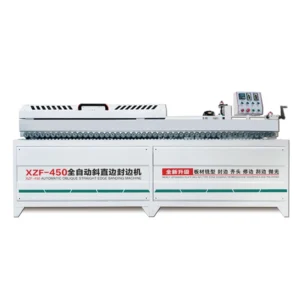
Pre-shipment Electrical Verification — every XZF-450 leaves the Ningjin floor only after its voltage and control wiring are cross-checked against the buyer's confirmed site supply, preventing the three-week transformer wait I once saw a PVC edge banding shop endure.
Technical Specifications
| Parameter |
Value |
| Model |
XZF-450 |
| Product Type |
45 Degree Full-Automatic Edge Banding Machine |
| Total Installed Power |
9.5 kW |
| Pre-milling Motor |
4 kW |
| Trimming Power |
2.2 kW × 2 |
| Polishing Power |
0.4 kW × 2 |
| Edge Banding Motor |
0.16 kW |
| Transmission Motor |
180 W |
| Vacuum Extraction |
550 W |
| Standard Voltage |
380V / 415V, 50Hz/60Hz (basis to be confirmed) |
| Feed Speed |
0–12 m/min |
| Minimum Sheet Length |
30 cm |
| Minimum Sheet Width |
15 cm |
| Edge Banding Height |
0–50 mm |
| Edge Banding Thickness |
0.3–3 mm |
| Glue Pot Capacity |
4000 ml |
| Air Source Pressure |
0.5–0.7 MPa |
| Machine Dimensions (L×W×H) |
300 × 65 × 135 cm |
| Machine Weight |
430 kg |
| Working Sequence |
Pre-milling, gluing, end trimming, rough trimming, fine trimming, scraping, polishing |
| Bevel Capability |
30° / 45° / 60° alongside standard 90° |
| Control Panel Language |
Chinese / English standard; Spanish and others customizable |
| Plug Configuration |
EU / USA / AU / UK options |
| Assembly State |
Fully assembled, wooden crate packed |
Application Suitability
| Application |
Material or Output |
| Custom cabinet door edging |
MDF and melamine-faced particleboard with PVC or ABS tape |
| Small-batch plywood shelving |
Plywood and blockboard with veneer or PVC banding |
| Modern bevel-profile furniture |
45° and 60° angled edges on MDF and polymer door panels |
| Joinery workshop short runs |
Mixed substrate batches requiring quick changeover between 0.3 mm and 3 mm tape |
Why the Voltage Question Should Come Before the Price on a 45 Degree Automatic Edge Banding Machine for Small Workshop
Confirming your workshop supply before you confirm the order saves you from a machine that sits idle on arrival.
I handled a shipment not long ago where a small PVC edge banding operation ordered a compact bander at 120V. Their shop floor actually ran 220V three-phase. The machine sat in its crate for three weeks while they sourced and installed a step-down transformer. That delay was entirely avoidable. When a buyer focuses on the sticker number first and the electrical spec second, the 45 degree automatic edge banding machine for small workshop arrives as a liability instead of a production asset [NEED_CITE: voltage and frequency standards by export market]. The XZF-450 is configurable across a range of voltages, but that configuration only works if the conversation happens before the wiring harness is built.

Stocked Configurations and Fast Dispatch
The XZF-450 sits in the ruiqishop.com ready-stock rotation because its footprint and power envelope match what a joinery startup or a growing cabinet shop actually has on the floor. Common voltage builds — 380V/50Hz for most of Europe and Asia, 415V for Australia and parts of the Middle East — are the configurations we stage first. When a buyer needs something outside that range, the lead time extends, but the wiring is done on the Ningjin line before crating, not improvised in the field.
Single-Unit Orders Without the Custom-Line Wait
Most edge bander manufacturers want you to commit to a production run before they adjust a voltage spec. For a small workshop buying its first automated bander, that makes no sense. The XZF-450 is built as a single-unit order machine: you specify the plug type, the control panel language, and the voltage, and the unit ships fully assembled. No minimum order quantity attached. The 4000 ml glue pot and the 0–12 m/min feed speed mean the machine handles sustained batch work once it arrives, so you are not buying a hobby-grade unit that will need replacing within a year.
Reading the Spec Sheet Against Your Actual Floor
The 9.5 kW total power draw tells you what your electrical panel needs to support. I have seen workshops trip their main breaker on first startup because they looked at the main motor rating alone and ignored the combined load of the pre-milling motor, both trimming stations, the polishing heads, and the vacuum extraction running simultaneously. The XZF-450's 4 kW pre-milling motor is the largest single draw, but at full operation every station is live. A dedicated circuit rated for the full 9.5 kW plus a safety margin is what keeps the machine running through a full shift without thermal cutoffs. The 0.5–0.7 MPa air source requirement is equally non-negotiable — insufficient air pressure causes the trimming and scraping pneumatic actuators to hesitate, leaving visible witness marks on the panel edge [NEED_CITE: pneumatic pressure requirements for edge trimming actuators].
The feed speed range of 0–12 m/min matters most at the low end. When you are running 3 mm PVC tape on a 45° bevel, a slower feed gives the glue more open time and lets the pressure rollers seat the tape fully before the end trimming station engages. Operators who push the feed to maximum on a bevel cut often see lift at the leading edge.
What Happens When the Configuration Is Wrong
A machine ordered at the wrong frequency runs its motors at the wrong speed. A 50Hz motor on a 60Hz supply spins faster, which changes the trim quality and accelerates bearing wear. I have seen edge banders of this class returned to the factory with scorched windings because the frequency mismatch was caught only after the first day of production. Beyond the electrical side, an operator who cannot read the control panel stalls the entire commissioning process. The XZF-450's language customization exists precisely because a Spanish-speaking operator in Mexico or a French-speaking operator in West Africa should not be deciphering Chinese characters on a fault screen [NEED_CITE: operator interface language requirements for exported industrial machinery].
Why Buyers Source This Machine Through ruiqishop
The XZF-450 ships with a factory test record that shows the edge banding result on the specific substrate and tape thickness the buyer nominated. That record is not a generic pass stamp — it documents the actual panel and tape combination. Voltage confirmation is part of the order paperwork, not an afterthought, because I personally check the electrical schematic against the buyer's declared supply before the crate is sealed. The pre-milling station is a genuine 4 kW unit with its own motor, not a token attachment, and it is the reason the glue bond stays consistent across MDF, plywood, and melamine without the operator adjusting glue temperature between materials. Customization of plug type, panel language, and voltage is standard procedure here, not a premium add-on. And the machine arrives fully assembled in a wooden crate, so the buyer is not spending the first two days aligning stations that shifted during transit.
Documentation & Verification
- CE declaration of conformity covering the XZF-450's full electrical and mechanical assembly
- Factory test record showing edge quality on your nominated panel material and tape thickness
- Electrical schematic with confirmed voltage and frequency matching your workshop supply
- Operation manual in your chosen language covering all seven working stations
- Spare parts list identifying trimming blades, scraping blades, and glue pot consumables
- Pre-shipment photographs of the crated machine and packing configuration
Installation, Commissioning & Support
- Allocate floor space of at least 350 × 100 cm to allow material infeed and outfeed clearance around the 300 × 65 cm machine body
- Provide a dedicated three-phase circuit rated above 9.5 kW with the confirmed voltage and frequency matching the machine nameplate
- The XZF-450 arrives fully assembled; uncrate, level the frame, and connect power and the 0.5–0.7 MPa air line
- First-run commissioning should verify each of the seven stations sequentially before running a full panel pass
- Keep the supplied spare trimming and scraping blades accessible for the first production week
- Clean the 4000 ml glue pot after each shift to prevent cured adhesive from blocking the feed mechanism
Before You Request a Quote
Tell us the panel materials you run most often — MDF, plywood, particleboard, or a mix — and the edge tape type and thickness range you need the machine to handle. Confirm your workshop voltage and frequency so the correct electrical build goes into the order. Let us know the control panel language your operators need. If you want a sample test run on your own material before committing, send a panel and tape sample and we will return the finished piece with the factory test record.
Frequently Asked Questions
Q: What is the smallest panel the XZF-450 can handle, and is that practical for a small workshop?
A: The minimum sheet dimensions are 30 cm in length and 15 cm in width, with edge banding height from 0 to 50 mm. That covers the drawer fronts, small cabinet sides, and shelving offcuts that a joinery shop processes daily. Panels smaller than this typically require a manual edge finishing step regardless of machine class.
Q: Can I run both 90-degree straight and 45-degree bevel edge banding on the same XZF-450?
A: Yes. The machine handles 30°, 45°, and 60° bevel angles alongside standard 90° straight edging within its normal working sequence. You adjust the tape guide and pressure roller angle for the bevel cut; no secondary machine or station swap is required.
Q: My workshop voltage is not 380V — can the XZF-450 be built for my local supply?
A: The standard build is 380V/415V, but the machine is configurable for other voltages. Declare your exact supply voltage and frequency at the order stage so the motor windings, transformer, and control circuit are matched before assembly. We confirm the electrical schematic against your specification before dispatch.
Q: Which edge banding thickness and materials does the XZF-450 support?
A: The machine runs tape from 0.3 mm to 3.0 mm thick and up to 50 mm in height. That range covers PVC, ABS, melamine, and wood veneer banding. The 4 kW pre-milling station prepares the panel edge before gluing, which maintains bond consistency across all these material types.