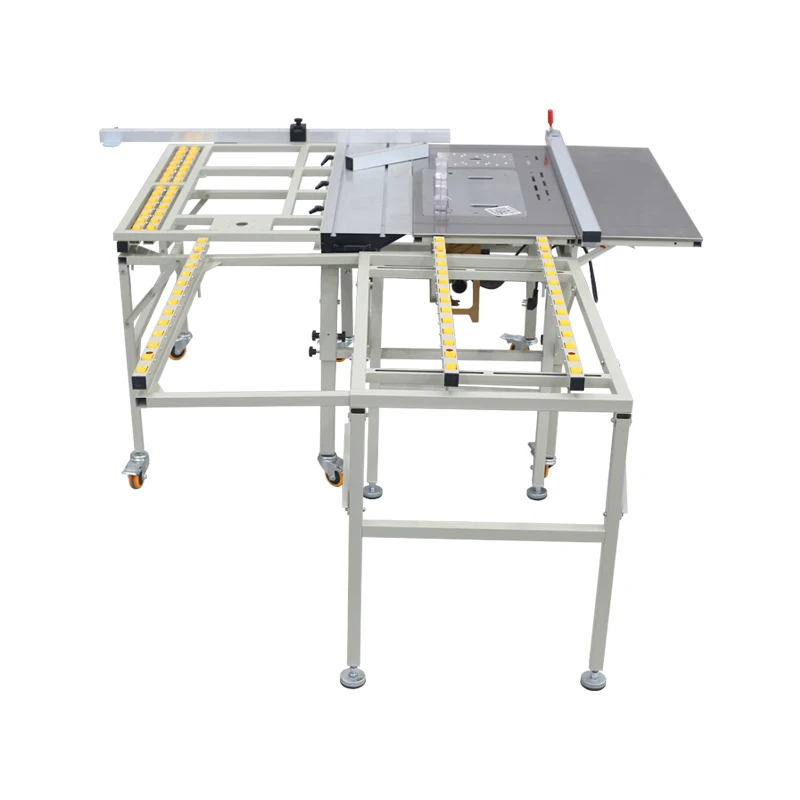
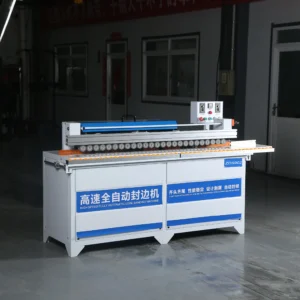
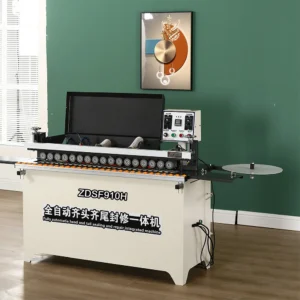
Compact Footprint, Full Function — the JT-550S arrives fully assembled in a wooden crate, so a small joinery shop can unbox, plug in, and start cutting MDF panels the same afternoon it is delivered.
Technical Specifications
| Parameter |
Value |
| Model |
JT-550S |
| Product Type |
Small Woodworking Electric Bench Cutting Saw / Portable Panel Saw with Sliding Table |
| Table Construction |
Stainless steel table with aluminum alloy flip plate |
| Angle Adjustment |
45° / 90° via flip plate mechanism, no manual recalibration |
| Saw Configuration |
Integrated sub saw and master saw with aluminum alloy chip collection |
| Motor Type |
Copper wire motor |
| Bearings |
Imported bearings |
| Dust Management |
Dust protection cover with integrated dust absorption |
| Operating Space Extension |
Sliding roller extension bracket |
| Plug Options |
EU, USA, AU, UK |
| Control Panel Language |
Chinese and English standard; English, Spanish or other languages on request |
| Assembly State |
Fully assembled, packed in wooden box |
| OEM Capability |
Logo printing and production according to customer drawings |
| Certification |
CE, ISO 9001 |
Application Suitability
| Application |
Material or Output |
| Small cabinet door and carcass sizing |
MDF and particleboard panels up to standard sheet thickness |
| Plywood shelving and divider cutting |
Plywood sheets requiring clean 90° crosscuts and 45° miters |
| Joinery startup replacing hand saws |
Solid wood panels for frame and tenon stock preparation |
| Compact workshop with limited floor space |
Panel components where the saw must be relocated between jobs |
Why the Plug Type Matters More Than You Think
A Small Sliding Table Saw in stock means nothing if it arrives with a plug that does not match your workshop outlet or a motor wound for a voltage your facility cannot supply. Confirming electrical compatibility before dispatch prevents a machine that sits idle while you source a transformer.
I have watched small workshop owners lose entire commissioning weeks because a bench saw arrived configured for 380V three-phase when the shop only had single-phase 220V available. The JT-550S ships with EU, USA, AU, or UK plug options, but the real question is whether your local frequency and amperage can sustain the copper wire motor under continuous panel cutting loads [NEED_CITE: voltage and frequency standards by export market]. A mismatch does not just stall production — it burns out windings and voids warranty coverage before the first sheet of MDF is cut.

Ready Stock, Single-Unit Orders, No Waiting for a Container
Small workshops do not buy in bulk. The JT-550S is available as a Small Sliding Table Saw in stock for single-unit dispatch, which means you are not waiting to fill a container or meet a minimum order threshold. The machine leaves the factory fully assembled inside a wooden crate — there is no on-site mechanical assembly required, no belt tensioning, and no alignment of the sliding table to the main saw. You position it, connect power, and run a test cut.
This matters when you are a joinery startup that needs one reliable bench saw to replace a handheld circular saw and a makeshift workbench. You do not need a production line; you need one machine that cuts square and true from day one.
The Flip Plate Advantage for Small Shops Without Setup Time
Workshops transitioning from manual tools rarely have a dedicated setter who spends the morning calibrating the saw for the day's cut list. The aluminum alloy flip plate on the JT-550S switches between 45° and 90° cuts without manual recalibration, which means the operator flips the plate and continues cutting [NEED_CITE: woodworking machinery setup time and operator skill requirements]. There is no dial indicator, no test cut on scrap, and no iterative adjustment that eats into a small batch schedule.
For a cabinet maker running short batches of MDF shelving one morning and plywood miters the next, this eliminates the most common source of downtime on entry-level bench saws. The sub saw and master saw run in tandem, and the aluminum chip collection keeps the cut line visible so the operator can track blade engagement in real time.
What the Specifications Actually Mean on the Shop Floor
The stainless steel table resists the resin buildup that warps cheaper aluminum tables after weeks of cutting particleboard — this keeps the panel sliding true over months of use rather than weeks. The sliding roller extension bracket extends the usable cutting surface without demanding a larger machine footprint, which matters when your workshop doubles as a storage area and every square meter of floor space is negotiated daily.
Imported bearings on the main shaft reduce the lateral play that causes wandering cuts on thicker MDF stock. When you are sizing panels for cabinet assembly, even a fraction of a millimeter of blade deflection compounds into visible gaps at the joints. The dust protection cover with integrated dust absorption is not optional luxury — it is what keeps a small enclosed workshop breathable when you are cutting particleboard for eight hours [NEED_CITE: airborne particulate standards in enclosed woodworking shops].
What Happens When You Skip the Voltage Conversation
Ordering a bench saw without confirming your local voltage and plug standard is the fastest way to receive a machine you cannot run. The motor will hum, overheat, and trip your breaker — or worse, it will run at reduced torque and burn through blades while delivering ragged cuts on plywood. Small workshops often lack the electrical infrastructure to adapt on the fly, and sourcing a step-up transformer adds cost and delay you did not budget for [NEED_CITE: CE machinery directive requirements for industrial equipment].
The JT-550S specification sheet includes voltage and frequency confirmation as a standard pre-dispatch step, so the machine you receive matches the outlet on your wall.
Why Order This Saw Through This Channel
The JT-550S is stocked for single-unit dispatch with verified plug and voltage configuration, so you are not negotiating a container load to get one machine. Every unit ships with a pre-shipment test record on your specified panel material, not a generic factory certificate. The control panel language defaults to Chinese and English, but Spanish or other languages can be configured before the machine leaves the floor — an operator who cannot read the interface is an operator who guesses at settings.
Voltage and plug are confirmed in writing before production begins, eliminating the most common cause of dead-on-arrival equipment in cross-border machinery trade. The machine arrives fully assembled, meaning your first cut happens hours after delivery, not days.
Documentation & Verification
- Electrical schematic matching your confirmed voltage and plug type
- Factory test record on your specified MDF or plywood thickness
- Operation manual in your agreed language with illustrated safety section
- Packing photographs taken before the wooden crate is sealed
- CE declaration of conformity for customs clearance in your market
- Spare parts list with part numbers for bearings, blades, and flip plate components
Installation, Commissioning & Support
- Position on level concrete floor; no foundation bolts required for bench-top operation
- Connect to a dedicated circuit matching the confirmed voltage and plug type
- Machine arrives fully assembled — no mechanical setup or belt tensioning needed
- Run first test cut on scrap MDF to verify square and miter accuracy
- Dust absorption port connects to standard workshop extraction hose
- Imported bearings require periodic lubrication per the maintenance schedule in your manual
Before You Request a Quote
Tell us your panel material, typical sheet dimensions, and whether your daily volume is a handful of cuts or a full shift of continuous sizing. Confirm your workshop voltage, frequency, and plug standard so the machine is wired correctly before it ships. Let us know if your operator needs the control panel and manual in a language beyond Chinese or English.
Frequently Asked Questions
Q: Is the JT-550S rated for my daily panel cutting volume, or do I need a larger model?
A: The JT-550S is designed for small workshops and joinery startups running low-to-medium daily volumes of MDF, plywood, and particleboard. If your operation runs continuous shifts at production-line pace, a larger sliding table saw with a higher-duty motor and longer sliding carriage would be a better match. Share your typical daily cut count and we will confirm suitability or recommend the next step up.
Q: What plug and voltage options ship from stock, and can I specify a non-standard setup?
A: The JT-550S ships from stock with EU, USA, AU, or UK plug options configured to match your local voltage and frequency. If your workshop runs a non-standard supply, confirm your exact voltage, phase, and frequency before order so the copper wire motor is wound correctly and the electrical schematic matches your facility.
Q: How do I order a single unit, and what is the typical dispatch lead time?
A: Single-unit orders are standard for this model with no minimum order requirement. The machine is stocked and dispatched after pre-shipment testing and documentation preparation. Confirm your voltage, plug type, and language preference at inquiry so there are no delays in configuration before the machine ships.
Q: Can the manual and control panel be supplied in my local language?
A: Chinese and English are standard. English, Spanish, or other languages can be configured before dispatch. Confirm your preferred language during inquiry so the operation manual, safety labels, and control panel interface all match what your operator can read and understand on day one.
Q: What does the upgrade path look like if my production outgrows this saw?
A: The JT-550S sits at the entry point of a full sliding table saw range. When your daily volume increases or you begin cutting thicker solid wood stock, you can move to a larger model within the same product family without changing suppliers. Your existing tooling knowledge and maintenance routines carry over, and the transition is a single machine swap rather than a full workshop reconfiguration.