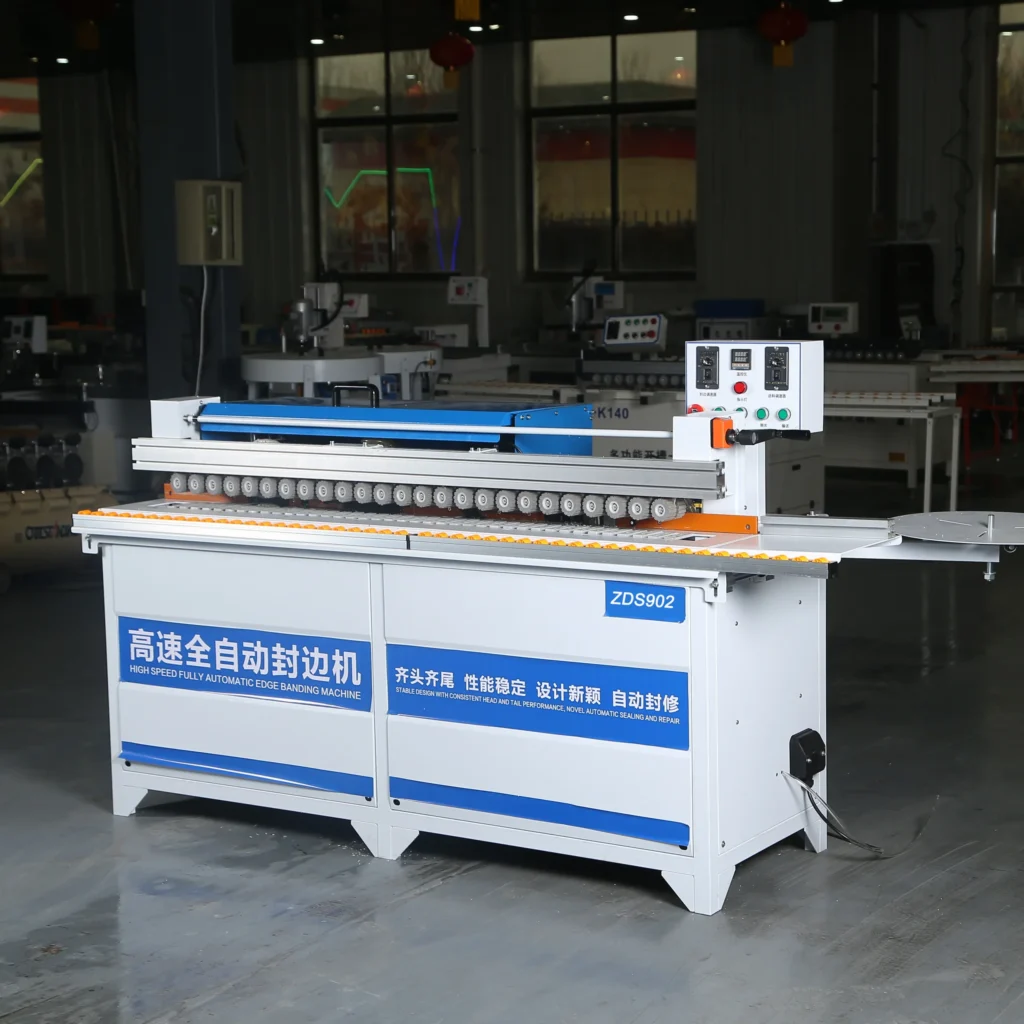
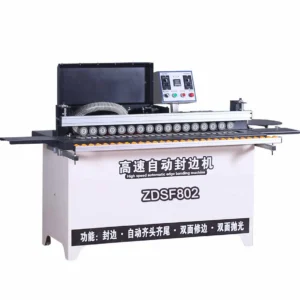
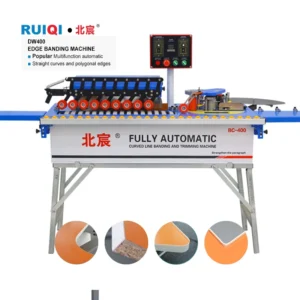
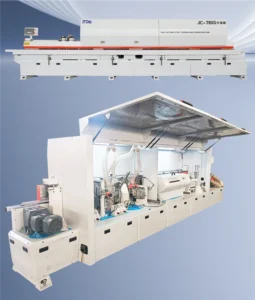
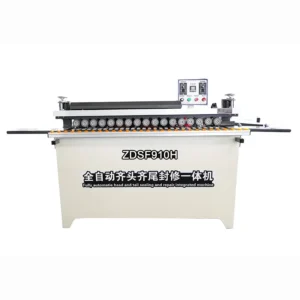
Compact Automation Ready — Stocked entry-level edge bander with double-sided gluing and 4000 ml glue pot, built for joinery shops stepping up from manual edging without a full line commitment.
Technical Specifications
| Parameter |
Value |
| Product Type |
Automatic Edge Banding Machine |
| Voltage |
220V (other configurations available on request) |
| Total Power |
4200W |
| Equipment Size |
207 × 60 × 122 cm |
| Net Weight |
245 kg |
| Edge Banding Type |
Linear Edge Banding Machine |
| Edge Band Height Range |
0–35 mm |
| Edge Band Thickness Range |
0.5–2.5 mm |
| Glue Pot Capacity |
4000 ml |
| Gluing Method |
Double-sided gluing |
| Trimming Stations |
Double high-speed trimming motors (up and down) |
| Polishing Stations |
Two (up and down) |
| Pressure Beam |
Integrated, adjustable handle, double rows of pressure wheels |
| Conveyor Belt |
Silicone material |
| Edge Strip Cutting Device |
Pneumatically controlled |
| Temperature Control |
Intelligent temperature control |
| Assembly State |
Partially assembled (setup required per manual) |
| Warranty |
1 year |
| Feed Speed |
(basis to be confirmed) |
| Panel Thickness Range |
(basis to be confirmed) |
| Tolerance |
(basis to be confirmed) |
| Air Supply Requirement |
Pneumatic device present — confirm pressure and flow |
| Certification |
(basis to be confirmed) |
Application Suitability
| Application |
Material or Output |
| Custom furniture panel edge banding |
MDF and plywood with PVC or veneer strips |
| Cabinet door and carcass finishing |
Particleboard with 0.5–2.5 mm edge band |
| Joinery startup production |
Straight linear edges on small to medium panels |
| Small workshop scaling from manual edging |
Moderate daily volumes of flat panel components |
Why the Voltage Question Should Come Before the Price
An edge banding machine for small workshop use is only as reliable as the electrical supply it connects to. Confirming your local voltage and frequency before the order is placed eliminates the single most common cause of commissioning failure. [NEED_CITE: voltage and frequency standards by export market]
I have watched a compact edge bander arrive at a job site in the Middle East wired for 220V, only to find the workshop running 380V three-phase. The machine tripped the breaker the instant it was powered on. A step-down transformer had to be shipped internationally, and the client lost two full weeks of production while waiting. That is why I now ask every buyer for a photo of their distribution board before we quote. A machine that cannot run in your shop is not a bargain — it is a liability.
Dispatch-Ready Stock for Growing Workshops
This automatic edge bander is positioned for the joinery shop or cabinet maker who has outgrown hand-held trimmers but does not yet need a full CNC line. The 207 cm footprint means it fits alongside an existing panel saw or sliding table without requiring a dedicated room. Because the machine ships from ready stock, the typical lead time is measured in days rather than the multi-week build cycle of custom-configured production lines.
Double-Sided Gluing Where It Matters
The double-sided gluing system applies adhesive to both the panel edge and the banding strip simultaneously. For MDF and particleboard — the substrates most small shops work with daily — this approach delivers consistent wet-out and reduces the chance of starved glue joints that show up only after trimming. The 4000 ml glue pot holds enough adhesive for sustained work sessions, so the operator is not stopping every few panels to refill.
What the Specification Sheet Tells You About Output Quality
The edge band height range of 0–35 mm covers the vast majority of panel thicknesses encountered in furniture and cabinet work. The integrated pressure beam with double rows of silicone pressure wheels holds the banding flush against the substrate during the glue cure phase, and the adjustable handle lets a single operator switch between panel thicknesses without tools. [NEED_CITE: edge banding adhesion standards for wood-based panels]
The pneumatically controlled edge strip cutting device removes the manual snip step that introduces inconsistency in hand-fed setups. Combined with double high-speed trimming motors and two polishing stations, the machine delivers a finished edge in a single pass. For a workshop processing dozens of panels per session rather than thousands, this configuration strikes the balance between automation and simplicity.

When Entry-Level Machines Are Pushed Beyond Their Design
Every edge bander has a production volume it was engineered for, and problems begin when that ceiling is ignored. I have seen small shops running entry-level machines at volumes suited for industrial lines, only to find the glue pot cannot maintain temperature under constant use and the trimming motors overheat by mid-shift. The result is visible glue lines, uneven trimming, and panel rejection that costs more than the time saved. [NEED_CITE: common causes of edge banding failure in small-scale production]
If your daily panel count is growing past what this class of machine handles comfortably, the answer is not to push harder — it is to plan an upgrade path before quality starts slipping.
What You Get Beyond the Machine Itself
The four-stage quality control process covers incoming material inspection, in-process checks, finished product verification, and pre-shipment testing — so the machine that arrives at your dock has already run panels before it was crated. Voltage configuration is confirmed against your site supply before production begins, eliminating the transformer scenario described above.
The operation and maintenance manual is provided in the language your operator reads, not a generic translation that stalls commissioning. Engineer-led configuration recommendations are delivered within 24 hours of inquiry, based on your actual panel sizes and substrate mix rather than a catalogue default. Factory visits are welcomed if you want to see the machine run your material before committing.
Documentation & Verification
- CE declaration of conformity matching the shipped configuration
- ISO 9001 certificate covering the manufacturing facility
- Machine specification sheet with confirmed voltage and frequency
- Electrical schematic with wiring diagram for local electrician reference
- Factory test record on your panel thickness range before dispatch
- Operation and maintenance manual in your operator's agreed language
Installation, Commissioning & Support
- Requires a dedicated 220V circuit rated for the 4200W total power draw
- Arrives partially assembled — allow time for pressure beam and conveyor alignment per manual
- Pneumatic edge strip cutter requires a compressed air supply at the specified pressure
- First-run glue temperature calibration should use your actual PVC or veneer banding stock
- 245 kg net weight requires a level concrete floor with adequate clearance around the 207 cm frame
- Spare parts list and trimming blade specifications included for local sourcing
What to Share When You Inquire
To receive an accurate configuration and dispatch timeline, provide your workshop's confirmed voltage and frequency, the panel substrates and edge band materials you work with most often, and the typical panel dimensions you process daily. If you are replacing a manual process, describe your current edging method and daily volume so the engineer can confirm this model matches your throughput range.
Frequently Asked Questions
Q: What panel thickness and edge band materials does this machine handle, and what is the realistic daily throughput?
A: The machine accommodates edge band heights from 0 to 35 mm and thicknesses from 0.5 to 2.5 mm, working with PVC and veneer on MDF, particleboard, and plywood. Realistic throughput depends on panel size and operator feed pace — this model is engineered for small workshop volumes, not high-speed line production.
Q: Can the voltage be configured for my local power supply, and is that confirmed before shipping?
A: The standard configuration is 220V, but other voltages from 110V to 440V are available on request. Voltage and frequency are confirmed against your site supply documentation before the order enters production, and the electrical schematic reflects the shipped configuration.
Q: Does the machine arrive fully assembled, or will I need to complete setup?
A: The machine ships partially assembled. Some components including the pressure beam and conveyor belt require field alignment per the included operation manual. Video guidance for the setup sequence can be requested before the machine arrives at your facility.
Q: What spare parts are included, and how quickly can consumables be resupplied?
A: A spare parts list is provided with the shipment, covering high-wear items. Consumables such as trimming blades and polishing wheels are standard industrial sizes, and replacement supply timelines are confirmed at the time of order based on your location.
Q: Is there an upgrade path if my order volume grows beyond this entry-level model?
A: The manufacturer offers a full product family from entry-level to full-function pre-milling edge banders within one lineup. Moving to a higher-tier model within the same brand preserves operator familiarity and simplifies spare parts management as your workshop scales.