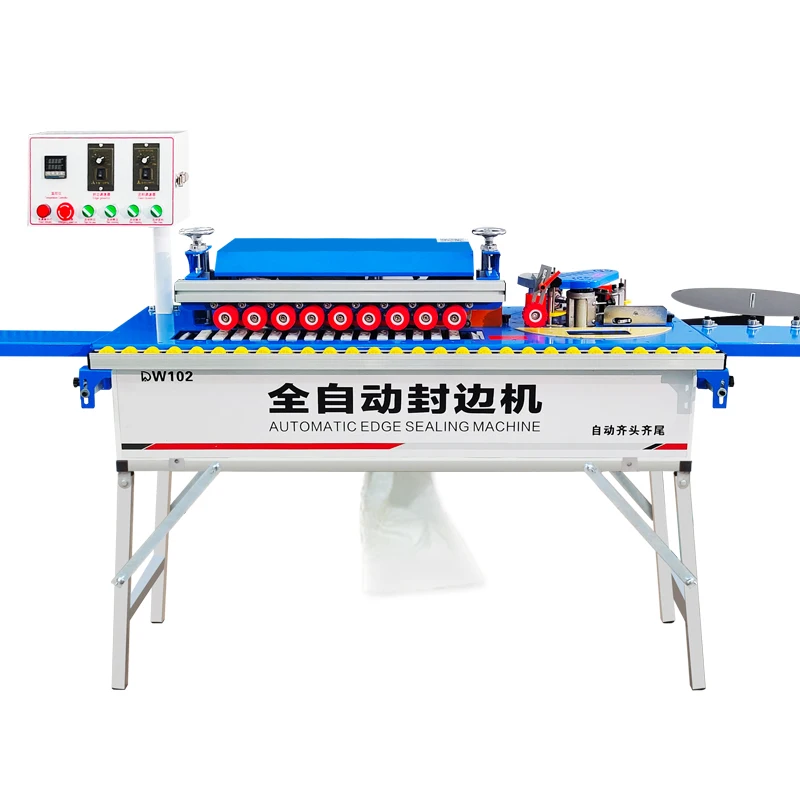
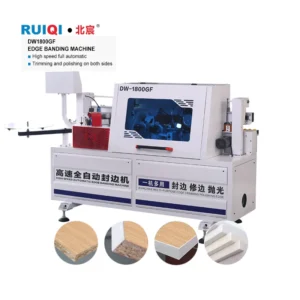
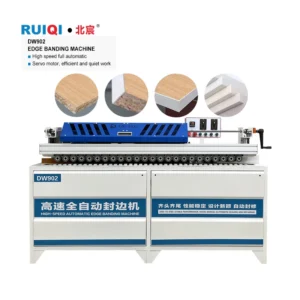
Compact Footprint, Verified Voltage — Every DW102 unit ships with electrical settings matched to your workshop supply, eliminating the most common cause of startup failure in entry-level edge banders.
Technical Specifications
| Parameter |
Value |
| Model |
DW102 |
| Product Type |
Automatic Edge Banding Machine |
| Total Power |
3800W |
| Voltage & Frequency |
220V / 380V / Customization available |
| Edge Banding Height Range |
0–50mm |
| Edge Banding Thickness Range |
0.3–3mm |
| Minimum Sheet Length |
25cm |
| Minimum Sheet Width |
5cm |
| Overall Dimensions (L×W×H) |
128×47×69cm |
| Net Weight |
75kg |
| Air Source Pressure |
0.5–0.8MPa |
| Glue Pot Capacity |
1000ml |
| Key Features |
Curved and straight edge banding, edge trimming, polishing, automatic head and tail cutting, vacuum assist, multilingual control panel options |
Application Suitability
| Application |
Material or Output |
| Small cabinet and furniture workshop production |
MDF, particleboard, plywood panels with straight or curved profiles |
| Joinery startup replacing manual edge finishing |
Blockboard and wood panels up to 50mm edge height |
| Polymer door component edge finishing |
PVC and veneer edge banding at 0.3–3mm thickness |
| Custom panel processing for fit-out projects |
Small-batch runs with mixed curved and straight edges |
Why the Voltage Question Must Come Before the Quote
A machine rated for the wrong supply will never start production, no matter how well it was built.
I learned this the hard way. Early in my career, I shipped a straight-and-curved edge bander to a workshop in West Africa without double-checking the local frequency standard. The transformer burned on first power-up. The customer lost three weeks of production while we sourced and shipped a replacement. That automatic edge banding machine in stock sat idle while the client fielded complaints from their own buyers. Since then, I treat voltage and frequency confirmation as the first step in any order — not an afterthought handled by the logistics team [NEED_CITE: voltage and frequency standards by export market]. When you are sourcing your first machine, the excitement of getting equipment on the floor can push electrical compatibility to the bottom of the checklist. It should be at the top.

What "In Stock" Actually Means for Your Workshop
Ready-to-ship availability matters most when you are a small operation with no backup plan. A large factory can absorb a six-week lead time because other lines keep running. A startup joinery shop or a two-person cabinet business cannot. The DW102 is held as an automatic edge banding machine in stock precisely because it serves buyers who need to move from manual trimming to mechanized finishing within days, not months. The unit ships fully assembled — you are not receiving a crate of sub-assemblies and a set of instructions.
The Compact Machine That Still Covers Real Work
The 128×47×69cm footprint fits against a wall in a small workshop, but the working range tells the real story. A 0–50mm edge banding height and 0.3–3mm thickness range covers the PVC and veneer stock that most small furniture and cabinet shops use daily [NEED_CITE: common edge banding material thickness ranges in small workshop production]. The curved-and-straight dual capability means you do not need two separate machines when a project includes radius panels. For a business processing its first machine-based orders, that flexibility removes a bottleneck before it appears.
Reading the Specs That Matter for Small-Scale Production
The 3800W total power draw is deliberate. Many small workshops operate on single-phase 220V supplies with limited breaker capacity. A machine pulling significantly more would require an electrical panel upgrade before installation. The 25cm minimum sheet length and 5cm minimum width mean you can process small offcuts and narrow components — drawer fronts, shelf brackets, and cabinet dividers — without feeding them through by hand. The 1000ml glue pot is sized for intermittent use rather than continuous production runs, which aligns with the volume profile of a shop producing custom or small-batch furniture. Air source pressure at 0.5–0.8MPa is standard shop compressor territory, so you are not adding a dedicated air supply to the purchase.
The Hidden Cost of Skipping Configuration Checks
Buying a single machine without confirming specifications against your actual conditions creates problems that compound. An unreadable control panel in a language your operator does not speak means commissioning stalls until someone improvises a translation. An edge bander set for 380V arriving at a 220V-only workshop sits in a crate while you arrange an electrician and a step-up transformer. These are not engineering failures. They are communication failures that happen when the sale closes before the specification sheet is reviewed [NEED_CITE: common causes of commissioning delays in imported woodworking machinery]. The cost is not the machine price — it is the lost production days and the operator frustration that follows.
Why Procurement Here Reduces Those Risks
Voltage and frequency are confirmed against your local supply before the machine leaves the factory, not assumed from a regional generalization. The control panel language is set to your operator's requirement — Chinese and English ship standard, with Spanish and other languages available on configuration. Every unit goes through a pre-shipment test on actual panel stock, and the factory test record ships with the machine so you can verify performance on arrival. The DW102 sits within a broader product family, so when your volume grows beyond what this compact unit handles, you move to the next tier without changing suppliers or relearning a new control interface. Single-unit orders are accepted with no minimum order quantity barrier, which is how most small workshops actually buy.
Documentation & Verification
- CE declaration of conformity covering this machine class and configuration
- Electrical schematic matching your confirmed voltage and frequency setup
- Factory test record run on panel thickness within your specified range
- Operation and maintenance manual written in your agreed language
- Spare parts list with part numbers for consumables and wear items
- Packing photographs taken before crate closure for condition verification
Installation, Commissioning & Support
- The 75kg net weight allows two-person placement without floor reinforcement or crane hire
- 3800W draw requires a dedicated circuit breaker sized to your confirmed voltage configuration
- Unit ships fully assembled — no mechanical assembly needed on the workshop floor
- Glue pot and feed mechanism require initial parameter setting matched to your banding material
- Vacuum assist connection needs 0.5–0.8MPa supply from your existing or new compressor
- Multilingual control panel reduces operator training time during first-week commissioning
What We Need to Configure Your Machine Correctly
To move from inquiry to confirmed order, share your local voltage and frequency so we lock the electrical configuration before production. Let us know which edge banding materials you run most often — PVC, veneer, or both — and the typical panel thickness range in your current projects. If your operators need the control panel in a language beyond Chinese or English, specify that early so the interface is set before testing.
Frequently Asked Questions
Q: How do you confirm the correct voltage before shipping my machine?
A: We ask for your local supply voltage and frequency during the inquiry stage, then match the motor winding and transformer specification to those values. The electrical schematic is prepared for your confirmed configuration, and the machine is tested at that voltage during the pre-shipment verification. This eliminates the risk of arriving with incompatible power settings.
Q: Can the control panel display instructions in my operator's language?
A: Chinese and English are loaded as standard on every unit. Spanish and other languages are available as a configuration option set before the machine ships. Confirming this during the order stage means the panel is ready on arrival, rather than requiring a software update during commissioning.
Q: What is the smallest panel this machine can handle?
A: The minimum sheet length is 25cm and the minimum width is 5cm. This covers small components like drawer fronts, narrow shelving, and cabinet dividers that larger edge banders cannot feed reliably. The vacuum assist helps hold these smaller pieces stable during the banding and trimming cycle.
Q: Is this model sufficient for my daily volume, or do I need a larger machine?
A: The DW102 suits small workshops and joinery startups moving from manual to mechanized edge finishing. If your daily output involves continuous production runs with large panel volumes, a higher-tier model with larger glue capacity and faster feed rates would be a better fit. We can advise based on your stated throughput.
Q: How is the machine packed and how quickly can it dispatch?
A: The machine ships fully assembled in protective crating with packing photographs provided before closure. As an in-stock model, dispatch lead time is shorter than built-to-order units. Exact timing depends on your destination and shipping method, confirmed at the order stage.