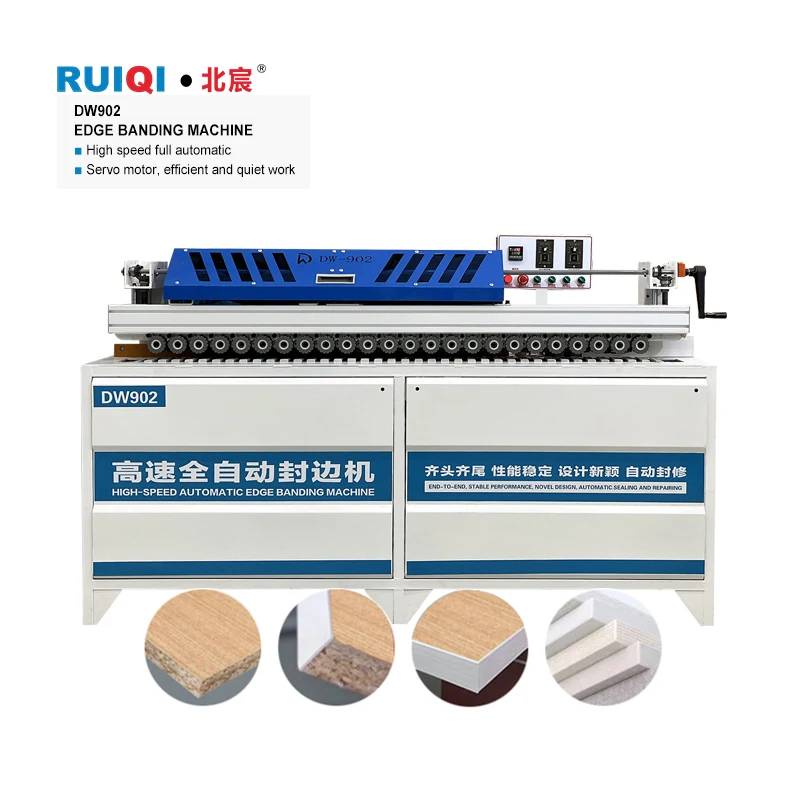
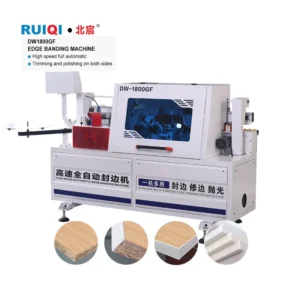
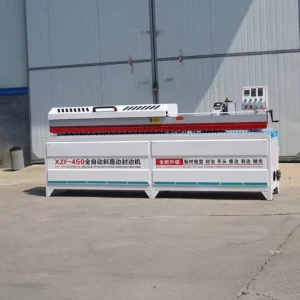
Compact Dual-Purpose Footprint — the DW902 handles both 90-degree bevel and straight edge banding within a 175cm frame, arriving voltage-confirmed so small workshops avoid the costly mistake of running two separate machines.
Technical Specifications
| Parameter |
Value |
| Model |
DW902 |
| Product Type |
Automatic Edge Banding Machine |
| Machine Configuration |
Oblique and straight dual-purpose (90-degree bevel and straight edge) |
| Total Power |
4000W |
| Voltage |
220V / 380V / customization available from 110V to 440V |
| Edge Banding Thickness Range |
0.3–3mm |
| Edge Banding Height |
50mm |
| Minimum Sheet Length |
250mm |
| Minimum Sheet Width |
100mm |
| Trimming Power and Speed |
800W × 2, 24000 r/min |
| Polishing Power |
380W × 2 |
| Vacuum Power |
550W |
| Edge Power |
140W |
| Transmission Power |
140W |
| Glue Pot Capacity |
4000ml |
| Air Source Pressure |
0.5–0.8 MPa |
| Pressing System |
4 groups of oblique pressure wheels, double row pressing wheels |
| Auxiliary Features |
Feeding auxiliary slide plate, double hot air design |
| Product Size |
175 × 87 × 112 cm |
| Product Weight |
240 kg |
| Assembly State |
Fully assembled |
| Plug Options |
EU, USA, AU, UK |
| Language Options |
Chinese and English (other languages customizable) |
| Standard Functions |
Edge banding, trimming, polishing, automatic trimming, scraping, vacuuming |
| Certification |
CE |
Application Suitability
| Application |
Material or Output |
| Cabinet door and carcass edge finishing |
MDF and particleboard panels with PVC or veneer edge banding |
| Home decoration furniture production |
Ecological board and plywood with 0.3–3mm banding material |
| Small-batch custom furniture runs |
Solid wood board panels requiring 90-degree bevel or straight edge treatment |
| Workshop offcut and small component banding |
Sheets as small as 250mm × 100mm processed with consistent edge quality |
Why the Voltage Question Should Come Before the Price for an Automatic Edge Banding Machine in Stock Fast Delivery
A machine that cannot match your workshop's electrical supply is dead weight on the day it arrives.
I have watched small cabinet shops take delivery of edge banders only to discover the motor hums but will not run because the frequency is wrong, or worse, the control board fries on first start-up because the local supply sits outside the machine's tolerance. The cost of shipping a 240kg unit back is not something a startup recovers from quickly. For a first Automatic Edge Banding Machine in stock fast delivery purchase, confirming voltage and frequency is the step that separates a working machine from a very expensive mistake [NEED_CITE: voltage and frequency standards by export market].

One Machine Instead of Two for Tight Workshop Floors
Small joinery shops rarely have the floor space to dedicate separate stations for straight edge and bevel banding. The DW902 addresses this by combining both 90-degree bevel and straight edge capability in a single chassis. A startup cabinet maker running MDF carcasses in the morning and beveled solid wood door fronts in the afternoon can switch between modes without moving material to a second machine. The 175 × 87 cm footprint leaves room for a sliding table saw and a workbench nearby, which matters when every square metre of floor is accounted for.
A Realistic First Step Away from Hand Trimming
Workshops moving from hand-held edge trimmers often overshoot, buying a full-production edge bander that demands dedicated circuits, compressed air volumes, and operator skill they have not yet developed. The DW902 sits at a more honest entry point. Total power at 4000W stays within the capacity of a standard workshop supply. The glue pot at 4000ml and banding thickness range of 0.3–3mm match the PVC and veneer materials typical in custom home decoration work. It is a machine designed for the volume and material mix a small shop actually runs, not the volume it hopes to reach in three years.
What the Numbers Mean on the Shop Floor
The trimming motors at 800W each and 24000 r/min provide the spindle speed needed to cleanly remove excess PVC banding on particleboard without tearing the substrate surface — a common failure point when low-speed trimmers try to cut rigid PVC on coarse board. The four groups of oblique pressure wheels and double row pressing system keep the banding tight against the panel edge during glue cure, which is where visible glue lines originate on uneven substrates. The double hot air design softens the banding material before it reaches the pressure zone, helping it conform to minor surface irregularities in ecological board or lower-grade plywood [NEED_CITE: edge banding adhesion factors on engineered wood substrates].
The Cost of Ignoring Panel Material When Choosing an Entry Bander
Some small shops buy the cheapest bander available and feed it whatever board happens to be in the rack. I have seen this go wrong: coarse, low-density particleboard tears under pre-milling cutters not designed for it, leaving a ragged substrate that no amount of scraping can clean up. The banding lifts within weeks because the glue never bonded to a smooth surface. With the DW902, the trimming and scraping stations handle the common 0.3–3mm PVC and veneer range, but the operator must still match feed rate to board density. Running high-density MDF and cheap particleboard at the same setting is how edge quality becomes inconsistent across a single batch.
Why Source This Automatic Edge Banding Machine in Stock Fast Delivery from Here
In-house manufacturing with patented cutting mechanisms means the trimming spindles are built and tested on-site, not sourced from a third-party catalogue and rebadged. The four-stage QC process — incoming material, in-process, finished product, and pre-shipment verification — catches tolerance drift before the machine leaves the factory. Voltage customization from 110V to 440V is handled as standard configuration, not a special engineering request. Every DW902 ships fully assembled with a factory test record specific to the panel material the buyer specifies, so commissioning is a matter of powering on and running a test piece, not diagnosing assembly issues [NEED_CITE: pre-shipment inspection standards for woodworking machinery].
Documentation & Verification
- CE declaration of conformity covering the DW902 edge banding and trimming functions
- Electrical schematic confirming your ordered voltage and plug type before dispatch
- Factory test record using your specified panel thickness and banding material
- Operation and maintenance manual provided in your requested language
- Spare parts list with part numbers for trimming blades, pressure wheels, and glue pot components
Installation, Commissioning & Support
- Floor space of at least 200 × 120 cm recommended around the 175 × 87 cm machine frame for operator access
- Dedicated 220V or 380V circuit matching the ordered voltage configuration with appropriate breaker rating for 4000W total draw
- Machine arrives fully assembled; no on-site mechanical assembly required beyond utility connections
- Air supply line delivering 0.5–0.8 MPa clean compressed air to the machine inlet for pressing and scraping functions
- First-run parameter setup covering glue temperature, feed speed, and trimming depth for your specific panel material
- Spare trimming blades and scraping tools included for initial operation period
Before You Request a Quote
Tell us what panel materials you run most often — MDF, particleboard, plywood, or solid wood — and the typical thickness range. Confirm your workshop voltage and frequency so we build the correct electrical configuration. Let us know if you need the control panel in a language other than Chinese or English, and whether you want to send sample panels for a factory test run before shipment.
Frequently Asked Questions
Q: What voltage and plug type will the DW902 arrive with for my country?
A: The machine is configurable from 110V to 440V. Before production, we confirm your local voltage, frequency, and plug standard — EU, USA, AU, or UK are stocked options, with other plug types available. The electrical schematic is provided in advance so your electrician can verify the workshop circuit before the machine arrives.
Q: Can the control panel be supplied in a language I specify?
A: Chinese and English are standard. Other languages are customizable on request. We confirm the panel language before production so operators can read settings and error messages from the first day of operation, avoiding commissioning delays caused by unreadable interfaces.
Q: What is the minimum panel size this machine can handle?
A: The DW902 processes sheets as small as 250mm in length and 100mm in width. This covers most offcut banding tasks in custom furniture work. For smaller components, manual edge finishing may still be more practical than machine feeding.
Q: How much floor space and air supply do I need in a small workshop?
A: Plan for roughly 200 × 120 cm of clear floor area around the machine. A compressed air supply delivering 0.5–0.8 MPa is required for the pressing and scraping stations. A standard workshop compressor with adequate receiver capacity typically meets this demand for single-machine operation.
Q: Is this machine a viable first step before scaling to a full production line?
A: Yes. The DW902 covers the core edge banding, trimming, polishing, and scraping functions needed for custom furniture production. As volume grows, it can serve as a secondary or backup machine while a higher-throughput line handles primary production, avoiding the need to replace it entirely.