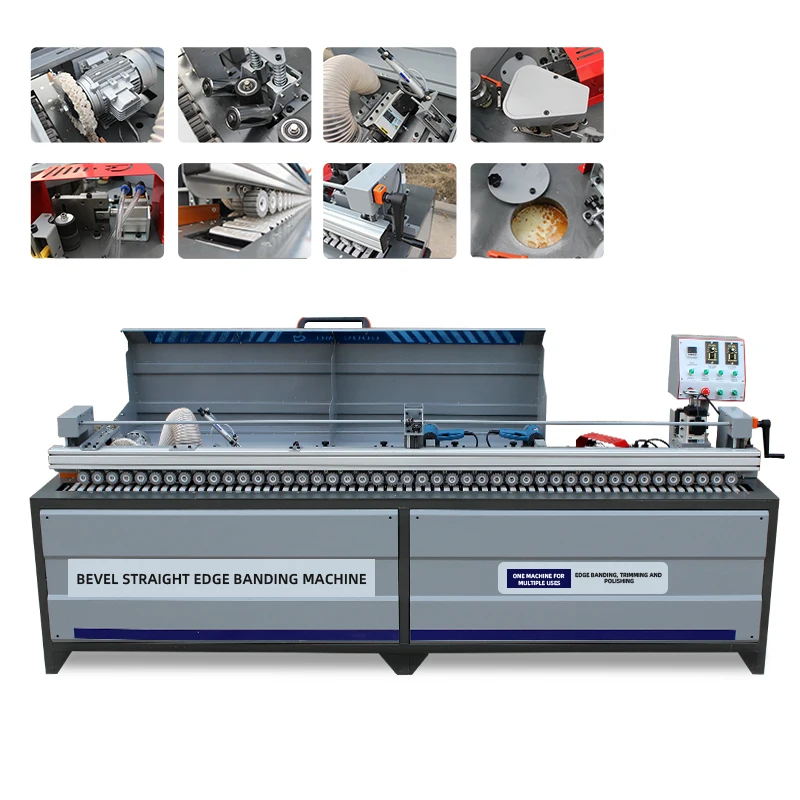
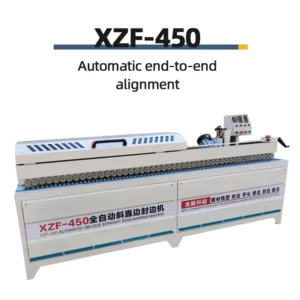
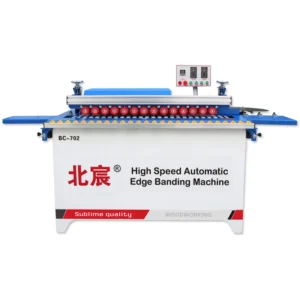
Ready Stock Dispatch — DW3000 units held in warehouse for immediate loading, with voltage and control language confirmed against your local grid before the crate is sealed.
Technical Specifications
| Parameter |
Value |
| Model |
DW3000 |
| Product Type |
Automatic Edge Banding Machine |
| Total Power |
11 kW |
| Voltage |
380V / 415V (configurable from 110V to 440V) |
| Feed Speed |
0–12 m/min |
| Edge Banding Thickness |
0.3–3 mm |
| Edge Banding Height |
0–50 mm |
| Minimum Sheet Length |
30 cm |
| Minimum Sheet Width |
15 cm |
| Pre-milling Motor |
2.2 kW |
| Heating Power |
2.2 kW × 2 (dual heat gun) |
| Trimming Power |
2.2 kW × 2 |
| Polishing Power |
0.4 kW × 2 |
| Vacuum Power |
550 W |
| Edge Feed Motor |
160 W |
| Transmission Motor |
180 W |
| Glue Pot Capacity |
4000 ml |
| Trimming Stations |
3 spindle motors |
| Air Source Pressure |
0.5–0.7 MPa |
| Machine Dimensions |
299 × 65 × 130 cm |
| Machine Weight |
430 kg |
| Pressure Wheels |
8-group adjustable oblique, 30–90° |
| Control Language |
Chinese, English (customizable to Spanish or other languages) |
| Key Features |
Pre-milling, 30–90° bevel edge banding, trimming, scraping, polishing, high-power dust extraction |
Application Suitability
| Application |
Material or Output |
| Custom cabinet door edging |
MDF and particleboard with PVC or veneer banding 0.3–3 mm |
| Straight-edge panel furniture |
Plywood and melamine-faced board, standard thickness panels |
| 45-degree bevel finishing |
MDF furniture components requiring angled edge profiles |
| Small-batch workshop production |
Mixed panel materials in joinery and fit-out projects |
Why the Voltage Question Must Come Before the Crates Are Sealed
The moment an automatic edge banding machine in stock arrives on a workshop floor with the wrong voltage rating, it becomes an expensive paperweight rather than a production asset.
We confirm your local voltage and frequency before any unit leaves the warehouse.
I have watched a container land in a Southeast Asian port with a motor wound for 380V/50Hz, only for the buyer to discover the local grid runs 220V/60Hz. The machine sat idle while a replacement motor was shipped. That kind of delay is not a logistics problem — it is a specification failure that happened weeks earlier during the quotation stage. When buyers compare machines online, the voltage question often gets pushed to the bottom of the email thread. The DW3000 is configurable across a wide voltage range, but that flexibility only matters if the conversation happens before the machine is wired and crated [NEED_CITE: voltage and frequency standards by export market].

Ready Inventory Means Shorter Wait Times
When a joinery workshop decides to move from hand-held edge banding to a fully automatic line, the gap between decision and first production run needs to be as short as possible. The DW3000 automatic edge banding machine in stock is held in the warehouse, reducing the wait from a typical multi-week production cycle to a dispatch window measured in days. Single-unit orders are accepted, so a small cabinet maker does not need to commit to a container load.
Compact Footprint for Workshops in Transition
The DW3000 sits at under three metres in length and 430 kg, meaning most small workshops can position it without reinforcing the floor or rearranging the entire production layout. The 15 cm minimum sheet width and 30 cm minimum sheet length allow operators to run offcuts and smaller components — a practical advantage for custom furniture makers who rarely run long production batches of identical panels. This machine bridges the gap between manual edge banding and a full industrial line.
What the Spec Sheet Actually Means on the Shop Floor
The dual 2.2 kW heating system uses two heat guns rather than one, which keeps glue temperature stable across a full shift even when ambient workshop temperature fluctuates. The 0–12 m/min feed speed range, driven by a double-cylinder feeding belt, gives the operator control when switching between thin 0.3 mm PVC tape and thicker 3 mm solid wood banding — slower speeds for thicker materials, faster for standard PVC runs. The 8-group adjustable oblique pressure wheels cover 30 to 90 degrees, enabling both straight-edge and bevel work on the same machine without a tooling changeover. Three spindle trimming motors handle the rough and fine trimming stages sequentially, which reduces the visible glue line that a single-motor setup often leaves behind on porous substrates like particleboard [NEED_CITE: edge banding adhesion standards on particleboard substrates].
The Cost of Skipping the Pre-Shipment Test
A buyer once sent us photos of chipped edge banding on melamine-faced board. The machine had been ordered online, shipped without a material sample test, and the trimming motor speed was wrong for the laminate density. With the DW3000, we run your actual panel material — or the closest available equivalent — before dispatch. Skipping that step is how workshops end up spending the first week of ownership adjusting parameters instead of producing furniture [NEED_CITE: common commissioning failures in imported woodworking machinery].
What Sets This Procurement Path Apart
Pre-dispatch testing on your specified panel material and edge banding thickness is standard, not an optional extra. Voltage, frequency, and control panel language are locked in during the quotation stage, so the machine that arrives matches the workshop it enters. The four-stage quality check covers incoming components, in-process assembly, finished product inspection, and a final pre-shipment verification. Every DW3000 ships with the electrical schematic and voltage confirmation document, so your local electrician can wire the dedicated circuit without guesswork. Engineer-led configuration recommendations are delivered within 24 hours of receiving your panel specifications and production requirements.
Documentation & Verification
- Electrical schematic with your confirmed voltage and frequency before dispatch
- Factory test record using panel thickness and banding material matching your specification
- Operation and maintenance manual in your agreed language
- Spare parts list with part numbers for trimming blades, pressure wheels, and heating elements
- Packing photographs showing crating and component protection before container loading
Installation, Commissioning & Support
- Dedicated 380V/415V circuit required; confirm amperage against the 11 kW total draw before arrival
- Machine footprint of 299 × 65 cm requires a level concrete floor with clearance on the infeed side
- Air supply must deliver 0.5–0.7 MPa clean dry air to the machine inlet
- First-run parameter setting covers glue pot temperature, feed speed, and trimming depth for your panel type
- Operator training covers the 8-group pressure wheel adjustment for switching between straight and 45-degree bevel work
- Spare trimming blades and polishing wheels included in the initial shipment package
Before You Send the Inquiry
Share the panel materials you run most often — MDF, particleboard, plywood, or a mix — along with the edge banding thickness and type you use. Confirm your local voltage and frequency so the correct motor and transformer configuration can be quoted. Let us know whether you need straight-edge only or both straight and 45-degree bevel capability, and what language the control panel should display.
Frequently Asked Questions
Q: What voltage options are available and how do I confirm compatibility for my region?
A: The DW3000 is configurable from 110V to 440V. During the quotation stage, tell us your local supply voltage and frequency. We provide an electrical schematic and voltage confirmation document before shipping, so your electrician can verify the circuit requirements match the machine configuration.
Q: How do I choose between straight edge and 45-degree bevel configurations?
A: The DW3000 handles both on the same machine through its 8-group adjustable pressure wheels set between 30 and 90 degrees. If your production includes cabinet doors with bevel profiles, both capabilities should be active. For flat-panel shelving and carcass work only, straight-edge setup simplifies daily operation.
Q: What is the dispatch lead time for ready stock units?
A: Ready stock units are prepared for dispatch within a short window after voltage confirmation and pre-shipment testing. The exact timeline depends on whether a material sample test is requested. Single-unit orders are accepted without minimum quantity requirements.
Q: Can I order a single unit or are there minimum order requirements?
A: Single-unit orders are standard. The DW3000 ships individually crated with spare parts, documentation, and packing photographs. There is no minimum order quantity, making it practical for a workshop adding its first automatic edge bander.
Q: What language options are available for the control panel?
A: Chinese and English are standard. Spanish and other languages can be configured before dispatch. Specify your preferred language during the quotation stage so the control panel is set up and the operation manual matches the interface your operators will use.