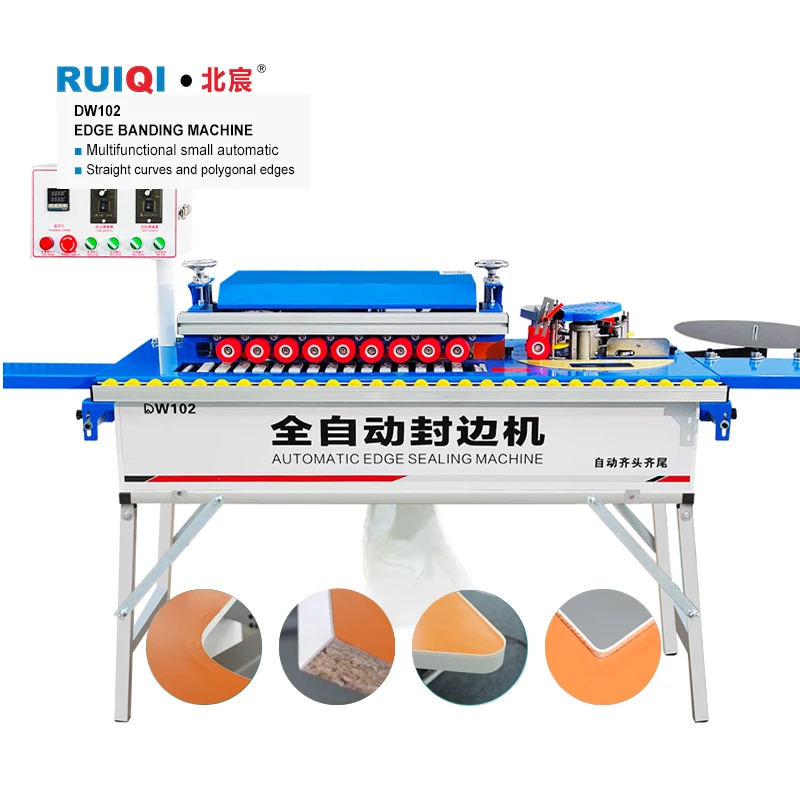
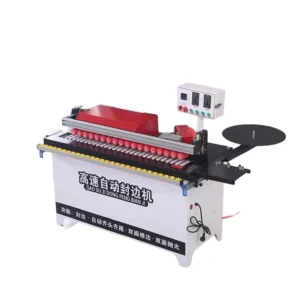
Compact Footprint Ready — The DW102 ships configured for your workshop's voltage and language, eliminating the commissioning delays that typically stall entry-level edge banding startups.
Technical Specifications
| Parameter |
Value |
| Model |
DW102 |
| Product Type |
Mini Automatic Edge Banding Machine |
| Total Power |
3800W |
| Voltage Options |
220V / 380V / customization available |
| Edge Banding Thickness |
0.3–3 mm |
| Edge Banding Height |
0–50 mm |
| Minimum Sheet Length |
25 cm |
| Minimum Sheet Width |
5 cm |
| Glue Pot Capacity |
1000 ml |
| Trimming Power |
650W × 2 |
| Polishing Power |
180W × 2 |
| Vacuum Power |
1200W |
| Air Source Pressure |
0.5–0.8 MPa |
| Product Dimensions |
128 × 47 × 69 cm |
| Product Weight |
75 kg |
| Key Features |
Curved and straight edge banding, automatic head and tail trimming, vacuum-assisted feed, edge polishing |
Application Suitability
| Application |
Material or Output |
| Small cabinet workshop |
MDF and particleboard panels with PVC edge banding |
| Custom furniture startup |
Plywood and blockboard components requiring curved edge trimming |
| Joinery transition from manual |
Medium density fiber board panels in low-to-medium batch volumes |
| Polymer door finishing |
Straight and curved profiles with 0.3–3 mm banding material |
Why the Voltage Question Must Come Before Anything Else
Confirming local voltage and frequency prevents a machine from sitting idle on your shop floor for weeks.
I have watched small workshop owners receive an edge bander only to discover the motor does not match their local supply. The mini automatic edge banding machine in stock might look ready to go, but if the 220V or 380V configuration does not align with your workshop's actual electrical setup, you face weeks of downtime waiting for a transformer or a replacement unit [NEED_CITE: voltage and frequency standards by export market]. Operators stand around while the machine gathers dust, and production schedules collapse.

Stock Availability Without the Guesswork
When a joinery startup needs its first machine fast, waiting months for production is not an option. The DW102 is held in stock specifically for buyers who need a mini automatic edge banding machine dispatched without extended lead times. Voltage configuration and plug type are confirmed at the point of order, so the unit that arrives at your dock matches your workshop's electrical infrastructure from day one.
Compact Frame, Real Capability
A 75 kg footprint means this machine rolls into place without reinforced flooring or dedicated foundations. The 128 × 47 × 69 cm frame fits against a wall in a small workshop, leaving room for material staging and offcut storage. Despite the compact size, the DW102 handles both straight and curved edge profiles, which matters when a custom furniture maker processes panels that are not simple rectangles [NEED_CITE: CE machinery directive requirements for edge banding equipment].
Reading the Numbers That Matter
The 0.3–3 mm edge banding thickness range covers the standard PVC and veneer tapes used in cabinet and furniture production. A glue pot capacity of 1000 ml suits intermittent small-batch runs where continuous high-volume glue circulation would waste energy and degrade adhesive quality. The dual 650W trimming motors provide sufficient torque for clean head-and-tail cuts on particleboard and MDF, while the 180W × 2 polishing wheels finish the edge to acceptable visual quality. Air supply at 0.5–0.8 MPa drives the vacuum feed system, keeping panels stable through the banding and trimming sequence without requiring a separate heavy-duty compressor.
What Happens When You Skip the Configuration Step
Buying an entry-level machine without confirming specifications leads to predictable failures. The control panel arrives in a language your operator cannot read, stalling commissioning entirely. The plug type does not match your workshop sockets, requiring an adapter that may not handle the 3800W total draw safely. The air pressure available in your shop falls below the 0.5 MPa minimum, causing the vacuum feed to slip on heavier panels [NEED_CITE: common pneumatic supply failures in small woodworking workshops]. Each of these issues is avoidable with a straightforward pre-order conversation.
Why Source This Configuration Here
In-house manufacturing means voltage customization is built into the order process rather than treated as an afterthought. Four-stage quality control covers incoming material through pre-shipment verification, so the DW102 is tested against your specified panel thickness before it leaves the factory. Engineer-led configuration recommendations ensure the machine you receive matches your actual production requirements, not just a catalog default. The product family spans from this entry-level unit to full-function pre-milling models, so a workshop can scale throughput later without switching suppliers entirely.
Documentation & Verification
- CE declaration of conformity covering the DW102 edge banding and trimming functions
- Electrical schematic matching your confirmed voltage and plug configuration
- Factory test record on your specified edge banding thickness range before dispatch
- Operation and maintenance manual provided in your operator's agreed language
- Spare parts list identifying consumables for first-year DW102 operation
Installation, Commissioning & Support
- Requires a dedicated circuit matching confirmed 220V or 380V supply at 3800W total draw
- Compressed air line at 0.5–0.8 MPa connected before first operation of the vacuum feed
- Machine arrives assembled; position on level floor within the 128 × 47 × 69 cm footprint
- Initial glue pot fill and temperature calibration performed using included 1000 ml capacity
- First-run test on sample MDF panels verifies trimming alignment and polishing finish
Getting the Right Configuration Quoted
Provide your workshop's local voltage, frequency, and plug type along with the edge banding materials you typically use. Share your smallest and largest panel dimensions so we can confirm the DW102 handles your workpiece range. If you run both straight and curved profiles, note the minimum curve radius so we can verify suitability before dispatch.
Frequently Asked Questions
Q: What panel sizes and materials can the DW102 handle in a typical small workshop?
A: The DW102 processes panels with a minimum length of 25 cm and minimum width of 5 cm, accommodating MDF, particleboard, plywood, and blockboard. Edge banding thickness from 0.3 to 3 mm covers standard PVC and veneer tapes. Both straight and curved edges are supported within the 0–50 mm banding height range.
Q: How do I confirm the correct voltage and plug type for my country before ordering?
A: Share your local voltage and frequency during the inquiry stage. The DW102 is configurable for 220V or 380V, and plug options include EU, USA, AU, and UK standards. We confirm the electrical configuration in writing before production or dispatch to ensure compatibility with your workshop supply.
Q: What is the dispatch lead time for stocked DW102 units versus custom voltage orders?
A: Stocked units with standard voltage configurations ship quickly after order confirmation. Custom voltage or language requests require a short additional lead time for configuration and pre-shipment testing. We provide a confirmed dispatch date once your specifications are finalized.
Q: Can the control panel and manual be provided in languages other than Chinese?
A: Yes. The DW102 control panel supports Chinese and English as standard, with additional languages available on request. The operation and maintenance manual is provided in your agreed language to ensure your operators can commission and run the machine without translation barriers.
Q: What spare parts and consumables should I order with the machine for first-year operation?
A: We recommend ordering replacement trimming blades, polishing wheels, and glue pot seals alongside the DW102. A spare parts list is included with every shipment, identifying wear items specific to this model so you can maintain continuous operation without waiting for overseas delivery.