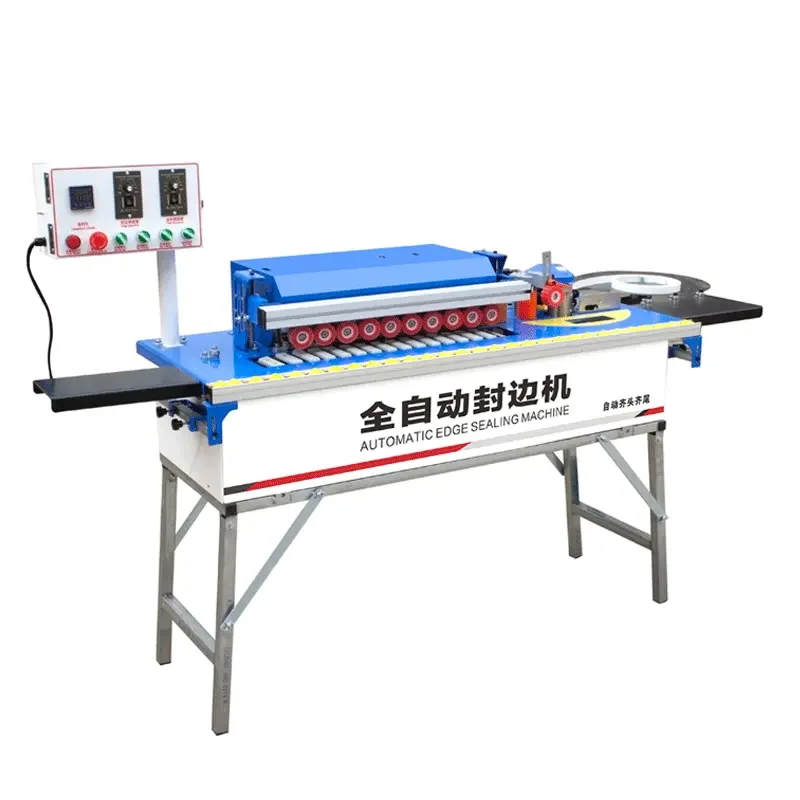
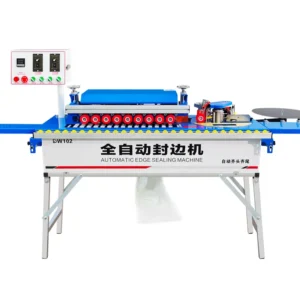
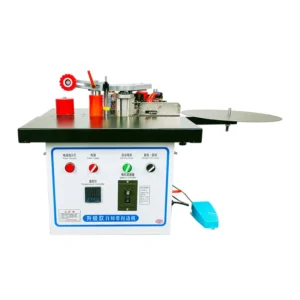
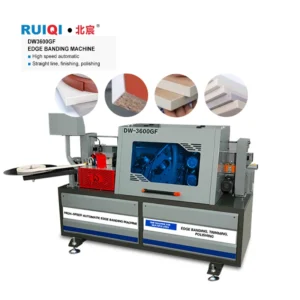
Compact Footprint, Verified Fit — the DW102 is stocked and configured to your local voltage before dispatch, so it runs the day it arrives in your workshop.
Technical Specifications
| Parameter |
Value |
| Model |
DW102 |
| Product Type |
Automatic Edge Banding Machine |
| Rated Power |
3800W |
| Voltage & Frequency |
220V/380V/customization |
| Overall Dimensions (L×W×H) |
128×47×69 CM |
| Net Weight |
75 KG |
| Minimum Sheet Length |
25 CM |
| Minimum Sheet Width |
5 CM |
| Edge Banding Height |
0-50 MM |
| Edge Banding Thickness |
0.3-3 MM |
| Panel Thickness Range |
0-50 MM |
| Trimming Motor |
650W×2 |
| Polishing Motor |
180W×2 |
| Glue Pot Capacity |
1000 ml |
| Vacuum Power |
1200W |
| Air Supply Requirement |
0.5-0.8 MPa |
| Language Options |
Chinese and English standard; Spanish or other languages customizable |
| Standard Features |
Curved and straight edge banding, edge trimming, polishing, automatic head and tail cutting, vacuum |
| Certification |
CE |
Application Suitability
| Application |
Material or Output |
| Small cabinet door production |
MDF and particleboard panels with PVC or veneer edge banding |
| Custom joinery components |
Plywood and blockboard for bespoke furniture frames |
| Curved panel edging |
Polymer door profiles and shaped MDF elements |
| Workshop prototyping runs |
Short batches of solid wood panels and composite boards |
Why the Voltage Question Should Come Before the Price
Confirming your local voltage and frequency is the first step in ordering an Automatic Edge Banding Machine in stock, not an afterthought once the crate arrives.
I once watched a customer in Southeast Asia receive a 45-degree edge bander that matched their production needs perfectly on paper — except the motor was wound for a frequency their local grid did not supply. The machine sat idle on the shop floor for three weeks while the electrical system was rebuilt. That delay cost more than any discount on the purchase price could recover. When workshops order entry-level equipment, the focus often lands on throughput or price per unit, while the power supply gets a passing mention. But a machine that cannot plug in and run is not a production asset; it is a crate taking up floor space [NEED_CITE: voltage and frequency standards by export market].

Built for the Workshop That Is Outgrowing Hand Tools
The DW102 occupies a specific position in a joinery shop's progression. It is designed for the stage where manual edge banding with an iron and a hand trimmer starts limiting output consistency, but a full inline production system is not yet justified. The 128×47×69 CM footprint means this automatic edge banding machine fits against a wall in a two-bay workshop without rearranging existing saws and benches.
Straight and Curved Edges Without Switching Machines
Many compact edge banders handle only straight runs. The DW102 processes both straight and curved edges with automatic head-and-tail cutting, so a cabinet maker producing shaped door fronts does not need a second station. The 0.3-3 MM edge banding thickness range covers standard PVC, melamine, and thin veneer tapes used in small-run custom furniture [NEED_CITE: edge banding material compatibility for PVC and veneer tapes].
Reading the Numbers That Matter for Daily Output
The 1000 ml glue pot capacity is sized for intermittent production — enough for a morning run of cabinet sides, then a reload before an afternoon batch of shelving. For a shop running continuous eight-hour shifts at high volume, a larger pot reduces refill frequency, but for the target use case here, the smaller pot heats faster and wastes less adhesive during end-of-day cleanup. The 650W×2 trimming motors provide adequate torque for trimming PVC and veneer on MDF and particleboard within the 0-50 MM panel thickness range. The vacuum function at 1200W captures offcuts and dust at the trimming station, which matters in enclosed small workshops where airborne particle accumulation affects both finish quality and operator comfort. Air supply at 0.5-0.8 MPa is within the range of a standard workshop compressor, so no dedicated pneumatic system is required.
What Happens When the Machine Is Undersized for the Workload
Entry-level machines carry a specific risk: they get sold to workshops that then push them through production volumes they were never designed for. The DW102 handles small-batch and intermittent runs well. When a shop's daily panel count grows beyond that scope, running the machine for extended continuous shifts accelerates wear on the trimming blades and glue pot heating element. The result is not a sudden failure but a gradual drift in edge quality — visible glue lines on some substrates, trimming chatter on thicker PVC. Recognizing where the DW102 stops and a higher-tier model begins is part of honest configuration [NEED_CITE: edge banding quality drift under continuous operation].
Procurement From Stock With Configuration Built In
Voltage is confirmed against your local supply before the machine leaves the factory, not assumed from a standard build sheet. The control panel language is set to match what your operator reads, so commissioning does not stall on day one. A pre-shipment test is run on your specified panel material and edge banding stock, with a test record included in the shipping documents. The four-stage quality control process — incoming material, in-process, finished product, and pre-shipment verification — applies to every unit, including stock items pulled for fast dispatch. Configuration details are locked in during the quotation stage, so what arrives on site matches what was discussed, not what happened to be on the warehouse floor.
Documentation & Verification
- CE declaration of conformity matching the DW102 model and its electrical specifications
- Factory test record on your specified panel thickness and edge banding material before dispatch
- Electrical schematic confirming voltage and frequency configuration for your local grid
- Operation and maintenance manual in the language agreed at order confirmation
- Spare parts list with part numbers for trimming blades, polishing wheels, and heating elements
Installation, Commissioning & Support
- Requires a dedicated 220V or 380V circuit matching the confirmed voltage configuration at order
- Air compressor delivering 0.5-0.8 MPa connected via standard workshop pneumatic line
- Compact 75 KG unit arrives assembled and can be positioned by two people with basic workshop trolley equipment
- First-run parameter setting covers glue temperature, feed rate, and trimming depth for your specific panel stock
- Trimming blade and polishing wheel replacement intervals documented in the operation manual
- Spare parts kit available at order to cover initial consumable needs for the first production months
Before You Request a Quote
Share the panel materials you process most often — MDF, particleboard, plywood, or solid wood — along with the edge banding type and thickness you run daily. Confirm your workshop's voltage and frequency, the language your operators need on the control panel, and whether you want to send sample material for a pre-shipment test run. These details allow the configuration to be finalized in the quotation rather than discovered after the machine is on your floor.
Frequently Asked Questions
Q: What production volume is this entry-level machine realistically designed for?
A: The DW102 is built for small workshops running intermittent batches — cabinet runs of a few dozen panels, custom joinery jobs, and prototyping work. If your shop processes continuous full-shift volumes daily, a higher-tier model with a larger glue pot and heavier-duty feed system would be a more appropriate long-term fit.
Q: How do I confirm the correct voltage and plug type for my workshop?
A: Provide your local supply voltage and frequency at the quotation stage. The machine is then configured and tested on that exact electrical specification before dispatch. This avoids the situation where a machine arrives and cannot be powered on until an electrician rewires the workshop supply.
Q: Can the control panel be set to my operator's language?
A: Chinese and English are standard. Spanish and other languages are available as customization options. Confirm the required language during specification so the panel is set before the machine ships, rather than requiring a post-delivery software adjustment.
Q: What is the upgrade path when my output outgrows this machine?
A: The DW102 sits at the entry point of a product family that extends through full-function pre-milling models. When your panel volume or edge quality requirements exceed what this compact configuration provides, the next tier adds stations and feed capacity within the same supplier ecosystem.
Q: How do I run a sample test with my own panel and edge banding material before committing?
A: Send a sample of your most-used panel stock and edge banding tape to the factory. A test run is performed on the DW102 before shipment, and a test record is included with the machine documentation so you can verify edge quality before the unit reaches your workshop.