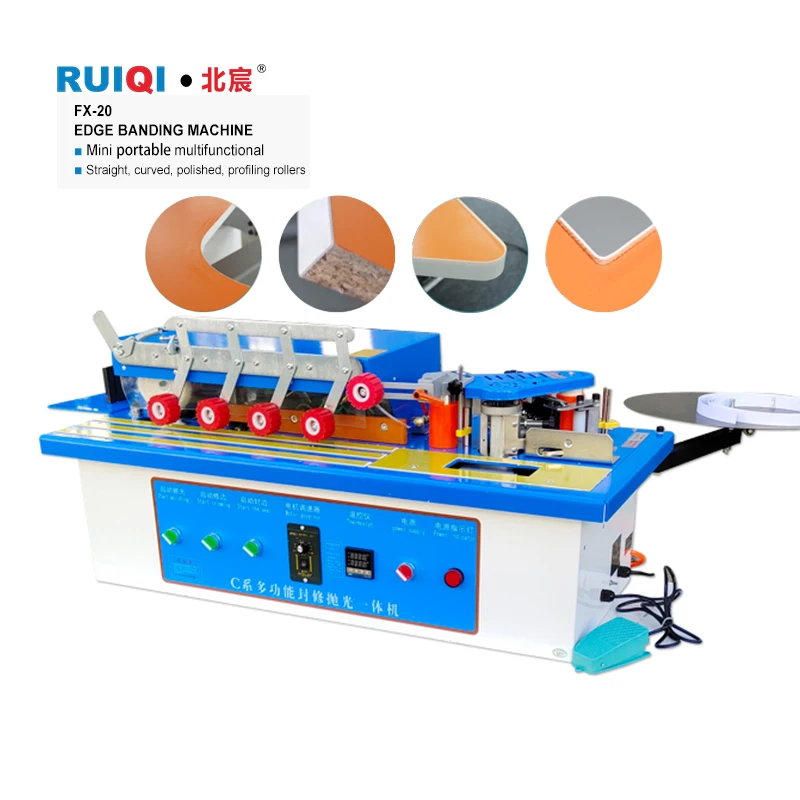
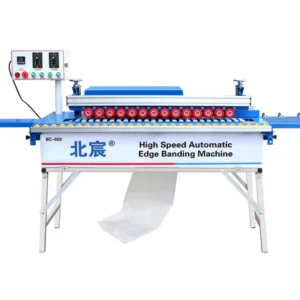
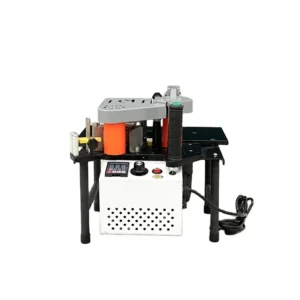
Compact Footprint — a 100×46×41 cm edge bander that ships ready to run on your local voltage, so small workshops can order with confidence and start producing immediately.
Technical Specifications
| Parameter |
Value |
| Product Type |
Multifunctional Edge Banding Machine |
| Rated Power |
2500W |
| Voltage & Frequency |
220V / 380V / customization (50Hz/60Hz to be confirmed) |
| Overall Dimensions (L×W×H) |
100×46×41 cm |
| Net Weight |
44 kg |
| Minimum Sheet Length |
25 cm |
| Minimum Sheet Width |
10 cm |
| Edge Banding Height |
0–50 mm |
| Edge Banding Thickness |
0.3–3 mm |
| Trimming Power |
650W×2 |
| Polishing Power |
180W×2 |
| Edge Power |
20W |
| Glue Pot Capacity |
1000 ml |
| Air Supply Requirement |
0.5–0.8 MPa |
| Control System |
Manual push plate operation |
| Language Options |
Chinese and English; other languages available on request |
Application Suitability
| Application |
Material or Output |
| Home decoration and custom cabinet production |
MDF, particleboard, ecological board |
| Small joinery workshop upgrading from manual methods |
Plywood and solid wood panels |
| Curved-edge furniture components |
PVC and veneer edge banding up to 3 mm thick |
| Short-run batch processing |
Panels as small as 25×10 cm |
Why the Voltage Question Must Come Before the Order
Confirming your local supply voltage and frequency is the single most important step before this machine leaves the factory.
I spent years on the buyer's side and watched a cabinet shop take delivery of an edge bander that matched every specification on paper—except the frequency. The local grid ran at 60Hz while the machine was wired for 50Hz. The motors overheated within the first hour, and the shop spent weeks sourcing a replacement drive. The FX-20 Multifunctional Edge Banding Machine for Small Workshop is available in 220V and 380V configurations with frequency matched to your region, but that only works if the conversation happens before production begins [NEED_CITE: voltage and frequency standards by export market]. Skipping this step turns a straightforward equipment purchase into an expensive lesson.

Straight and Curved Edges in One Machine
Most entry-level edge banders force a workshop to choose: either straight panels or curved components, requiring a second machine or hand-finishing for the other. This Multifunctional Edge Banding Machine for Small Workshop handles both curved and straight edges within the same footprint, which matters when a custom cabinet job includes shaped panels alongside standard rectangular carcasses. The manual push plate operation gives the operator direct control over feed pressure, making it easier to manage the transition around a curve without delamination or uneven glue spread.
Sizing the Machine to the Workshop Floor
A 100×46×41 cm footprint with a 44 kg net weight means this machine sits on an existing workbench or a dedicated stand without requiring floor anchors or special foundation work. Small joinery shops and home decoration workshops typically operate in constrained spaces where every square meter counts. The compact dimensions allow placement next to a panel saw or drilling station, keeping the material flow logical—cut, edge, assemble—without forklifts or long carry distances between stations [NEED_CITE: small workshop layout and material flow planning].
Reading the Specs That Actually Affect Edge Quality
The 0.3–3 mm edge banding thickness range covers the PVC and veneer materials most small workshops use daily, but the trimming and polishing stations determine whether that banding looks finished or hand-done. With dual 650W trimming motors and dual 180W polishing motors, the machine removes excess material and smooths the edge in a single pass. The 1000 ml glue pot capacity sustains small-batch runs without stopping to refill, which keeps temperature stable—cold spots in a small pot cause inconsistent adhesion, particularly on plywood where the core absorbs heat faster than MDF. Panel thickness capability reaches 50 mm based on the edge banding height, handling everything from 18 mm standard cabinet stock to thicker solid wood panels. The 0.5–0.8 MPa air supply requirement is standard shop compressor territory, but confirm your compressor can sustain that pressure at the required flow rate before connecting.
The Cost of Skipping Specification Confirmation
When a workshop orders a machine without verifying that the edge banding thickness range matches their actual banding stock, the result is material waste and rework. Banding that is too thick for the trimming stations leaves visible ridges; banding that is too thin can slip during feed and create misaligned edges. Language is another common oversight—operators staring at an unfamiliar control interface delay commissioning and increase the risk of incorrect glue temperature settings. These are not warranty issues; they are configuration mismatches that a ten-minute pre-order conversation would have prevented [NEED_CITE: edge banding material compatibility and machine setup].
Why Procurement from This Source Works for Small Orders
Single-unit orders ship without minimum quantity requirements, which is how most small workshops actually buy equipment. Voltage and frequency are confirmed as part of the standard ordering process, not left to chance. The operation and maintenance manual ships in your agreed language, so the operator can read the glue temperature guidance and daily maintenance checklist on day one. Factory test records are available before dispatch, documenting how the machine performed on your specified panel material and edge banding type. An engineer reviews your processing requirements and provides a formal quotation within 24 hours, including configuration notes specific to your production scope.
Documentation & Verification
- CE declaration of conformity for the FX-20 multifunctional edge bander
- Factory test record on your specified panel thickness and banding material before dispatch
- Electrical schematic confirming voltage and frequency match your local grid
- Operation and maintenance manual provided in the agreed language
- Spare parts list covering trimming blades, polishing wheels, and glue pot components
Installation, Commissioning & Support
- Requires a stable bench or stand supporting at least 44 kg with the 100×46×41 cm footprint
- Dedicated electrical circuit matching the confirmed 220V or 380V supply with correct frequency
- Ships as a single assembled unit, reducing on-site setup to power and air connection
- Initial glue pot temperature calibration based on your specific banding material type
- Air compressor verification to sustain 0.5–0.8 MPa at required flow during trimming and polishing cycles
What to Share Before Placing Your Order
To get an accurate configuration quote, provide the panel materials you process most often—MDF, plywood, particleboard—and the edge banding types and thicknesses you use. Confirm your local voltage and frequency so the electrical system is built correctly before the machine ships. If your operators need the control interface in a specific language beyond Chinese or English, state that requirement upfront so the manual and any labels match.
Frequently Asked Questions
Q: What voltage options are available and how do I confirm the right one for my country?
A: The machine is available in 220V and 380V with customization options. Frequency must be confirmed as 50Hz or 60Hz based on your local grid. Provide your country and city, and the engineering team will specify the correct electrical configuration before production begins, ensuring the machine is usable upon arrival.
Q: Can I order a single unit or is there a minimum order quantity?
A: Single-unit orders are standard. This machine is designed for small workshops and startups that purchase equipment one station at a time. There is no minimum order quantity, and single units ship with the same documentation, factory testing, and spare parts support as larger orders.
Q: What languages are available for the operation panel and manual?
A: Chinese and English are standard. Spanish, French, and other languages are available on request. Specify your required language during the inquiry stage so the operation manual, maintenance guide, and any interface labels are prepared in the correct language before dispatch.
Q: What is the dispatch lead time once I place my order?
A: Lead time depends on current stock status and any customization requirements such as non-standard voltage or language configuration. Typical lead times range across several weeks. Confirm the expected dispatch date at the quotation stage, and a factory test record will be provided before the machine ships.
Q: Does the machine come with a spare parts list and maintenance guidance?
A: Yes. The shipment includes a spare parts list identifying consumables such as trimming blades and polishing wheels, along with a maintenance manual in your agreed language. The manual covers daily cleaning, glue pot maintenance, and air system checks specific to this machine model.