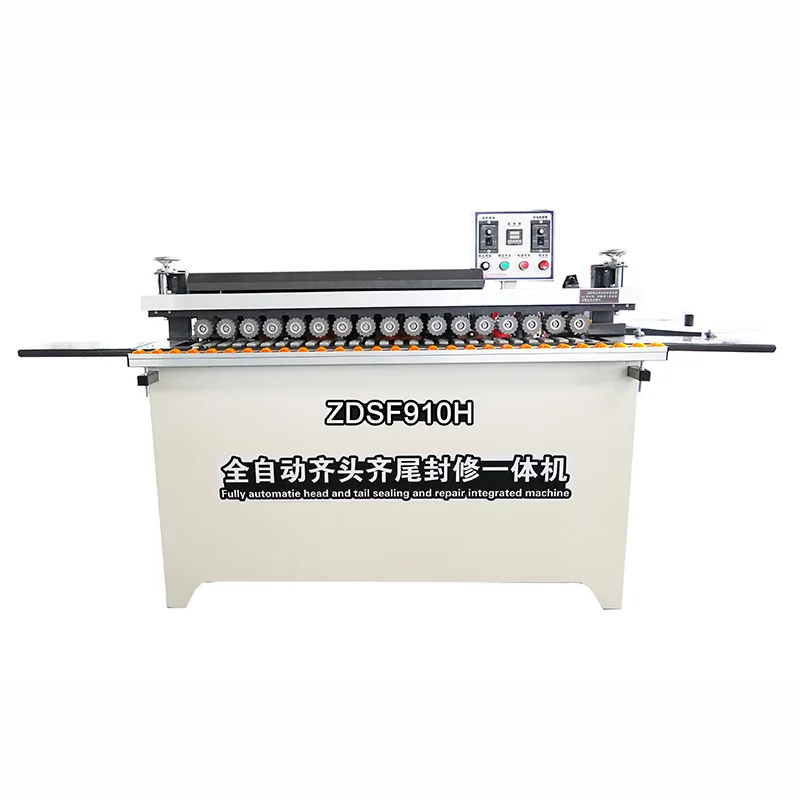
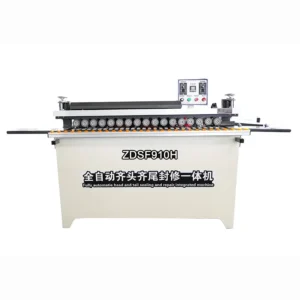
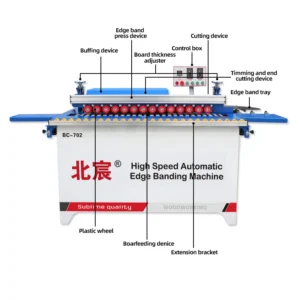
Compact Footprint, Real Capability — engineered for joinery startups that need both curved and straight edge banding without committing to three-phase power or a production-line footprint.
Technical Specifications
| Parameter |
Value |
| Model |
910H |
| Product Type |
Miniature Fully Automatic Curved and Straight Dual-purpose Edge Banding Machine |
| Edge Type |
Curved and straight lines |
| Voltage & Frequency |
220V 50Hz |
| Rated Power |
4 kW |
| Heating Power |
800 W |
| Trimming Power |
800 W × 2 |
| Polishing Power |
180 W × 2 |
| Suction Power |
1200 W |
| Belt Power |
25 W |
| Transmission Power |
120 W |
| Rated Air Pressure |
0.4–0.6 MPa |
| Sheet Thickness Range |
10–50 mm |
| Strip Thickness Range |
0.5–2.5 mm |
| Minimum Board Width |
2.5 cm |
| Glue Capacity |
1000 ml |
| Overall Dimensions (L×W×H) |
1300 × 560 × 1090 mm |
| Net Weight |
140 kg |
| Trimming Stations |
2 high-speed motors with 4-edge arc-shaped alloy cutter heads |
| Dust Extraction |
2 large-diameter dust collectors |
| Transmission |
Crawler transmission with steel rod slide rails |
| Feed Mechanism |
Double-row rubber pressure wheels, automatic plate feeding |
| Glue Application |
Adjustable glue roller with glue line cleaning device |
| Curved Edge Capability |
180-degree rotation for curved edge banding |
| Control Panel |
Multi-function button operation |
Application Suitability
| Application |
Material or Output |
| Custom cabinet door and drawer front banding |
MDF, particleboard, plywood with PVC or melamine strips |
| Curved shelving and shaped joinery components |
Solid wood panels and contoured board edges up to 50 mm |
| Small-batch bespoke furniture production |
Mixed straight and curved profiles on panels 10–50 mm thick |
| Workshop transitioning from manual to machine edge banding |
Standard sheet stock processed in single-operator workflow |
Why the Voltage Question Should Come Before the Price
An Automatic Edge Banding Machine in stock for fast delivery is useless if it cannot run on your workshop's existing supply.
Many entry-level buyers focus on throughput and edge finish, then discover their single-phase 220V outlet cannot support the machine they ordered — or worse, they ordered a 380V unit without realising their shop lacks three-phase infrastructure. I have seen small joinery workshops sit on a brand-new edge bander for weeks while waiting for an electrician to install a dedicated circuit. The 910H is configured for 220V 50Hz single-phase from the start, so it plugs into a standard workshop supply. Always confirm local frequency compatibility before committing to an order, because 50Hz and 60Hz grids behave differently under motor load [NEED_CITE: voltage and frequency standards by export market].

A Footprint That Fits Where You Already Work
At 1300 × 560 mm and 140 kg, this Automatic Edge Banding Machine in stock for fast delivery passes through standard doorways and positions without a forklift or overhead crane. That matters when your workshop shares space with a sliding table saw and a drill press. The compact frame does not mean compromised function — the crawler transmission with steel rod slide rails keeps panels stable through each station, and the adjustable aluminum alloy pressure beam accommodates the full 10–50 mm sheet thickness range without manual reconfiguration between jobs.
Dual-Purpose Curved and Straight in One Pass
Switching between straight and curved edge banding typically means owning two machines or tolerating a time-consuming re-setup. The 910H rotates 180 degrees to handle curved profiles, so the same unit bands a cabinet carcase side panel in the morning and a radiused shelf bracket in the afternoon. The double-row rubber pressure wheels maintain consistent feed pressure on both geometries, and the adjustable glue roller applies adhesive evenly regardless of contour. For a startup taking on varied custom orders, that flexibility determines which jobs you can accept [NEED_CITE: edge banding quality requirements across curved and straight panel profiles].
Reading the Numbers That Actually Matter
The 4 kW total rated power is distributed across heating, trimming, polishing, suction, and feed motors — each station draws independently, so the machine does not demand peak current at all moments. The two 800 W trimming motors spin 4-edge arc-shaped alloy cutter heads that shear excess banding flush to the panel surface, which directly affects how cleanly downstream components assemble. Glue pot capacity at 1000 ml is sized for small-batch runs; you reload between jobs rather than mid-run, which avoids cold-glue defects on longer boards. The 0.4–0.6 MPa air pressure requirement is compatible with most small workshop compressors, so you are unlikely to need a dedicated pneumatic upgrade.
What Happens When You Skip Substrate Verification
Ordering a machine rated for MDF and then running high-moisture particleboard is one of the most common reasons small workshops blame the equipment for poor edge adhesion. I once watched a custom cabinet shop spend two full days adjusting glue temperature and feed speed because their standard board stock absorbed heat faster than the test samples. The 910H's adjustable glue roller and glue line cleaning device give you tuning range, but only if you identify your actual substrate before the first production run. Always request a pre-shipment test on your specific board material and edge strip thickness — it takes minutes at the factory and saves days on your floor [NEED_CITE: substrate moisture content impact on hot-melt adhesive bonding].
Why Procure This Unit Here
The 910H ships with a pre-shipment test record including photographs of edge quality on your specified substrate, so you see results before the crate leaves the factory. Voltage confirmation happens at the quotation stage — if your local grid runs 60Hz or a non-standard voltage, the configuration is adjusted before production. An operation and maintenance manual in your working language ships inside the crate, not as an afterthought download. The four-stage quality control process covers incoming material inspection through final dispatch verification, which is particularly important for a compact machine where component tolerances directly affect edge finish. Spare parts — including replacement glue rollers, trimming cutter heads, and polishing pads — are packed with the machine so you can run from day one.
Documentation & Verification
- CE declaration of conformity for the 910H miniature edge bander
- Factory test record showing edge finish on your specified board thickness and strip material
- Electrical schematic confirming 220V 50Hz wiring and motor circuit layout
- Operation and maintenance manual translated into your working language
- Spare parts list matching the trimming cutter heads and polishing pads shipped with the unit
Installation, Commissioning & Support
- Requires a dedicated 220V single-phase circuit rated above 4 kW to avoid voltage drop under trimming motor load
- 1300 × 560 mm footprint needs a level concrete floor; no anchor bolts required at 140 kg operating weight
- Arrives fully assembled — connect air supply at 0.4–0.6 MPa and plug in to begin commissioning
- First-run parameter setting covers glue roller adjustment and trimming head alignment for your strip thickness range
- Two dust collector ports require connection to your existing extraction system or standalone units for clean operation
Before You Request a Quote
To configure the 910H correctly for your workshop, share your most common board material and thickness, the edge strip type and width you run most often, and your local voltage and frequency. If you process both curved and straight components, note the minimum curve radius you typically encounter. This information allows an engineer-led configuration recommendation with a formal quotation, including a pre-shipment test on your actual material.
Frequently Asked Questions
Q: What is the realistic daily throughput for a small workshop running standard cabinet panels?
A: Throughput depends on panel size, strip thickness, and whether you alternate between straight and curved edges. The 910H is designed for small-batch custom work rather than continuous production-line volumes. For a shop running mixed components, expect to process a steady daily batch without the feed mechanism or glue system falling behind operator pace.
Q: Does my workshop need three-phase power to run this Automatic Edge Banding Machine in stock for fast delivery?
A: No. The 910H is configured for 220V 50Hz single-phase supply with a 4 kW total rated load. A dedicated circuit rated above the machine's draw is recommended to prevent voltage drop when the trimming motors engage. Confirm your local frequency before ordering.
Q: Can I switch between straight and curved edge banding without purchasing extra tooling?
A: Yes. The machine body rotates 180 degrees to accommodate curved profiles, and the same trimming and polishing stations handle both geometries. No additional cutter heads or pressure wheel sets are needed for the transition.
Q: What are the minimum and maximum board dimensions this machine accepts?
A: Sheet thickness ranges from 10 to 50 mm, and the minimum board width for edge sealing is 2.5 cm. Edge strip thickness accommodates 0.5 to 2.5 mm. The adjustable aluminum alloy pressure beam adapts across the full range without tooling changes.
Q: How does the upgrade path work when my volume outgrows entry-level capacity?
A: The 910H covers the startup phase well. When daily volume consistently exceeds what a single-operator compact unit handles, the natural next step is a full-function inline edge bander with additional trimming and buffing stations. The 910H then serves as a secondary machine for curved work or overflow runs.