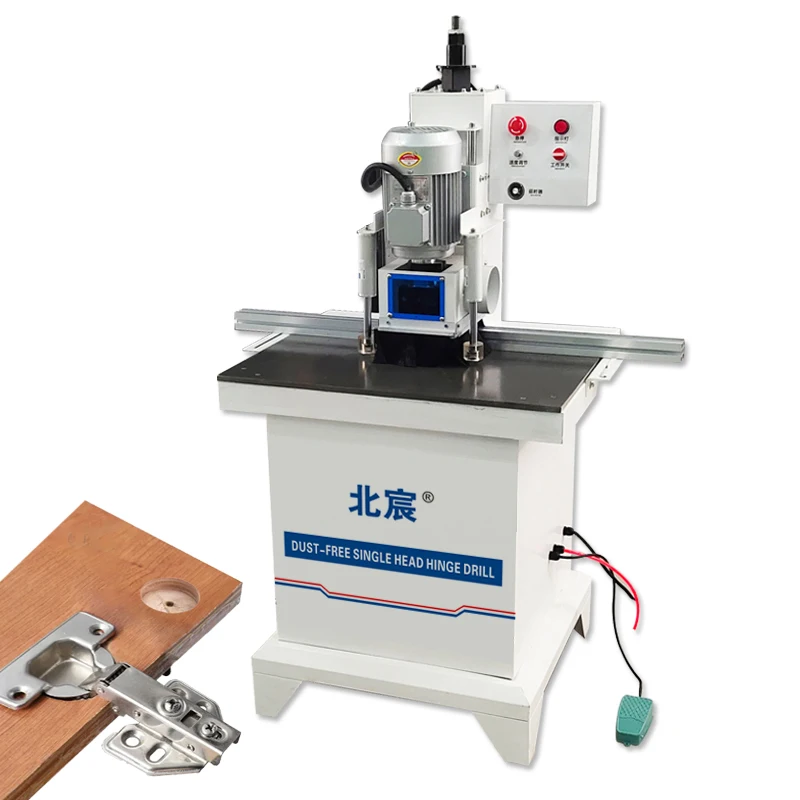
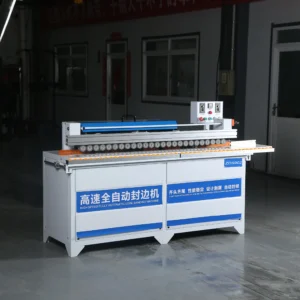
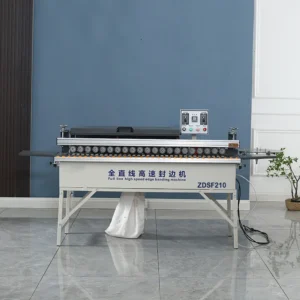
Voltage-configurable boring unit — the JL-1 hinge drilling platform ships with confirmed 50 Hz or 60 Hz matching before dispatch, preventing unusable arrivals at your workshop.
Technical Specifications
| Parameter |
Value |
| Product Type |
CNC Wood Boring and Hinge Drilling Machine |
| Rated Power |
1.5 kW |
| Voltage & Frequency |
380V/415V three-phase four-wire (50 Hz or 60 Hz to be confirmed) |
| Control System |
Foot switch control |
| Overall Dimensions (L×W×H) |
70 × 56 × 145 cm |
| Net Weight |
55 kg |
| Drill Sizes |
Large drill 35 mm, small drill 3 mm |
| Drilling Position Adjustment |
Vertical and horizontal adjustment |
| Guide Rail |
Precision guide rails for sliding |
| Motor |
Pure copper motor |
| Vacuum Power |
External vacuum port |
| Assembly State |
Fully assembled (source value — verify against manufacturer catalog) |
Application Suitability
| Application |
Material or Output |
| Cabinet door hinge cup drilling |
MDF, particleboard, and plywood panels up to standard hinge cup depth |
| Dowel hole boring for carcass assembly |
Solid wood panels and engineered board for 3 mm dowel insertion |
| Short-batch hinge preparation |
Custom wardrobe and fitted-furniture door components |
| Joinery startup production |
Small-volume cabinet runs transitioning from hand-held drills |
Why Voltage Confirmation Must Precede Your Purchase Order
A machine wired for the wrong frequency burns out its motor within the first week of operation.
I have watched small cabinet shops take delivery of a boring unit only to discover the motor hums at the wrong speed, overheating within minutes because the local grid runs 60 Hz while the machine was built for 50 Hz. The compact CNC hinge boring machine for small workshop environments is especially vulnerable here — its 1.5 kW pure copper motor has no internal frequency compensation, so mismatched supply destroys the winding. [NEED_CITE: voltage and frequency standards by export market]
Compact Footprint Without Compromised Bore Repeatability
Guide Rail Precision in a 70 cm Envelope
The precision guide rails on this compact CNC hinge boring machine for small workshop use allow both vertical and horizontal drill positioning across the panel face. For a one-person operation cutting hinge cups into cabinet doors, that sliding accuracy removes the guesswork of marking and re-measuring every bore location. The 35 mm large drill handles standard European hinge cups while the 3 mm small drill covers dowel alignment holes in a single setup, meaning you change tooling only between batch runs rather than between every door.
Foot-Switch Operation and the Two-Handed Workflow
When your workshop runs with one or two operators, freeing both hands for panel handling is not a luxury — it is the difference between holding a door panel steady and watching it drift off the registration fence. The foot switch control on this unit keeps both hands on the workpiece during the bore cycle. [NEED_CITE: ergonomic standards for single-operator woodworking machinery] An external vacuum port connects to your existing shop extraction without requiring a dedicated dust collection system at this production scale, keeping the guide rails clear of MDF dust that would otherwise degrade sliding accuracy over a production shift.
What 1.5 kW Actually Means for Panel Thickness
The pure copper motor delivers 1.5 kW through a direct-drive spindle, which is sufficient for clean 35 mm hinge cup bores in 16 mm to 22 mm MDF and particleboard — the standard thickness range for cabinet door production. Attempting the same bore in 25 mm solid oak with a motor of this rating would produce tear-out at the cup floor and excessive cycle heat. The compact CNC hinge boring machine for small workshop production is therefore matched to engineered board applications where the spindle torque and feed pressure align with substrate density.
Drill Size Coverage and Downstream Assembly Fit
The 35 mm and 3 mm drill combination covers the two most common bore types in cabinet door manufacturing: the hinge cup and the dowel alignment hole. Bore position accuracy directly affects whether the hinge arm seats flush and whether the door hangs square on the carcass. If the guide rail has any lateral play, that error transfers into every door you produce, compounding across a full kitchen run until assembly gaps become visible to the end customer.

The Hidden Cost of Skipping Voltage and Language Verification
A control panel in a language your operator cannot read means the drilling depth and position parameters are set by guesswork, not by specification. I have seen a hinge boring machine sit idle for two days while the workshop owner waited for remote translation support, losing an entire production run of cabinet doors. [NEED_CITE: common commissioning delays in exported woodworking machinery] When the operation manual arrives only in the manufacturer's language, your team has no reference for troubleshooting the foot switch timing or the guide rail calibration sequence.
Why Procurement Through This Channel Reduces Configuration Risk
Voltage and frequency confirmation is written into the quotation before production begins, so your 380V/415V three-phase supply is matched to the correct motor winding at the factory. The JL-1 ships with an operation and maintenance manual in the language you specify during the order process. Factory test records are generated using your actual panel material and thickness, verifying bore tolerance before the machine leaves the production floor. A spare parts list covering drill bits, guide rail bearings, and foot switch assemblies is included with every shipment, so consumable replacement does not halt your cabinet line.
Documentation & Verification
- Factory test record measuring bore tolerance on your specified MDF or particleboard thickness
- Electrical schematic confirming 380V/415V three-phase wiring and frequency match
- Operation and maintenance manual supplied in your operator's working language
- Spare parts list itemizing drill bits, guide rail bearings, and foot switch components
- CE declaration of conformity for machinery directive compliance
Installation, Commissioning & Support
- Requires a dedicated 380V/415V three-phase circuit rated for at least 1.5 kW continuous draw
- Floor space of 70 × 56 cm with clearance on two sides for panel loading and operator access
- Arrives fully assembled; verify guide rail sliding smoothness before first power-on
- External vacuum port connects to existing shop dust extraction using standard hose diameter
- First-bore test on scrap panel to confirm 35 mm hinge cup depth and 3 mm dowel position
- Guide rail bearing inspection and lubrication at weekly intervals during continuous production
What to Include in Your Inquiry
Send your panel material type and thickness range, the hinge cup specification you use, and your local voltage and frequency. Confirm the language your operators need for the control interface and the maintenance manual. If you are planning a phased expansion from single-row to multi-row boring, note your target daily door volume so the configuration recommendation accounts for your growth path.
Frequently Asked Questions
Q: Can this hinge boring machine run on 220V single-phase supply?
A: The standard configuration is 380V/415V three-phase four-wire. Single-phase 220V operation requires a different motor winding and is not available on the base JL-1 configuration. Confirm your workshop supply before ordering to ensure the correct voltage and frequency are built at the factory.
Q: Is a single-row machine sufficient for my current cabinet door volume?
A: The JL-1 handles short-batch hinge and dowel boring for workshops producing custom cabinet doors. If your daily volume requires continuous multi-panel throughput, a multi-row boring machine with automatic feed would better match that production rate. State your target daily output during inquiry for an honest capacity assessment.
Q: What panel thickness range does the 35 mm hinge drill handle cleanly?
A: The 1.5 kW pure copper motor produces clean 35 mm hinge cup bores in standard 16 mm to 22 mm MDF and particleboard. Thicker or harder substrates may produce tear-out at the bore floor. Request a factory test record on your specific panel material to verify bore quality before shipment.
Q: How do I verify bore position accuracy before the machine ships?
A: A factory test record is generated using your specified panel material and thickness, documenting actual bore position measurements against your hinge pattern drawing. Review this record before authorizing shipment to confirm the precision guide rails deliver the repeatability your assembly process requires.