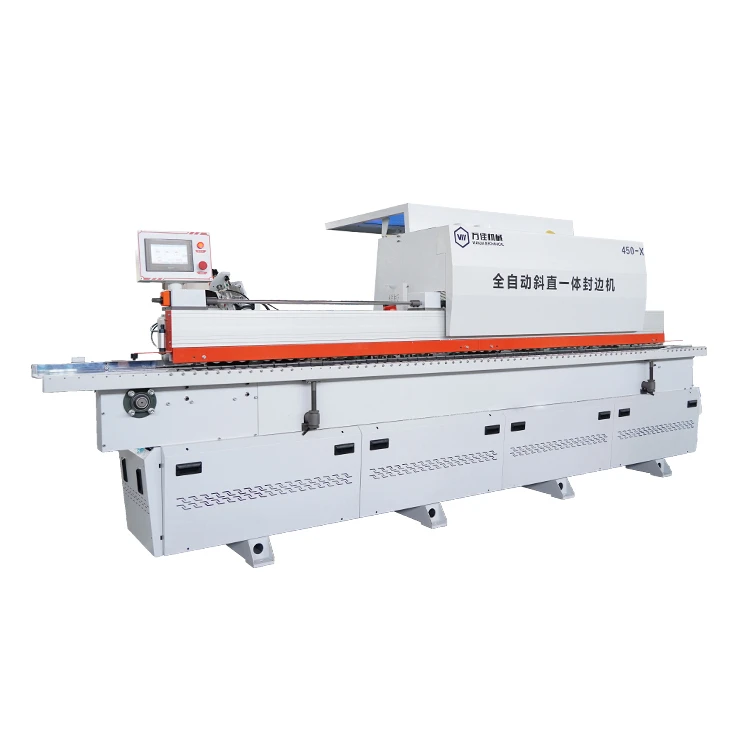
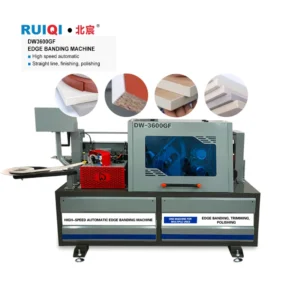
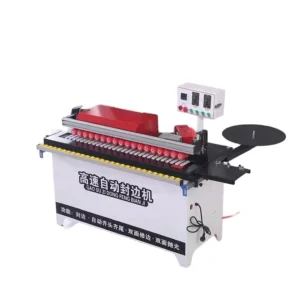
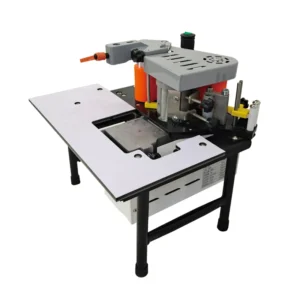
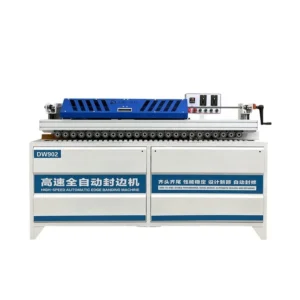
Stocked Edge Banding, Fast Dispatch — This automatic edge banding machine ships from ready inventory, so a small workshop can move from manual trimming to single-pass finishing without waiting through a custom build cycle.
Technical Specifications
| Parameter |
Value |
| Product Type |
Automatic Edge Banding Machine |
| Overall Dimensions (L×W×H) |
435 × 92 × 165 cm |
| Total Installed Power |
17.5 kW |
| Voltage & Frequency |
Configurable from 110V to 440V (source default 380V / 50Hz, verify local standard) |
| Feed Speed |
0–12 m/min, variable via frequency converter |
| Conveying Motor |
2.2 kW with inverter |
| Edge Strip Width Range |
20–50 mm |
| Edge Banding Thickness |
Up to 1.2 mm PVC |
| Panel Thickness Range |
18 / 22 / 25 mm |
| Minimum Panel Width |
>100 mm |
| Minimum Panel Length |
>250 mm |
| Glue Pot Capacity |
2000 mL |
| Glue Pot Heating Power |
1.2 kW |
| Glue Pot Operating Temperature |
150–170 °C |
| Heat Gun Power |
2 kW |
| Trimming Motor |
0.75 kW × 2 |
| End Trimming Motor |
0.37 kW × 2 |
| Milling Motor B |
3.5 kW |
| Selection Motor A |
4 kW |
| Polishing Motor |
0.37 kW × 2 |
| Edge Feeding Motor |
0.18 kW with inverter |
| Lifting Motor |
0.25 kW with inverter |
| Slotted Motor |
0.8 kW (220V) |
| Air Source Pressure |
0.6–0.8 MPa |
| Air Storage Tank Volume |
5 L |
| External Suction Port Diameter |
100 mm |
| Control System |
Xinjie industrial touch screen with Xinjie industrial inverter |
| Assembly State |
Fully assembled |
| Key Features |
Pre-milling, trimming, end trimming, milling, polishing, slotting stations in one pass |
Application Suitability
| Application |
Material or Output |
| Cabinet door and carcass edge finishing |
Melamine-faced particleboard, 18–25 mm, PVC edge banding |
| Custom furniture panel edging |
MDF panels with PVC strips up to 1.2 mm thick |
| Small-batch joinery production |
Plywood shelving and frame components ≥100 mm wide |
| Workshop transition from manual to automated |
Mixed board stock requiring consistent glue-line and trim quality |
Why the Voltage Conversation Must Happen Before You Click "Order"
Confirm your workshop's supply voltage and frequency before selecting a stock model, or the machine may arrive unable to run.
I have watched a container land in Bogotá with a 380V/50Hz motor on a 60Hz grid — the main spindle ran hot within the first hour, and the inverter faulted repeatedly until a step-down transformer was rigged on-site [NEED_CITE: voltage and frequency standards by export market]. Entry-level workshops in Latin America frequently operate on split-phase or delta configurations that differ from the Chinese domestic default. When you source an Automatic Edge Banding Machine in stock, the lead-time advantage disappears the moment the unit sits idle waiting for an electrician. Request a voltage confirmation document matched to your local supply before the crate closes.

Ready Inventory Means You Can React to Orders, Not Forecasts
Small workshops rarely plan panel runs months ahead. A furniture maker picking up a kitchen remodel needs the edge bander on the floor within days, not weeks. Keeping this Automatic Edge Banding Machine in stock shortens the gap between signing a client contract and delivering finished carcasses. The machine arrives fully assembled, so once power and air are connected, the first panel can feed through that same afternoon.
Compact Footprint for Shops That Cannot Reconfigure the Floor
At 435 cm in length and under one meter in width, this unit fits along a wall or between a panel saw and an assembly bench. Shops renting urban industrial space in cities like Medellín or Lima rarely have the luxury of rearranging a production line for a single new machine [NEED_CITE: typical small workshop floor layouts in Latin American urban zones]. The compact footprint also means a future upgrade to a higher-throughput model can slot into the same position without relocating extraction ducting or electrical drops.
What the Station Layout Means for Edge Quality
Six working groups — pre-milling, trimming, end trimming, rough and finish milling, polishing, and slotting — process the panel in a single pass. Pre-milling squares the panel edge before the glue pot, removing saw marks that would otherwise telegraph through thin PVC. The 0.75 kW trimming motors run at a speed matched to feed rate through the inverter, keeping the cut perpendicular on 18 mm stock and 25 mm shelving alike. Polishing wheels then burnish the trimmed edge, removing the haze that causes rejected doors in visible-grain applications.
When a Cheaper Configuration Costs More Than the Machine
I once visited a carpentry shop in Cali that had purchased a bare-bones bander without end-trimming motors. Every panel came off the line with overhang at both ends, requiring a hand router pass that doubled labor time per door [NEED_CITE: hidden labor cost of missing trimming stations in entry-level edge banders]. The owner calculated the extra man-hours and realized the savings on the invoice had vanished within the first production month. Skipping stations at the quoting stage often shifts cost from the machine budget to the payroll budget. Always match the station list to the finish tolerance your downstream assembly demands.
Why Procurement Starts Here
The same product family spans entry-level through full-function pre-milling models, so a workshop can add capacity later without switching suppliers or retraining operators on a new control interface. Voltage, control panel language, and plug configuration are confirmed per order rather than assumed. Each unit undergoes four-stage quality control covering incoming material, in-process build, finished assembly, and pre-shipment verification, with photographic evidence supplied before crating. An engineer reviews your panel list and edge banding specification before releasing the quotation, catching mismatches like 2 mm ABS on a machine rated to 1.2 mm PVC before they become a container problem.
Documentation & Verification
- CE declaration of conformity matched to the automatic edge banding machine category
- Electrical schematic confirming your local voltage and phase configuration
- Factory test record on your specified panel thickness and PVC edge banding width
- Operation and maintenance manual supplied in the operator's working language
- Spare parts list with consumable part numbers for glue pot and trimming blades
- Pre-shipment photographs of your specific unit on the test bench
Installation, Commissioning & Support
- Requires a dedicated three-phase circuit rated for at least 17.5 kW total draw
- 100 mm suction port connects to existing workshop dust extraction at 0.6–0.8 MPa air supply
- Machine ships fully assembled — position, level, connect power and air, then run first panel
- Xinjie touch screen configured to operator language before dispatch to speed first-day commissioning
- Trimming and polishing motor brushes listed in spare parts for routine workshop replacement
- Glue pot cleaning cycle documented in manual to prevent adhesive carbonization during idle periods
Before You Request a Quote
Send your panel material type, board thickness, and the PVC edge banding width and thickness you plan to run most often. Include your workshop supply voltage, phase configuration, and frequency so the motor and inverter can be matched before stock is allocated. If your production includes panels near the minimum 100 mm width or 250 mm length, note that so the infeed fence and pressure beam can be verified. A short list of your top five panel dimensions speeds up the engineer configuration and helps confirm this is the right stock unit for your volume.
Frequently Asked Questions
Q: What panel materials and edge banding types does this machine handle, and what is the maximum edge thickness?
A: The machine is set up for PVC edge banding up to 1.2 mm thick on melamine-faced particleboard, MDF, and plywood panels between 18 and 25 mm. Strip width ranges from 20 to 50 mm. If you work with ABS or wood veneer banding, confirm compatibility before ordering, as glue pot temperature and pressure roller settings differ by material.
Q: Can the voltage be customized for my country's electrical standard before shipment?
A: Yes. Voltage is configurable from 110V to 440V, and frequency can be matched to 50 Hz or 60 Hz grids. Provide your workshop's exact supply specification during the quoting stage so the motor windings, inverter, and control transformer are set correctly before the unit leaves the factory.
Q: What is the dispatch lead time for stocked models, and what shipping options are available for single-unit orders?
A: Stocked units ship once voltage confirmation and pre-shipment testing are complete, typically within a short window after order confirmation. Single-unit orders can be dispatched via LCL or FCL depending on your port and timeline. Shipping options are quoted upfront so there are no surprises at the booking stage.
Q: How do I know when my workshop volume justifies upgrading from this entry-level model to a higher-throughput machine?
A: When your daily panel count consistently exceeds what a 12 m/min feed speed can clear in a single shift, or when edge banding thickness moves beyond 1.2 mm PVC into ABS or solid wood strips, it is time to look at the next tier. The same supplier offers higher-feed models within the same product family, so operator training transfers directly.
Q: What installation support and operator training materials are included with delivery?
A: The machine arrives fully assembled with an operation and maintenance manual in your chosen language, a spare parts list, and an electrical schematic. Remote installation guidance is available via video call, and the Xinjie touch screen interface is configured to your operator's language before dispatch to reduce first-day setup time.