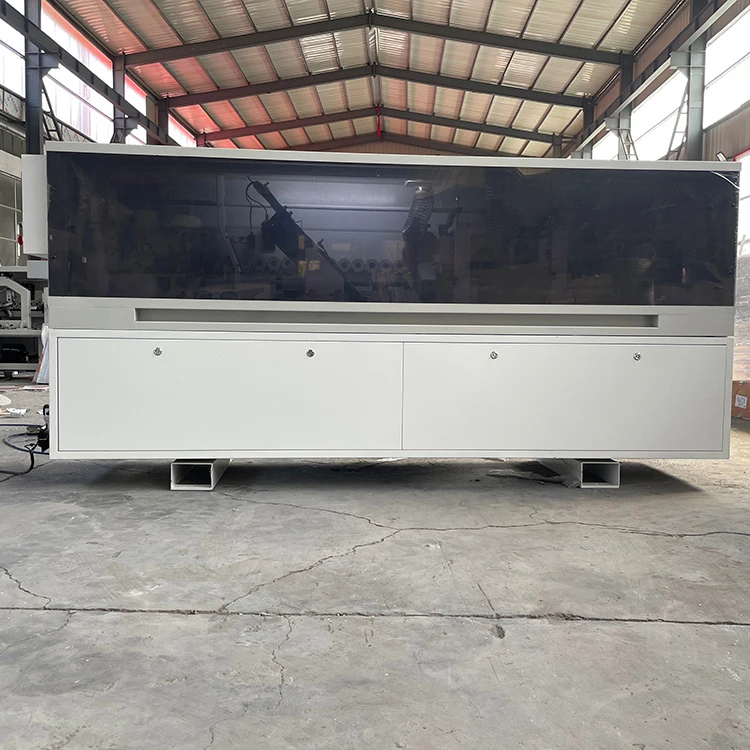
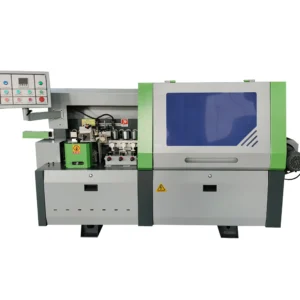
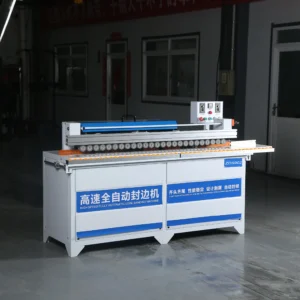
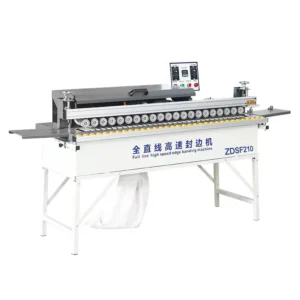
Ready-Stock Dispatch — ZDS280B and ZDS280C held in inventory for single-unit orders, with voltage and language confirmed before the crate closes.
Technical Specifications
| Parameter |
Value |
| Model |
ZDS280B / ZDS280C |
| Product Type |
Automatic Edge Banding Machine |
| Main Functions |
ZDS280B: Gluing, End Trimming, Fine Trimming, Buffing; ZDS280C: Gluing, End Trimming, Fine Trimming, Scraping, Buffing |
| Working Pressure |
0.6–0.8 MPa |
| Panel Thickness Range |
10–55 mm |
| Edge Thickness Range |
0.4–3 mm |
| Conveyor Belt Speed |
15 m/min |
| Min. Panel Width |
45 mm |
| Min. Panel Length |
80 mm |
| Voltage |
380V 3-Phase |
| Rated Power |
7.5 kW |
| Net Weight |
ZDS280B: 650 kg; ZDS280C: 800 kg |
| Overall Dimensions (L×W×H) |
ZDS280B: 2300×700×1250 mm; ZDS280C: 2800×700×1250 mm |
| Fuselage Construction |
14 mm national standard high-strength steel plate, frame-type structure, high-temperature quenching treatment |
| Conveyor Guide Rail Material |
HT260 |
| Conveying Motor |
Taiwan brand, customized, with thermal protection system |
| Pneumatic System |
German Festo or Taiwan AirTAC cylinders and safety valves; AirTAC magnetic switches |
| Electrical Components |
Delixi/Chint air switches and contactors; Japanese Omron travel switches |
| Head Guide Rail |
Taiwan brand |
| Control System |
Standard electrical control panel |
| Certification |
CE |
Application Suitability
| Application |
Material or Output |
| Custom cabinet door edging |
MDF and melamine-faced particleboard with 0.4–3 mm PVC or melamine banding |
| Small-batch furniture production |
Plywood and MDF panels from 10 mm to 55 mm thickness |
| Joinery workshop upgrade |
Transitioning from manual iron-on edging to consistent machine-fed output |
| Shelving and carcass panel edging |
Standard chipboard and MDF with PVC edge banding up to 3 mm |
Why the Voltage Question Must Come Before the Crate Nails Down
Every ZDS280B and ZDS28C leaving the floor carries a signed voltage confirmation sheet matching the buyer's local supply.
I worked the assembly bay for years before moving into customer-facing work, and I still remember the call from a cabinet maker in South America. His new automatic edge banding machine sat idle for three weeks because the quoted voltage did not match the local grid. The transformer retrofit cost him time he could not recover. That compact automatic edge banding machine episode reshaped how every order is handled here: voltage and frequency are locked in writing before production or dispatch is greenlit [NEED_CITE: voltage and frequency standards by export market]. Small workshops rarely keep an electrical engineer on call, so a mismatch is not an inconvenience — it is a shutdown.

Stock on the Floor Means Shorter Wait Times
The ZDS280B and ZDS280C are configured for the workshop that does not have months to plan around a build schedule. Ready-stock availability means a single-unit order can be matched against existing inventory, with dispatch lead time quoted at the point of inquiry rather than after weeks of back-and-forth. The compact footprint — starting at 2300×700×1250 mm for the ZDS280B — fits through a standard workshop roller door and into a space where a manual edging bench used to sit.
Choosing Between Trimming-Only and Scraping-Included
The ZDS280B handles gluing, end trimming, fine trimming, and buffing, which covers the majority of PVC and melamine edging work on MDF carcass panels. The ZDS280C adds a scraping station between fine trimming and buffing, removing the thin radius left by the trimming cutter on thicker banding. For workshops running mostly 0.4 mm melamine on thin panels, the ZDS280B is often sufficient. For those handling 2–3 mm PVC on cabinet doors where a clean radiused edge matters at the assembly stage, the scraping station on the ZDS280C eliminates a hand-finishing step [NEED_CITE: edge scraping function in automatic edge banding workflow].
Reading the Specs That Actually Affect Your Panels
The 10–55 mm panel thickness range means this compact automatic edge banding machine covers everything from 10 mm shelving stock up to 55 mm solid-core worktops without a changeover jig. The HT260 conveyor guide rail is a cast iron grade chosen for wear resistance — it holds the belt alignment steady at 15 m/min, which matters when you are feeding narrow 45 mm drawer sides that tend to drift on lighter rails. The 14 mm high-strength steel fuselage with high-temperature quenching treatment is not a marketing claim but a weight-bearing reality: the ZDS280C weighs 800 kg, and that mass absorbs vibration that would otherwise show up as chatter marks on the trimmed edge. The 7.5 kW rated power is sized for the function set — there is no pre-milling station drawing extra current, which keeps the electrical draw within the capacity of a standard small-workshop three-phase supply. Pneumatic cylinders from Festo or AirTAC handle the pressure roller and trimming head actuation, and their response consistency directly affects whether the glue bead stays uniform across panels of varying thickness.
What Happens When the Wrong Model Meets the Wrong Volume
An entry-level machine pushed into production volumes it was never designed for will show the damage in stages. First the trimming cutters dull faster than the maintenance schedule accounts for. Then the conveyor belt begins to track off-center because the guide rail is absorbing more lateral load than its duty cycle allows. Eventually the glue pot cannot recover temperature between panels when the feed rate is sustained for hours. Workshops that started on this compact automatic edge banding machine for ten to twenty panels a day and then scaled to two hundred a day without moving to a higher-tier model often discover these limits the hard way [NEED_CITE: entry-level woodworking machinery duty cycle expectations]. The honest answer is to treat this range as the right starting point, not the final destination.
Why Small Workshops Source This Range Here
Every unit is tested on the buyer's stated panel thickness range before dispatch, not just run empty to confirm motor rotation. Voltage configuration from 110V to 440V is confirmed in writing and matched to the nameplate before the machine is crated. The control panel language is specified at order — an operator who cannot read the interface will stall commissioning regardless of how well the machine runs. The product family spans from this entry-level model through full-function pre-milling versions, so a workshop can scale its line without changing supplier or relearning a new control layout. Four-stage quality control covers incoming material, in-process assembly, finished-product testing, and pre-shipment verification, which means the test record you receive reflects the machine as it will arrive.
Documentation & Verification
- CE declaration of conformity matched to the ZDS280B or ZDS280C model variant
- Factory test record run on your specified panel thickness and edge material before dispatch
- Electrical schematic confirming voltage and phase wired to your local supply standard
- Operation and maintenance manual in the language your operator reads
- Spare parts list with part numbers for trimming cutters, pressure rollers, and glue pot elements
Installation, Commissioning & Support
- Confirm a dedicated 380V three-phase circuit rated for the 7.5 kW draw before delivery day
- Allow a clear floor area of at least 2800×700 mm plus operator clearance on the feed side for the ZDS280C
- Connect 0.6–0.8 MPa compressed air supply with a moisture trap upstream of the machine inlet
- Verify conveyor belt tracking and pressure roller alignment during first-hour commissioning on scrap panels
- Receive operator training covering glue temperature settings for PVC versus melamine banding materials
- Schedule trimming cutter inspection after the first fifty running hours on abrasive MDF stock
What to Send With Your Inquiry
To get a configuration recommendation and a dispatch timeline, share the panel materials and thickness range you run most often, the edge banding material and thickness you intend to use, and your local voltage and frequency. If your workshop has limited space, include the floor area available so the right model variant can be confirmed against your layout.
Frequently Asked Questions
Q: What is the dispatch lead time for single-unit orders of ZDS280B or ZDS280C?
A: Ready-stock models can typically be prepared for dispatch once the voltage and control panel language are confirmed in writing. If the exact variant you need is not on the floor, a build-to-order timeline will be quoted at inquiry. Lead times vary by model availability and destination port scheduling.
Q: Can the voltage be confirmed to match my local power supply before shipping?
A: Yes. Voltage and frequency are confirmed in writing before the machine is finalized for dispatch. The 380V three-phase configuration is standard, but other voltages from 110V to 440V are available. The nameplate and electrical schematic will reflect your confirmed supply specification.
Q: What panel thickness and edge materials does this machine handle reliably?
A: The panel thickness range is 10–55 mm, with edge banding from 0.4 mm to 3 mm. PVC, melamine, and veneer edging materials are all within the machine's operating range. The ZDS280C adds a scraping station that improves finish quality on thicker PVC banding.
Q: Is there an upgrade path to a higher-capacity edge bander as my workshop volume grows?
A: The product family extends from this entry-level range through full-function models with pre-milling and additional trimming stations. When your daily panel volume outgrows the 15 m/min feed speed or the function set here, a higher-tier model within the same family keeps the control language and spare parts supply consistent.
Q: How is installation supported if a fault appears after the machine arrives?
A: Each machine ships with an operation and maintenance manual, electrical schematic, and spare parts list in the agreed language. Post-installation support is provided remotely to guide fault diagnosis, and the documentation package is structured so a local electrician or technician can trace circuits and pneumatic lines without needing the original assembly team on site.