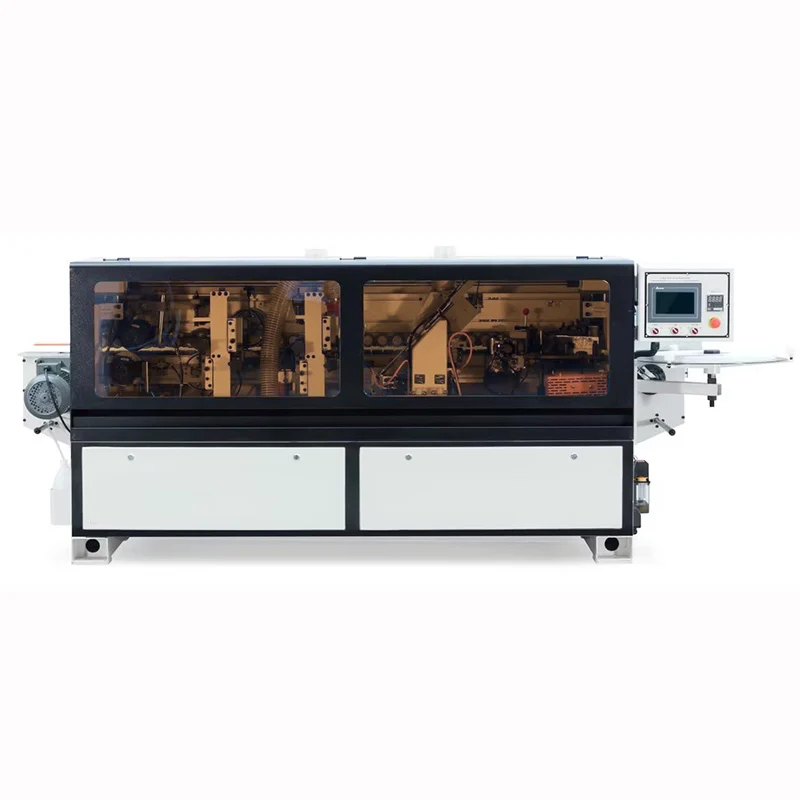
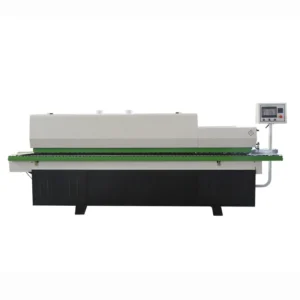
Compact Footprint, Full Function — Six edge banding stations from gluing through buffing packed into a 3-metre frame, letting a small workshop step into automated finishing without rewiring the shop.
Technical Specifications
| Parameter |
Value |
| Model |
ZDS-280 Automatic Edge Banding Machine |
| Product Type |
Automatic Edge Banding Machine |
| Main Functions |
Gluing, End Trimming, Fine Trimming, Scraping, Cleaning, Buffing |
| Total Power |
9 kW |
| Voltage |
380V-3PH (confirm 50Hz/60Hz before dispatch) |
| Feed Speed |
9–12 m/min |
| Panel Thickness Range |
10–60 mm |
| Edge Banding Thickness |
0.3–3 mm |
| Min. Panel Width |
60 mm |
| Min. Panel Length |
120 mm |
| Control System |
PLC + Touch Screen + Frequency Converter (Taiwan Delta) |
| Electrical Contactors |
Schneider Electric |
| High Speed Motor |
UFC brand |
| Glue Pot |
Teflon spraying process with glue-back anti-carbonization design |
| Pressing Unit |
Pneumatic double-wheel with adjustable stroke |
| End Trimming |
Air pressure balance device with optimized gas path |
| Buffing Unit |
Dual 0.37 kW motors, up-and-down polishing |
| Assembly State |
Fully assembled, KD packing for spare parts |
| Working Pressure |
0.65 MPa |
| Net Weight |
860 kg |
| Overall Dimensions |
3000 × 750 × 1270 mm |
| Warranty |
1 year |
Application Suitability
| Application |
Material or Output |
| Custom cabinet door production |
MDF and particleboard panels, 10–60 mm thick |
| Small-batch furniture workshop output |
Plywood shelving and carcass panels |
| Joinery shop first automated edge run |
PVC edge banding 0.3–3 mm |
| Straight-edge finishing for batch orders |
Wood veneer edging on flat panel stock |
Why the Voltage Question Must Come Before the Quote
An automatic edge banding machine in stock is only useful if it matches your workshop's electrical supply.
I once walked into a Pearl River Delta cabinet shop where a brand-new edge bander sat unplugged for three weeks. The buyer had focused entirely on feed speed and station count during negotiations, never once confirming the local three-phase frequency. When the machine arrived, the main motor hummed but the glue pot heater would not reach temperature. The distributor blamed the factory, the factory blamed the distributor, and the shop owner was left with a silent machine blocking the aisle. That gap between a competitive quote and a running machine is almost always electrical — and it is entirely preventable with a five-minute conversation before the order is placed [NEED_CITE: voltage and frequency standards by export market].
A Starter Line That Does Not Require a Specialist Programmer
The Delta PLC and touch-screen interface on the ZDS-280 means your lead operator can learn the full station sequence in a single shift. There is no ladder logic to decode and no proprietary software licence to purchase. You load the panel, set the edge thickness on screen, and the frequency converter adjusts feed speed automatically. For a workshop moving away from hand-held trimmers, this is the difference between a machine that runs on day one and one that waits for a visiting technician.
Footprint and Power Budget That Fit a Small Shop
At three metres long and 860 kg, this automatic edge banding machine in stock fits against a wall in a two-bay workshop and draws only 9 kW total. You do not need to install a new transformer or pour a reinforced slab. The pneumatic pressing wheels and scraping unit all run from a single 0.65 MPa air line, so if you already have a compressor for your panel saw, you are already plumbed. The compact layout is deliberate: it gives a startup furniture brand the full six-station finish without consuming the floor space that a growing operation needs for material staging.
How the Specs Translate to Edge Quality
The 10–60 mm panel thickness range covers everything from 10 mm MDF drawer bottoms to 60 mm solid-core worktops, meaning one machine handles your entire carcass-to-countertop catalogue. The Teflon-coated glue pot with anti-carbonization design keeps the adhesive uniform across a batch — the streaky glue lines that appear on entry-level machines after forty minutes of continuous running come from hot spots in the pot, not from the edging material itself. Feed speed of 9–12 m/min, regulated by the Delta frequency converter, gives the glue enough open time to wet the substrate before the pneumatic pressing wheels close the bond. At the back end, the dual-motor buffing station removes the haze that scraping leaves behind, so panels go straight to assembly without a hand-wipe step [NEED_CITE: adhesive open time and feed speed relationship in edge banding].

The Hidden Cost of Skipping the Factory Test Record
When an edge bander arrives without a factory test record matched to your actual panel and edging combination, the first real test happens on your shop floor with your delivery deadline already ticking. If the glue temperature does not suit your PVC supplier's formulation, or the end-trimming pressure leaves a visible step on 18 mm particleboard, you are now troubleshooting under production pressure. Panels get scrapped, the operator loses confidence in the machine, and the whole investment starts to feel like a mistake — when in reality the mismatch could have been caught and corrected before the crate left the loading dock [NEED_CITE: pre-shipment inspection standards for woodworking machinery].
Why Small Workshops Source From This Range
The in-house manufacturing process covers precision-ground components with multi-stage inspection, so the tolerance you see on the specification sheet is the tolerance you get on the panel. Voltage customization from 110V to 440V is offered as standard rather than as an expensive afterthought, which eliminates the unplugged-machine scenario described earlier. The product family spans from this entry-level six-station unit up to full pre-milling configurations, so when your daily volume outgrows the ZDS-280 you can move to the next model in the same family without relearning a new control system or changing suppliers. A four-stage QC process with pre-shipment verification means the test record you receive reflects the actual machine that ships, not a generic sample from the showroom.
Documentation & Verification
- CE declaration of conformity matching the ZDS-280 serial number
- Electrical schematic confirming your ordered voltage and frequency before build
- Factory test record showing edge samples on your specified panel and edging thickness
- Operation and maintenance manual in your operator's agreed language
- Spare parts list with part numbers for scraper blades, buffing wheels, and glue pot elements
Installation, Commissioning & Support
- Requires a level concrete floor capable of supporting 860 kg across the 3000 × 750 mm footprint
- Dedicated 9 kW three-phase circuit with breaker rated to local code for 380V operation
- Arrives fully assembled — connect power, air at 0.65 MPa, and dust extraction before first run
- Delta touch screen parameters pre-set at factory; verify feed speed and glue temperature on your first panel
- Consumable spare parts list included for immediate re-order planning of buffing wheels and scraper blades
Ready to Configure Your Order
To get a formal quotation within one working day, share your primary panel material and thickness range, the edge banding type and thickness you run most often, and your workshop's confirmed voltage and frequency. If you are replacing an existing machine, note its current feed speed so we can match or adjust throughput expectations. For workshops outside standard 380V/50Hz markets, confirm your supply specification early so the correct motor and heater configuration is built in before dispatch.
Frequently Asked Questions
Q: What is the smallest panel this machine can handle, and does that cover typical cabinet doors?
A: The ZDS-280 accepts panels down to 120 mm long and 60 mm wide, with thickness from 10 to 60 mm. Standard cabinet door stiles and drawer fronts fall well within this range. For very small offcut pieces below the minimum dimensions, a manual trimming approach is still recommended to avoid feeding issues at the infeed roller.
Q: Can I switch between 0.4 mm PVC and 2 mm wood veneer edging without extra attachments?
A: Yes. The pneumatic double-wheel pressing unit has an adjustable stroke controlled from the touch screen, so you change edging thickness by entering the new value. No mechanical tool change or extra pressure roller set is needed. The end-trimming and fine-trimming stations follow the same setting automatically through the PLC.
Q: My workshop runs on non-standard voltage — can the ZDS-280 be configured before shipping?
A: The machine is configurable across a 110V to 440V range before dispatch. You must confirm your exact voltage, phase, and frequency during the quotation stage so the correct motor, heater element, and transformer are installed. Machines shipped without this confirmation are a leading cause of delayed commissioning on arrival.
Q: What does the one-year warranty cover, and how do I get a replacement part?
A: The warranty covers manufacturing defects in the frame, motors, PLC, and pneumatic components for twelve months from dispatch. The spare parts list supplied with your machine includes part numbers for every consumable and wear item. When you request a replacement, the factory ships against those part numbers so there is no ambiguity about what fits.
Q: How long does delivery take, and is door-to-door shipping available?
A: Stocked configurations of this automatic edge banding machine in stock typically dispatch within a short lead time once voltage and language are confirmed. Door-to-door shipping with customs documentation support is available to most markets. The exact transit duration depends on your destination port and whether you choose sea or express freight.