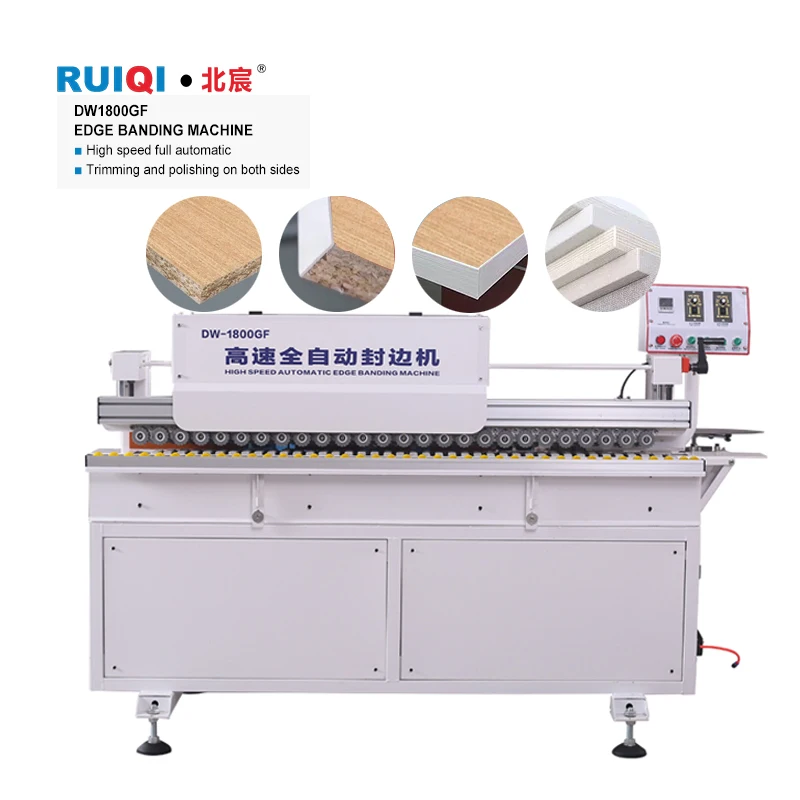
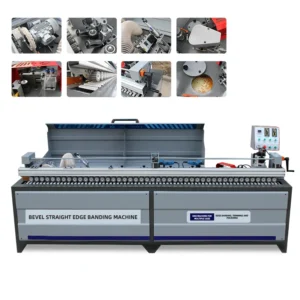
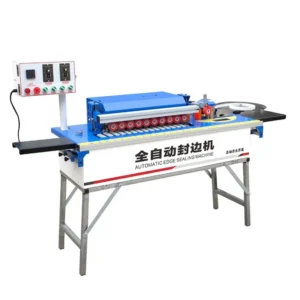
Ready-stock dispatch — DW1800 units ship as single orders with confirmed voltage and plug type, cutting the wait between decision and first production run.
Technical Specifications
| Parameter |
Value |
| Model |
DW1800 |
| Product Type |
Automatic Edge Banding Machine |
| Rated Power |
4.9 kW |
| Voltage Options |
380V / 220V / 415V |
| Feed Speed |
0–14 m/min |
| Trimming Motor |
800W × 2 at 24,000 r/min |
| Polishing Motor |
380W × 2 |
| Vacuum Motor |
550W |
| Edge Banding Thickness |
0.3–3 mm |
| Edge Banding Height |
0–50 mm |
| Minimum Sheet Length |
20 cm |
| Minimum Sheet Width |
10 cm |
| Glue Pot Capacity |
4,000 ml |
| Air Source Pressure |
0.4–0.6 MPa |
| Overall Dimensions (L×W×H) |
220 × 65 × 125 cm |
| Net Weight |
320 kg |
| Key Features |
Double-sided gluing, end cutting, rough and fine trimming, profile tracking, flexible scraping, dust extraction port |
Application Suitability
| Application |
Material or Output |
| Custom cabinet door edging |
MDF and particleboard with PVC or melamine banding |
| Small-batch plywood shelving |
Plywood panels up to 50 mm edge height |
| Joinery workshop upgrade path |
Solid wood and ABB boards moving from hand-banding to automated feed |
| Startup panel processing |
Organic glass plates and similar hardness substrates |
Why the Voltage Question Should Come Before the Price on an Edge Banding Machine for Small Workshop
A machine wired for the wrong frequency sits idle until an electrician rewires the panel — costing more than the shipping.
I have walked into workshops in Shandong where a brand-new edge bander was still wrapped in plastic three weeks after delivery. The buyer ordered on price alone and never mentioned their local supply was 220V single-phase. The machine arrived configured for 380V three-phase. Rewiring the control cabinet and sourcing a matching breaker took longer than the production delay they were trying to avoid. An edge banding machine for small workshop buyers should arrive plug-ready, not project-ready [NEED_CITE: voltage and frequency standards by export market].

Stock Configuration That Arrives Ready to Run
The DW1800 ships with confirmed plug type — EU, USA, AU, or UK — matched to the buyer's declared supply before the order is released. The control panel defaults to English, with Spanish or other language options configurable at the factory. This means the first panel fed through the machine on arrival is a production panel, not a test coupon waiting for a translator.
Single-Unit Ordering Without Minimum-Quantity Friction
Small workshops rarely need a container load. The DW1800 is available as a single-unit order with the same pre-shipment test record that larger batches receive. Lead time is quoted at inquiry rather than buried in fine print, so a joinery shop replacing a failed hand-banding process can plan its first machine-run week with confidence.
What the Spec Sheet Means at the Bench
Feed speed ranges from 0 to 14 m/min, which lets the operator slow the belt when running thin 0.3 mm PVC on curved components and open it up for straight particleboard runs. The double-sided gluing system applies adhesive to both the panel edge and the banding strip, reducing the visible glue line that single-sided systems leave on porous MDF. Trimming runs at 24,000 r/min across two 800W motors — enough spindle speed to leave a clean cut on melamine-faced chipboard without chipping the decorative layer. Profile tracking follows the panel contour into corners, and flexible scraping removes the residual bead left by the trimmer. The 4,000 ml glue pot holds enough EVA for a full shift of standard cabinet work without a mid-run refill [NEED_CITE: EVA glue pot sizing for shift-length edge banding].
The Cost of Choosing a Machine That Almost Fits
A workshop running 18 mm particleboard at volume discovers quickly that an entry-level trimmer leaves micro-chips on melamine faces. Those chips become customer rejections. The operator then slows the feed to compensate, and throughput drops below what the order book demands. Buying a second machine to cover the gap costs more than specifying full-function trimming from the start. I have seen shops run a light-duty bander into the ground within a year because it was rated for prototype volumes, not daily production [NEED_CITE: edge banding machine duty cycle and component wear].
Why Buyers Order This Model Here
The DW1800 is built on the same production line as the manufacturer's full-function pre-milling models, sharing component sourcing and quality checkpoints. Voltage and plug configuration are confirmed in writing before production starts, so the machine arrives wired for the buyer's panel board. A factory test record is generated on the buyer's declared panel thickness range and included with shipping documents. The operation manual is supplied in the agreed language — not a generic Chinese-English printout. Spare parts lists ship inside the crate, so the first re-order of scraper blades or glue rollers does not require a detective exercise.
Documentation & Verification
- CE declaration of conformity covering the DW1800 electrical and mechanical safety envelope
- Factory test record run on buyer-specified panel thickness and edge banding material
- Electrical schematic with confirmed voltage, frequency, and plug type for local inspection
- Operation and maintenance manual in agreed language with illustrated troubleshooting flow
- Spare parts list with part numbers matching the units installed on the shipped machine
- Packing photographs taken before crate closure for condition verification on arrival
Installation, Commissioning & Support
- Requires a level concrete floor supporting 320 kg across the 220 × 65 cm footprint with clearance for panel infeed
- Dedicated circuit matching confirmed voltage rating with appropriately rated breaker and isolator switch
- Arrives as a single assembled unit — no sub-frame bolting or station alignment required on site
- First-run parameter setting covers glue temperature, feed speed, and trimming depth for the buyer's panel stock
- Operator training covers glue pot refill, scraper blade change, and dust extraction hose routing
- Consumable spare parts list enables local sourcing of polishing wheels and trimming cutters
What to Include With Your Inquiry
Tell us the panel materials you run most often — MDF, particleboard, plywood, or solid wood — along with typical thickness and the edge banding material and thickness you plan to use. Confirm your workshop supply voltage, phase, and plug type so the machine ships wired correctly. If you have existing upstream saws or downstream boring machines, note their feed height so we can verify compatibility with the DW1800's 0–50 mm banding height range.
Frequently Asked Questions
Q: How do I confirm the voltage and plug match my workshop's electrical supply?
A: State your local supply voltage, phase, and frequency at inquiry. The DW1800 is configurable across 380V, 220V, and 415V. The factory confirms the wiring diagram and plug type — EU, USA, AU, or UK — in writing before production begins, and the electrical schematic ships with the machine for your local electrician's reference.
Q: Can I order a single unit, and what is the dispatch lead time?
A: Single-unit orders are accepted with no minimum quantity requirement. Dispatch timing is quoted at inquiry based on current stock position and any voltage or language customization requested. The machine ships with a pre-shipment test record and packing photographs so you know exactly what left the factory.
Q: What is the upgrade path if my production volume grows beyond this model?
A: The DW1800 sits within a broader product family that extends to full-function pre-milling edge banders with higher feed speeds. When volume outgrows this unit, the transition stays within the same supplier ecosystem, keeping spare parts sourcing and operator familiarity consistent.
Q: Is the control panel available in English or my local language?
A: The standard control panel is configured in Chinese and English. Spanish and other languages are available as a factory option confirmed at order. The operation manual is produced in the agreed language so your operator can read commissioning and maintenance instructions without translation delays.
Q: What spare parts are included, and how do I reorder consumables?
A: A spare parts list ships inside the crate with part numbers matching the installed components. Consumables such as polishing wheels, scraper blades, and glue pot elements can be reordered using these numbers directly from the factory or matched to local suppliers using the same specifications.