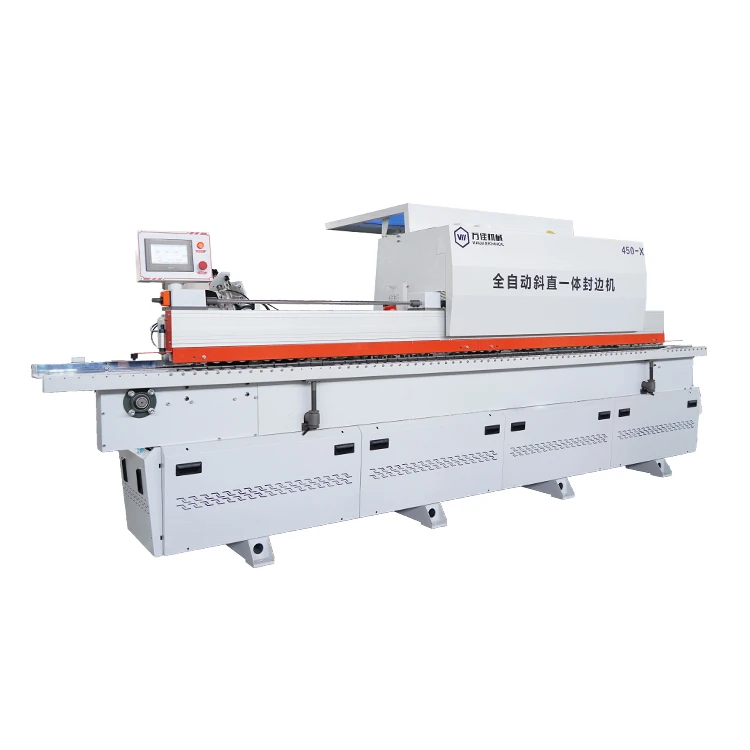
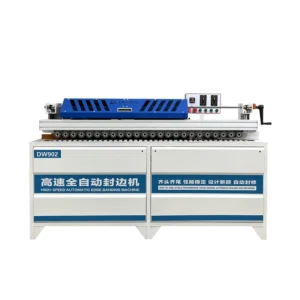
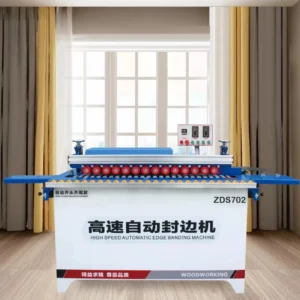
Customized Control Interfaces — every touch-screen language pack is confirmed and loaded before the machine leaves the factory, eliminating the two-day commissioning stall I once saw shut down a Portuguese cabinet shop.
Technical Specifications
| Parameter |
Value |
| Product Type |
Automatic Edge Banding Machine with Pre-Milling |
| Overall Dimensions (L×W×H) |
4350 × 920 × 1650 mm |
| Total Connected Power |
17.5 kW |
| Voltage & Frequency |
380V / three-phase five-wire / 50Hz (configurable 110V–440V) |
| Conveying Motor |
380V 2.2 kW with frequency converter |
| Feed Speed |
0–12 m/min variable, inclined straight edge |
| Pre-Milling Motor |
380V 3.5 kW |
| Edge Banding Thickness |
Up to 1.2 mm PVC (material dependent) |
| Edge Strip Width Range |
20–50 mm |
| Panel Thickness Range |
18 / 22 / 25 mm |
| Minimum Sheet Dimensions |
>250 mm length × >100 mm width |
| Glue Pot Capacity |
2000 ml |
| Glue Pot Operating Temperature |
150–170 °C |
| Glue Pot Heating Power |
1.2 kW |
| Trimming Motors |
380V 0.75 kW × 2 |
| End Trimming Motors |
380V 0.37 kW × 2 |
| Polishing Motors |
380V 0.37 kW × 2 |
| Selection Motor |
380V 4 kW |
| Lifting Motor |
380V 0.25 kW with inverter |
| Edge Feeding Motor |
380V 0.18 kW with inverter |
| Slotted Motor |
220V 0.8 kW |
| Heat Gun Power |
2 kW |
| Control System |
Xinjie industrial touch screen with industrial inverter |
| Air Supply Pressure |
0.6–0.8 MPa |
| Air Storage Tank Volume |
5 L |
| External Dust Extraction Port |
100 mm diameter |
| Key Features |
Straight and curved edge processing, pre-milling station, variable feed speed, PVC edge banding |
Application Suitability
| Application |
Material or Output |
| Custom cabinet door edge banding |
MDF and particleboard with PVC strips |
| Small workshop furniture panels |
Plywood and melamine-faced board |
| Joinery startup first automated edge finish |
Straight and curved profile panels |
| Shelving and carcass component edging |
18–25 mm thickness range substrates |
Why the Language on the Control Panel Matters More Than the Feed Speed
An automatic edge banding machine compact for small workshop environments is only as productive as the operator who can read its screen.
I have watched a brand-new edge bander sit idle for two full days in a Portuguese joinery shop because the touch screen defaulted to a language the operator could not parse. The crew could not enter feed speed, adjust glue temperature, or switch between straight and curved profiles. Production stopped while we pushed a language pack remotely. For a small shop running tight deadlines, that kind of commissioning stall is the difference between meeting a kitchen install date and losing the contract. [NEED_CITE: common commissioning delays reported by European woodworking importers]

Smallest Viable Configuration for a Manual-to-Machine Transition
When a joinery workshop moves from hand-held edge banding to its first automated unit, the priority is not maximum throughput — it is consistent glue-line quality on the panels the shop already produces. This automatic edge banding machine compact for small workshop floors keeps the footprint under five metres in length and pulls 17.5 kW total, meaning most small workshops can run it on an existing three-phase supply without a dedicated transformer upgrade. The pre-milling station addresses the most common complaint I hear from shops still doing manual edging: visible glue lines on particleboard and MDF.
Straight and Curved Profiles in One Pass
Many entry-level banders handle only straight edges, forcing a workshop to buy a second unit or outsource curved panels. This model processes both profiles within the same feed path, which keeps the learning curve manageable for a single operator. The Xinjie touch screen lets the operator store profile-specific parameters — feed speed, glue temperature, trimming offsets — so switching from a straight cabinet side to a curved shelf front becomes a screen tap rather than a full recalibration. [NEED_CITE: edge profile versatility requirements in small-batch furniture production]
What the Spec Sheet Numbers Actually Mean on the Shop Floor
The 0–12 m/min variable feed speed, managed by the frequency converter on the 2.2 kW conveying motor, lets an operator slow the feed for delicate curved profiles and open it up for long straight runs. Running curved panels at the same speed as straight ones typically causes the edge strip to lift at the radius — the variable drive prevents that without requiring a separate machine. The pre-milling motor at 3.5 kW removes a thin layer from the panel edge before glue application, which matters on particleboard where the saw blade can leave micro-chips that the glue alone cannot bridge. Panel thickness is set at 18, 22, or 25 mm, covering the standard range for cabinet carcasses, shelving, and desk tops. The glue pot holds 2000 ml and runs between 150–170 °C, which suits standard PVC hot-melt adhesives; running outside this window risks either incomplete bonding or thermal degradation of the adhesive. The 100 mm dust extraction port ties into a standard workshop extraction system, keeping fine MDF dust off the polishing wheels where it would otherwise embed into the finished edge.
The Cost of Skipping Voltage Confirmation Before the Order
I have seen machines arrive at a workshop wired for 380V 50Hz when the local grid runs 220V 60Hz. The motors spin at the wrong speed, the inverter throws fault codes, and the glue pot cannot reach operating temperature. Returning the unit is rarely practical — freight, customs, and lead time make on-site rewiring the lesser evil, but it still delays production by weeks. Confirming local voltage and frequency before production starts removes this entire failure mode. [NEED_CITE: voltage and frequency standards by export market]
What Makes This Sourcing Channel Work for Entry-Level Buyers
The pre-milling station is included as standard rather than an optional add-on, so a small workshop does not discover after delivery that glue-line quality requires a second machine. Voltage is configurable from 110V to 440V as part of the standard order, not a custom engineering request. The control panel language is confirmed and loaded during production, verified before the crate closes. Every unit ships with a factory test record run on the buyer's specified panel thickness, so there is documented proof the machine performs within tolerance before it leaves Shandong. The configuration recommendation comes from an engineer, not a sales desk, and the formal quotation lands within 24 hours of the initial inquiry.
Documentation & Verification
- CE declaration of conformity covering the full machine assembly
- Electrical schematic with confirmed voltage and frequency for your grid
- Factory test record on your specified panel thickness before dispatch
- Operation manual in your operator's confirmed language
- Spare parts list with cross-referenced component numbers
- Packing photographs showing crate condition at loading
Installation, Commissioning & Support
- Requires a level concrete floor with 4350 × 920 mm clear footprint and overhead clearance above 1650 mm
- Dedicated three-phase circuit rated for the 17.5 kW total connected load with confirmed voltage
- Machine ships fully assembled; connect dust extraction to the 100 mm port and supply 0.6–0.8 MPa air
- First-run calibration covers pre-milling depth, glue temperature, and trimming offsets on your actual panels
- Touch screen language pack verified against operator requirement before shipment
- Wear parts include trimming blades, polishing wheels, and glue pot heating element with replacements on the spare parts list
What to Include in Your First Inquiry
Send your typical panel material and thickness range, the edge banding profile mix between straight and curved work, and your workshop's existing voltage and frequency. If you are replacing a manual process, note your current daily panel count so the feed speed setting can be matched to your pace. Mention the language your operator reads, and whether your extraction system can take another 100 mm port.
Frequently Asked Questions
Q: What is the smallest workshop footprint this machine requires?
A: The machine measures 4350 × 920 mm on the floor with a height of 1650 mm. You need clearance on the infeed and outfeed sides for panel handling, so a bay roughly six metres long by two metres wide works for most small joinery shops. The 100 mm dust port should reach your existing extraction trunk.
Q: Can the control panel be set to my operator's language before delivery?
A: Yes. The Xinjie touch screen supports multiple language packs, and we confirm the required language during the specification stage. It is loaded and verified during the factory test before shipment, so the operator can set parameters from day one without waiting for a remote update.
Q: Is the voltage configurable for my local power supply?
A: The standard configuration is 380V three-phase 50Hz, but the machine is configurable from 110V to 440V to match local grids. We confirm your exact voltage and frequency before production begins, and the electrical schematic ships with the documentation package reflecting your confirmed supply.
Q: What panel thicknesses and edge materials does this model handle?
A: Panel thickness is set at 18, 22, or 25 mm, covering standard cabinet and furniture board sizes. The machine processes PVC edge banding up to 1.2 mm thick and 20–50 mm wide. Minimum sheet dimensions are greater than 250 mm in length and 100 mm in width.
Q: What is the upgrade path when production volume outgrows this machine?
A: This unit sits at the entry point of a product family that scales through higher feed speeds, additional trimming stations, and full-line configurations. When your daily panel count exceeds what 12 m/min variable feed can deliver, the next tier in the range adds throughput capacity without requiring you to change supplier or retrain operators on an unfamiliar control system.